

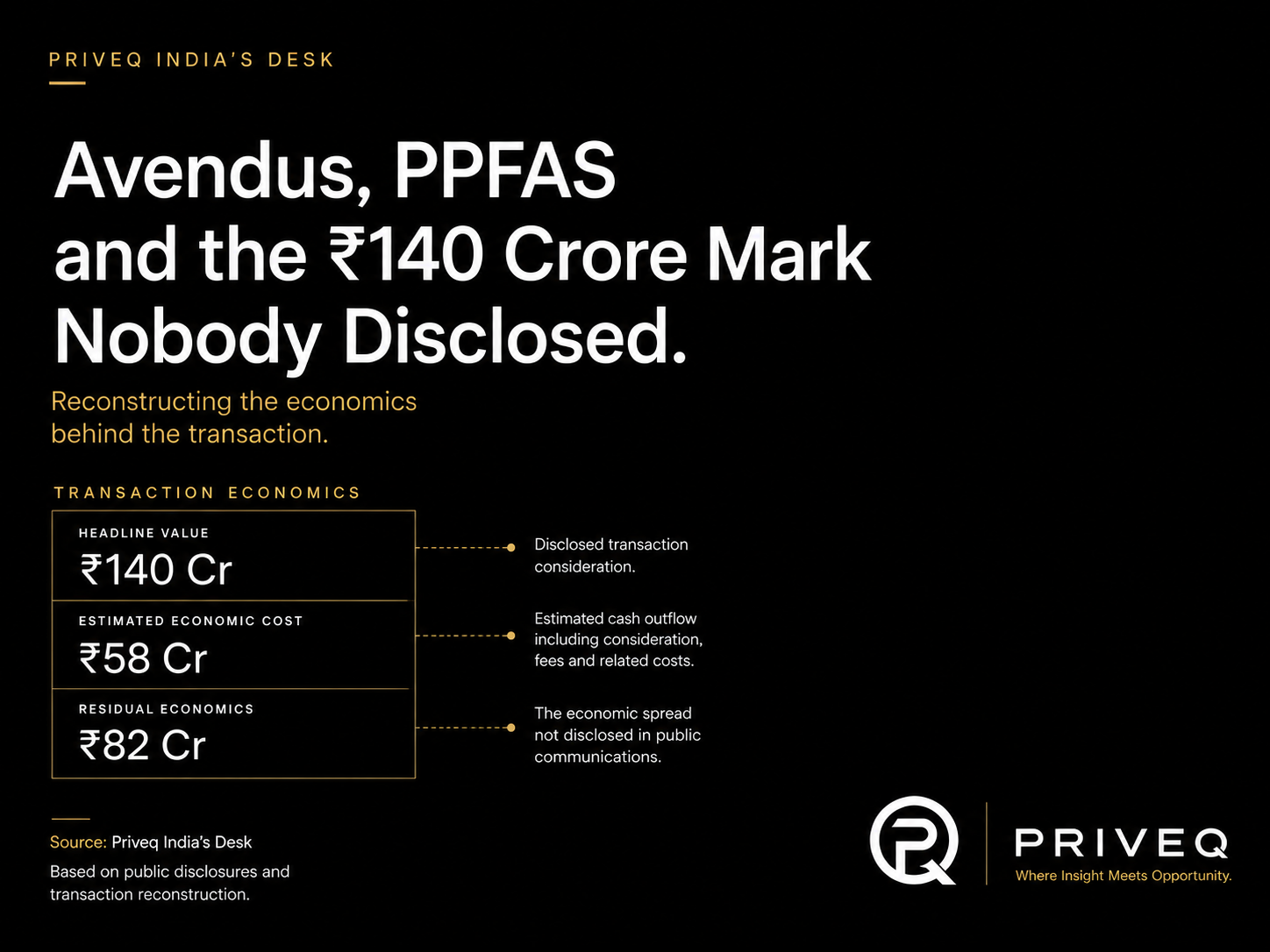
An investment firm has bought a small stake in Parag Parikh Financial Advisory Services Ltd. (PPFAS), the company behind the Parag Parikh Flexi Cap Fund. The buyer is Avendus, through its Future Leaders Fund III. The size is about ₹140 crore for just over one percent of the business, and the shares came from the founding family, not from the company itself.
That last detail is where most of the meaning sits, and it is the part the headlines skipped. Read on for what the deal implies about price, and what it does not.
The deal in one line
Avendus Future Leaders Fund III paid roughly ₹140 crore for just over 1% of Parag Parikh Financial Advisory Services. It was a secondary: the sellers were Neil Parag Parikh, Chairman and CEO, and Khushboo Joshi, President of Wealth Management. No new shares were issued, so no fresh capital entered the business.
The valuation nobody disclosed
Neither side put out a valuation. They rarely do. It is still derivable.
Just over 1% for about ₹140 crore places the whole equity a shade under ₹14,000 crore. The softer the rounding on "just over 1%," the lower that figure sits, toward ₹13,000 crore. So the honest read is a band, ₹13,000 to 14,000 crore, not a single point. Treat anyone quoting a precise number off this deal with suspicion, because the two inputs, an approximate cheque and an approximate stake, do not support precision.
Now set that band against where the paper actually changes hands. On our desk, PPFAS has been trading between ₹19,000 and ₹20,000 a share. Bridging a per-share price to a whole-company value needs the share count. Backed out from reported FY26 equity and per-share earnings, PPFAS carries roughly 76 to 78 lakh shares, which puts the current unlisted market value near ₹14,500 to 15,500 crore. We flag that share count as derived, not lifted from the audited filing, so the bridge is provisional until the FY26 accounts confirm it.
Provisional or not, the direction is firm enough to act on. The Avendus print sits at, or a little below, the current screen. A four to five year institution, after its own diligence, underwrote PPFAS at roughly today's level or a touch under it. It did not pay up.
What this is, and what it is not
It is a promoter secondary and an institutional anchor. Two founders trimmed a slice of their holding, and a serious long-horizon fund took the other side. At just over one percent, promoter trimming of that size is routine and not a signal of doubt.
It is not growth capital. The company received nothing. This does not fund expansion, hiring, or new lines. Anyone reading the deal as money into PPFAS has misread it.
It is not an IPO bet. Avendus stated the thesis does not depend on a listing, with a hold of four to five years. An IPO is one possible exit, not the reason for the trade. If you are buying PPFAS unlisted paper as a listing-pop play, the anchor here is not your co-investor.
Why the buyer matters
The identity of the buyer carries information. The stake sits with Avendus Future Leaders Fund III, the late-stage private equity arm of Avendus Group, run by managing partner Ritesh Chandra. The strategy is narrow and consistent: minority positions in scaled, profitable market leaders, taken through both primary rounds and secondaries, in companies where institutional ownership is still fragmented. This is a pre-IPO compounding book, not a startup punt.
Fund at a glance:
Vintage: launched 2024, first close ₹850 crore in January 2025, final close near ₹1,800 crore, above its ₹1,500 crore base target.
Cheque size: ₹200 to 300 crore on average, 10 to 12 positions planned, about 30% deployed, with five to six more names planned over the next year.
Sectors being scouted: financial services, consumption, digital and technology, healthcare, and manufacturing.
Platform: the broader Future Leaders Fund runs more than ₹4,000 crore across its funds.
Track record is what gives the PPFAS mark its weight. Fund I, from 2019, backed Lenskart, Delhivery, VerSe, Bikaji Foods, Ujjivan Small Finance Bank, and the National Stock Exchange, and exited Lenskart and NSE at close to 4x. Fund II, closed in 2022, added names across consumption and financial services. The current fund already holds La Renon Healthcare, Aragen Life Sciences, and IL JIN Electronics, with PPFAS as the fourth. Across the platform sit Sagility, SBI General Insurance, Licious, Juspay, Zeta, Veritas Finance, and Avanse.
So when a buyer with realised exits at strong multiples underwrites a level after its own diligence, that level is worth more than a screen quote. But note the size. At about ₹140 crore, PPFAS is a below-average cheque for this fund and a stake of just over one percent. Read it as a considered toe-hold in a name they rate, not a core, high-conviction position. That distinction matters when you weigh how much the vote of confidence is actually worth.
Where the print sits against the screen
Two independent routes into the same zone is the signal, so here they are, kept honest:
Deal-implied value, from the cheque and the stake: ₹13,000 to 14,000 crore.
Current unlisted market, from the ₹19,000 to 20,000 desk range and a provisional share count: ₹14,500 to 15,500 crore.
The overlap is close, and the deal band sits at the lower edge. The takeaway is not a headline valuation. It is that a professional buyer's mark and the live screen agree within a narrow range, with the institution landing at the conservative end.
The risks worth pricing
Concentration. PPFAS runs a compact set of schemes, and the flagship Flexi Cap dominates the brand and the assets. That is strength while performance and trust hold, and a single point of exposure if either slips.
Fee pressure. AMC revenue is assets multiplied by fee rate. Any tightening of expense-ratio norms across the industry compresses that rate, and even a small change matters on a base this size.
Valuation is not cheap. On reported FY26 profit near ₹348 crore, the implied band values PPFAS at a premium multiple. This is a quality-compounding case, not a discount case. The margin of safety here is the business, not the price.
Liquidity and price discovery. This is unlisted paper. Exit timing is not in your control, and marks move in wider steps than on a listed screen.
What it means: holder versus buyer
If you hold PPFAS, a professional buyer just underwrote your mark at roughly the current level. That is a second opinion worth having, and it lowers the odds that the screen is running ahead of reality.
If you are buying, the only conversation is the discount to that band. The anchor came in at or below screen, so paying a premium to it needs a reason you can name. If you cannot, wait for the level.
FAQs
Did Avendus buy new shares in PPFAS ? No. It was a secondary. The shares came from promoters Neil Parag Parikh and Khushboo Joshi, and no fresh capital went to the company.
What valuation does the deal imply? Neither side disclosed one. The cheque and the stake imply a band of roughly ₹13,000 to 14,000 crore, which is an inference, not an official figure.
Is this an IPO play? Avendus said the investment does not depend on a listing and expects to hold four to five years. An IPO is one possible exit, not the thesis.
What is PPFAS trading at in the unlisted market? On our desk, indicatively between ₹19,000 and ₹20,000 a share. Indicative levels are for information and are not an offer to deal.
Priveq India's Perspective
Our read: the Avendus deal is confirming, not repricing. It validates a level PPFAS was already carrying, and it does so at the conservative end of the range. For a holder, that is reassurance. For a buyer, it sets a ceiling to bid under, not a green light to chase. The one input that would change this view is the audited FY26 share count, which firms up the bridge between the ₹19,000 to 20,000 screen and the whole-company value. We will update the moment the filing lands.
To ask where PPFAS is clearing today, or to work an order, reach us on WhatsApp at +91 82878 66698 or at support@priveq.in.
Disclaimer: This note is prepared by Priveq Investech Private Limited for information and educational purposes only. It is not investment, financial, legal, or tax advice, nor a recommendation or an offer to buy or sell any security. Figures are drawn from public disclosures, company and industry data, and unlisted-market references. Certain figures, including the implied valuation and the share count used to derive market value, are inferences or estimates and may change with audited filings, restatements, or market movement. Indicative prices are not a quote or an offer and may differ from any level at which a transaction is concluded. Investing in unlisted and pre-IPO shares carries substantial risk, including illiquidity, valuation uncertainty, and the possibility that a listing does not occur. Past performance does not indicate future results. Conduct your own due diligence and consult a SEBI-registered adviser before investing.