


The Short Version
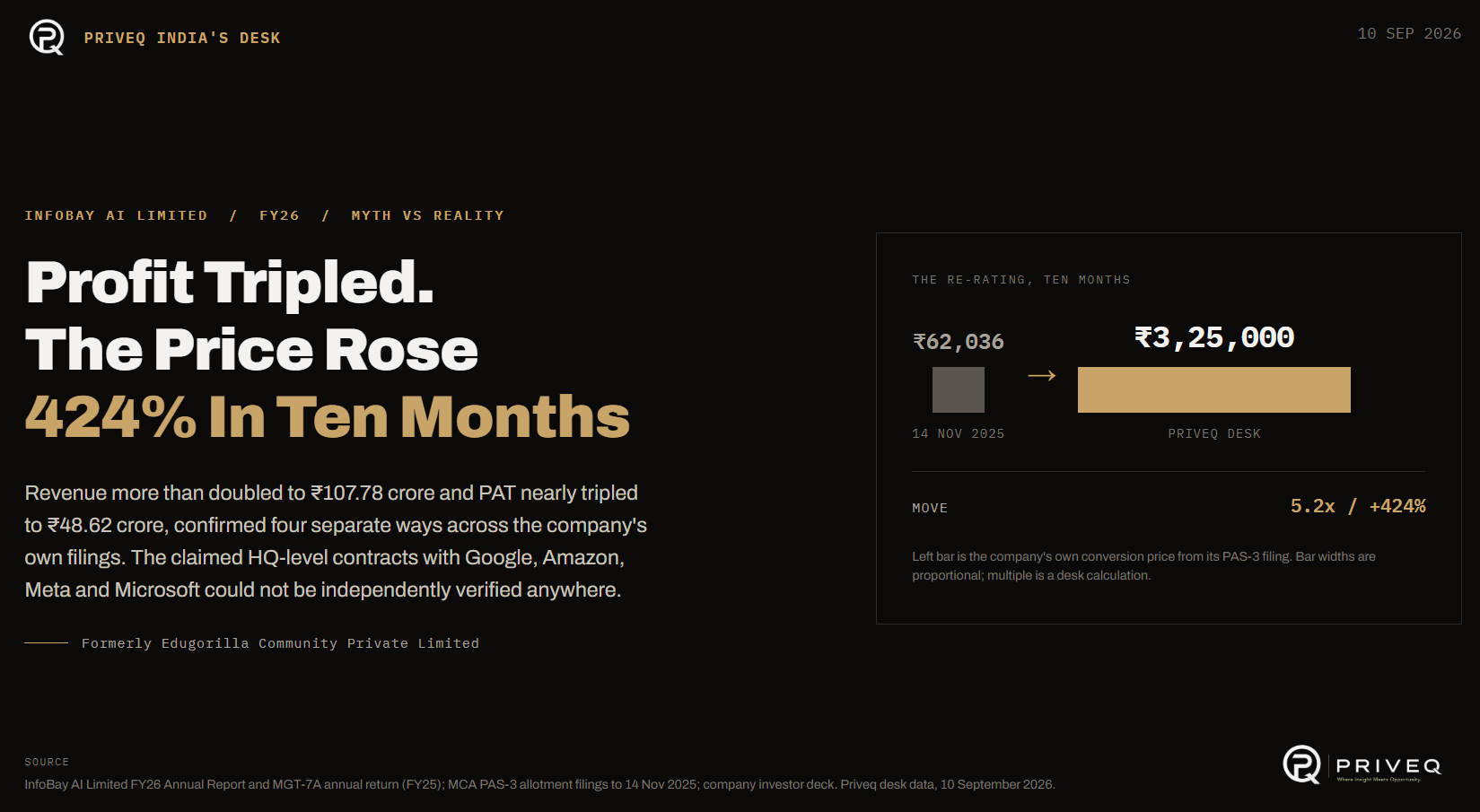
INFOBAY AI LIMITED, incorporated in 2016 as Edugorilla Community Private Limited and renamed to InfoBay AI Private Limited on 8 December 2025 before converting to a public limited company on 7 January 2026, had a genuinely strong FY26: revenue more than doubled to ₹107.78 crore, PAT nearly tripled to ₹48.62 crore, and ROE crossed 55%. These figures are corroborated across five independent sources, the company's own audited financial statement notes, its balance sheet, its MGT-7A annual return, Priveq's desk data, and the company's own investor deck, and the desk trusts them. The company's own audited segment note discloses that AI-related business now contributes approximately 98% of revenue, with the original EduGorilla test-prep business down to under 2%, a real, audited figure supporting the stated pivot, not just a marketing claim. What the desk will not extend the same trust to is the story built on top of those numbers. InfoBay now markets itself as an AI training-data infrastructure provider with direct, HQ-level contracts naming Google, Amazon, Meta, and Microsoft. The company has also, per its own audited notes, already begun the process of listing on the NSE, appointing a merchant banker and other intermediaries. At Priveq's desk price of ₹3,25,000 per share, implying a valuation of roughly ₹759 crore, the desk is pricing the verified growth and the real segment shift, not the unverified client list, and buyers should hold the same distinction.
The Desk Snapshot
InfoBay AI Limited, formerly Edugorilla Community Private Limited. Figures cross-checked across the company's own filings and Priveq's data.
Priveq Desk Price | |
Implied valuation | ~₹759 crore (23,355 shares outstanding) |
FY26 revenue | ₹107.78 crore, up from ₹49.70 crore in FY25 |
FY26 PAT | ₹48.62 crore, up from ₹16.27 crore in FY25. EPS ₹20,822.09 |
Debt / Equity | 0.00. The business carries no debt |
Biggest positive | Financials independently confirmed four separate ways across the balance sheet, MGT-7A, and derived ratios |
Biggest risk | Claimed direct contracts with Google, Amazon, Meta, and Microsoft could not be independently verified anywhere |
Key monitor | Any independent confirmation, positive or negative, of the named enterprise client relationships |
Net worth of ₹88.05 crore (FY26) is confirmed three separate ways : Share Capital plus Reserves, Book Value per Share × total shares, and the year's increase in Reserves and Surplus against stated PAT.
The Business : From Test-Prep to "AI Infrastructure"
InfoBay AI Limited was incorporated on 23 December 2016 as Edugorilla Community Private Limited, founded by Rohit Manglik and Shashwat Vikram. For most of its operating history, the company built vernacular-language test series and mock exams for students preparing for competitive government job examinations, raising early venture capital on that basis: ₹5.3 crore in a September 2020 pre-Series A round from Auxano Entrepreneur Fund and angel investors led by Venture Garage, followed by a ₹16.5 crore round in mid-2022 led by SucSEED Indovation Fund with participation from Mumbai Angels, Lead Angels, TiE India, and others.
The legal rename to InfoBay AI Limited happened very recently. A share allotment filing dated as late as 3 November 2025 still lists the company under its original name, Edugorilla Community Private Limited, meaning the current name and the current "AI training-data infrastructure" positioning both post-date that filing by only months, not years.
The company's own MCA industry classification remains "other business activities n.e.c.," and its DPIIT startup recognition describes it as a test-prep and competitive-exam coaching business, still operating its original product under the edugorilla.com domain. Its current public marketing describes an entirely different business: expert-verified training data, annotation infrastructure, and evaluation systems for large language models, spanning education, healthcare, conversational audio, and video data, with stated plans to expand into physical AI and defence AI data. Both descriptions can be true of the same company at different points in its life. The desk's job is to be clear about which one the filed financials actually support, addressed below.
Product and Revenue Segmentation
The company's investor deck describes its current data offering across four categories, with specific volume claims for each. These figures are sourced entirely from the company's own investor materials, not from an audited filing, and are presented as stated, not independently verified:
Education : 7.2 million Q&A pairs, 2.5 billion training tokens, across 15 languages including English, Hindi, Arabic, Bahasa, Javanese, Nepali, Urdu, and eight further Indic languages.
Conversational Audio : 2.1 million hours of audio, including 57,000 podcast hours, across 36 languages and 13 countries.
Healthcare : data drawn from 2 million patients, covering oncology, tuberculosis, infertility, dermatology, and HIV, sourced through a stated network of 47 hospital networks across India, Indonesia, and the Philippines, with 15 super-specialist doctors involved.
Video : 4.5 million vertical videos.
The deck also states two forward categories not yet reflected in current revenue : Physical AI (sensor fusion, spatial reasoning, and environment-perception data for robotics) and Defence AI (training data for military applications including drone targeting and threat identification).
The company's live website (https://infobay.ai/), active and current as of this piece's research, states materially different figures for some of the same categories, and does not agree with itself across its own pages. Its homepage states 3.6 million-plus hours of multilingual audio, while its dedicated datasets page, on the same live site, states 2.1 million-plus hours of multilingual audio, the same metric, two different numbers, from the same company, at the same time. The datasets page also introduces categories absent from the deck entirely, including a coding dataset (stated as 12,000-plus codebases on the homepage, but 25 million-plus coding tokens on the datasets page, different units that do not reconcile) and an image-labeling product branded "Bunnies Mode."
The desk is not selecting whichever figure is most flattering or most damaging; it is reporting that the company's own current self-description is internally inconsistent, across its investor deck and across its own website, which is itself relevant to how much confidence any single stated figure deserves.
The company does not break out revenue across these four specific marketing categories in any audited filing. It does, however, disclose a broader segment split: per the FY26 financial statements' segment reporting note, the company's AI-related business contributed approximately 98% of total revenue in FY26, while its Education-related business, the original EduGorilla test-prep operation, contributed less than 2%, below the threshold for separate segment reporting under AS-17. This is a real, audited disclosure, not a marketing claim, and it materially supports the company's stated pivot: the legacy business has become genuinely marginal to current revenue, not merely rebranded around. What remains undisclosed is any further breakdown within that 98%, how much of it maps to the four categories in the deck above, or to any of the seven named enterprise relationships addressed below.
Corporate History and Capital Structure
INFOBAY AI LIMITED was incorporated on 23 December 2016 as Edugorilla Community Private Limited. It was renamed to Infobay AI Private Limited via a fresh Certificate of Incorporation dated 8 December 2025, and converted to a public limited company, taking its current name, via a further fresh Certificate of Incorporation dated 7 January 2026, both real, recent events, not a rebrand that happened gradually or quietly.
MCA's own PAS-3 allotment filings give a real, priced history of the company's equity, independent of any funding-round press release. Excluding par-value conversions that carry the hallmarks of ESOP exercises (zero premium, small consistent share counts, spread across 2025 and 2026), the priced equity events are:
The priced equity events, in sequence:
24 May 2019 : 176 shares at ₹6,818.18 per share
June 2020 to April 2021 (four rounds) : 1,519 shares total, all at ₹14,139.27 per share
19 August 2024 : conversion of 16,683 Pre-Series B Compulsorily Convertible Debentures (₹10,000 face value each) into 5,243 equity shares, an effective price of ₹31,819.57 per share
14 November 2025 : conversion of a further 350 Pre-Series B CCDs into 56 equity shares, an effective price of ₹62,035.54 per share
That is a real, escalating valuation trail: roughly ₹6,800 in 2019, ₹14,100 in 2020-21, ₹31,800 in August 2024, ₹62,000 in November 2025. At Priveq's desk price of ₹3,25,000, that is 5.2 times the November 2025 conversion price, itself less than a year old, a 424% move in roughly ten months. The desk states this plainly because it is the single most important context for reading the current price: whatever else is true about this company, its implied valuation has moved further and faster in the last year than in the five years before it.
The Priced Equity Ladder -
Real per-share prices from the company's own PAS-3 allotment filings with MCA. Face value has stayed ₹10 throughout; no split adjustment needed.
Date | Shares | Price / share | vs desk ₹3,25,000 |
|---|---|---|---|
24 May 2019 | 176 | ₹6,818.18 | 47.7x |
Jun 2020 – Apr 2021 (4 rounds) | 1,519 | ₹14,139.27 | 23.0x |
19 Aug 2024 (CCPS converted) | 5,243 | ₹31,819.57 | 10.2x |
14 Nov 2025 (conversion) | 56 | ₹62,035.54 | 5.2x |
Excludes several 2025-2026 zero-premium conversions at exactly ₹10/share (par value), which carry the hallmarks of ESOP exercises rather than priced rounds. Separately, ~₹15.18 crore was raised via preference shares/CCDs at ₹10,000 face value across four 2022 tranches, a distinct security class not directly comparable to this equity ladder.
Separately, in FY26 the company converted 3,196 Compulsorily Convertible Cumulative Preference Shares into 3,354 equity shares (743 CCPS at a 1:1 ratio, and 2,453 CCPS at a 1:1.065 ratio, per the specific terms of each issue).
On promoter shareholding, two figures both appear in the company's own filings and both are correct, they are simply computed on different bases, worth stating plainly rather than picking one. As at 31 March 2025, Rohit Manglik and Pushpa Manglik together held 10,000 shares. As a share of equity shares only (14,608 outstanding), that is 68.46%, the figure in the company's MGT-7A annual return. As a share of total shares including Compulsorily Convertible Preference Shares (23,138 outstanding), that is 43.22%, the figure in the FY26 financial statements' promoter shareholding note. By 31 March 2026, combined promoter holding on the equity-plus-CCPS basis had grown to 45.00% (10,508 shares: Pushpa Manglik 27.87%, Rohit Manglik 17.13%).
Two further ownership changes in FY26 are worth noting directly: PEB Educational Services Private Limited emerged as a new shareholder holding more than 5% of equity, at 11.31% (2,037 shares), having held none as at the prior year-end; and Priyanka Gupta, who held 6.75% of equity as at 31 March 2025, no longer appears among holders of more than 5% as at 31 March 2026. The desk has not established what transaction moved these stakes.
The non-promoter shareholder base grew from 63 to 164 members within FY25 alone, while debenture holders fell from 128 to 4, consistent with the CCD-to-preference-to-equity conversion activity described above.
Two secondary-source funding claims are worth flagging as unresolved rather than repeated as fact: total historical funding raised is reported as $6.34 million across 6 rounds by one data provider and $3.36 million across 19 investors by another, a near-2x discrepancy neither primary filing resolves. Separately, a September 2025 transaction reported as "Auxano Capital achieves 5.5x return with EduGorilla exit" was a secondary shareholder-liquidity sale, not a new company fundraise, worth distinguishing since a secondary exit price reflects one buyer's and one seller's agreement, not a company-validated primary round.
FY25 shareholding pattern
From the company's own MGT-7A Annual Return, year ended 31 March 2025.
Holder category | Equity shares | % of equity | Preference (CCPS) | % of preference |
|---|---|---|---|---|
Promoters (2 individuals) | 10,000 | 68.46% | 0 | 0.00% |
Non-promoter individuals (incl. NRI, foreign) | 4,502 | 30.81% | 4,334 | 50.81% |
Venture capital | 0 | 0.00% | 2,817 | 33.02% |
Body corporate | 106 | 0.73% | 862 | 10.11% |
Partnership firms | 0 | 0.00% | 517 | 6.06% |
Total | 14,608 | 100% | 8,530 | 100% |
Non-promoter shareholder count grew from 63 to 164 within FY25 alone; debenture holders fell from 128 to 4 in the same period, consistent with CCD-to-preference-to-equity conversion activity. Net worth stated in this filing (₹36.98 crore) matches the desk's independent calculation from the FY26 Annual Report's comparative balance sheet exactly.
Two secondary-source funding claims are worth flagging as unresolved rather than repeated as fact: total historical funding raised is reported as $6.34 million across 6 rounds by one data provider and $3.36 million across 19 investors by another, a near-2x discrepancy neither primary filing resolves. Separately, a September 2025 transaction reported as "Auxano Capital achieves 5.5x return with EduGorilla exit" was a secondary shareholder-liquidity sale, not a new company fundraise, worth distinguishing since a secondary exit price reflects one buyer's and one seller's agreement, not a company-validated primary round.
IPO and Listing Status
The company's own FY26 financial statement notes disclose that it has initiated the process of listing its equity shares on the NSE, and has appointed a merchant banker, legal advisor, registrar to the issue, and other intermediaries to that end. During FY26, the company incurred ₹45 lakh in listing-related expenses, professional fees, statutory filing fees, due diligence costs, and similar items, which have not been charged to the Statement of Profit and Loss but capitalized in other current assets pending completion. As at the reporting date, the company states the process is ongoing and that it is "actively engaging with the appointed intermediaries to complete the required formalities within next few months." No DRHP has been filed with SEBI as of this piece's publish date; the listing process described is a pre-DRHP preparatory stage.
FY26 Financial Performance
FY26 revenue grew to ₹107.78 crore from ₹49.70 crore in FY25, more than doubling. PAT reached ₹48.62 crore against ₹16.27 crore the year before, nearly tripling. EBITDA stands at ₹68.71 crore and gross profit at ₹106.51 crore, giving a profit margin of 45.12%. Return on equity is 55.23%.
The desk independently cross-checked these figures rather than take them on trust. Net worth computed from Share Capital plus Reserves and Surplus on the company's own FY26 balance sheet comes to ₹88.05 crore. That figure is confirmed twice more: by Priveq's own Book Value per Share (₹37,700.71) multiplied by the total share count (23,355), which comes to the same ₹88.05 crore, and by the increase in Reserves and Surplus during the year, ₹51.07 crore, which sits close to the stated PAT once minor other comprehensive income items are accounted for. Separately, PAT of ₹48.62 crore is confirmed by EPS (₹20,822.09) multiplied by total shares, which comes to ₹48.63 crore, a figure close to but not identical to the ₹20,771.22 diluted EPS stated directly in the company's own FY26 financial statement notes, the small gap most likely reflecting a difference in weighted-average share count methodology between the two calculations, not a material discrepancy. Four independent reference points, converging within rounding, is real evidence these numbers are reliable.
The company carries no debt: Debt to Equity is 0.00. At Priveq's desk price of ₹3,25,000, that implies a P/E of 15.61, a P/B of 8.62, a P/S of 7.04, and EV/EBITDA of 10.99, each internally consistent with the others on a closing-equity basis.
The Claims the Desk Could Not Verify
InfoBay's own investor materials describe direct, HQ-level contracts with seven named global technology companies:
Google: 7 repeat orders
Amazon: 4 repeat orders, with the relationship stated as approved at CTO level
Meta
Microsoft, with the relationship stated as approved at the level of the company's AI chief
Alibaba
LG
Naver
The same materials state $17 million in orders executed, a $37 million sales pipeline, an 80%+ gross margin, and a projected path to $400 million in revenue by FY30.
The desk searched directly for independent confirmation of any of these relationships: press coverage, case studies, procurement disclosures, third-party industry reports. It found none. InfoBay's own website is substantially more detailed than a general services page, it includes dedicated pages describing specific dataset categories and volumes, but even there, none of the seven named companies is identified by name, and no client logo or case study naming any of them appears anywhere the desk could find. One of the company's own investors describes it, in careful, hedged language, as a company that "positions itself as" a strategic partner to AI labs and Fortune 500 technology companies, phrasing that relays the company's own framing rather than confirming it independently.
Separately, and worth weighing on its own: the company's current live website does not agree with itself. Its homepage states 3.6 million-plus hours of multilingual audio in its data corpus; its own datasets page states 2.1 million-plus hours of multilingual audio, the same metric, a different number, on two pages of the same site at the same time. This is not a claim about a competitor's relationship the desk cannot check; it is the company's own self-description failing to reconcile internally, which the desk can check, and did.
A third data point reinforces the same pattern rather than resolving it. A press release distributed via NewsVoir and published as advertorial content on Business Standard on 21 July 2026, explicitly disclosed as company-provided, with no journalist involvement, states the company's video corpus at 34 million vertical videos. The investor deck, reviewed separately by the desk, states 4.5 million vertical videos for the same named metric, a roughly 7.6-times difference. The same release states audio coverage in 40 languages, versus 36 languages in the deck. The release's revenue and PAT figures (crossing ₹100 crore and ₹50 crore respectively) are broadly consistent with the audited FY26 figures the desk has independently verified elsewhere in this piece, so this is not a case where every number in the release is suspect, but the scale claims specifically continue the same unreconciled pattern as the website's own internal inconsistency.
The same release attributes to the company's CEO a claim that InfoBay is "among the most profitable AI-powered companies in India, powering half of the world's frontier labs." The desk treats this the same way it treats the seven named enterprise relationships: a claim with no available path to independent confirmation, stated with more confidence than the desk can extend to it. The release also states a Net Revenue Retention of 140-160% and a gross margin above 80%, both company-stated metrics without audited corroboration available to the desk, and confirms the appointment of a new CFO, VP-Global Sales, and R&D Manager, and expansion into Indonesia, Kenya, the Philippines, and Uganda alongside India, consistent with, though not independently confirming, similar claims in the investor deck.
A related detail worth stating plainly, since it's now settled rather than open : The company's own investor deck states its headcount at 400, and this is broadly consistent with LinkedIn's own company data, which lists InfoBay AI in the 201-500 employee band with 443 currently associated members, the large majority based in India, concentrated around Lucknow, where the company's R&D center is located. Scale of this kind does not confirm the specific named client relationships, but it does mean the claims aren't implausible on headcount grounds the way a genuinely tiny team's would be.
None of this means the claimed relationships are false. NDA-covered vendor relationships with large technology companies are common in this industry and are rarely independently confirmable from outside. It means the desk is treating the financial performance as verified and the narrative built on top of it as the company's own, unconfirmed account, and pricing accordingly.
The Desk View
Priveq's desk price for InfoBay AI Limited is ₹3,25,000 per share, implying a valuation of approximately ₹759 crore, 15.61 times FY26 earnings. The financial performance behind that multiple is real and well-corroborated: profit nearly tripled in a debt-free business with a genuinely improving margin profile, confirmed across four independent calculations rather than one company's say-so.
The desk's price reflects that verified performance, not the seven named hyperscaler relationships the company's marketing leads with. Those claims may be entirely accurate; the desk simply has no way to confirm them, and a valuation built on unconfirmable enterprise relationships carries a different risk profile than one built on audited, cross-checked financials, even when the multiple looks similar on paper. The other fact worth holding alongside the price: this valuation has moved 5.2 times higher than the company's own most recent internal share conversion price, set less than a year ago. The one variable that would most change this view: independent confirmation, one way or the other, of the named enterprise client relationships. Until that exists, the desk prices the business it can verify and treats the rest as the company's own claim.
FAQs
What is the InfoBay AI Limited unlisted share price today?
Priveq's live desk price is ₹3,25,000 per share as of the date noted at the top of this piece. Desk prices move; talk to the desk for the current quote before any transaction.
Is InfoBay AI Limited the same company as EduGorilla?
Yes. InfoBay AI Limited was incorporated in 2016 as Edugorilla Community Private Limited, renamed to Infobay AI Private Limited on 8 December 2025, and converted to a public limited company on 7 January 2026.
How much of InfoBay AI's revenue actually comes from AI, versus the old test-prep business?
Per the company's own audited FY26 segment reporting note, AI-related business contributed approximately 98% of total revenue in FY26, with the original Education-related (test-prep) business contributing less than 2%.
Does InfoBay AI Limited really work with Google, Amazon, Meta, and Microsoft?
The company's own investor materials claim direct, HQ-level contracts with these companies and others. The desk searched for independent confirmation, press coverage, case studies, third-party reports, and found none. This does not mean the claims are false; it means they are currently unverifiable from outside the company.
Why did InfoBay AI's valuation increase so sharply?
The company's own internal share conversion price rose from roughly ₹62,000 per share in November 2025 to Priveq's current desk price of ₹3,25,000, a 424% increase in about ten months. This tracks the company's reported FY26 revenue and profit growth, though the pace of the re-rating is itself worth noting.
Is InfoBay AI Limited planning an IPO?
The company's own FY26 financial statements disclose that it has initiated the process of listing on the NSE and has appointed a merchant banker and other intermediaries, with the process described as ongoing. No DRHP has been filed with SEBI as of this piece's publish date.
What We Can And Cannot Stand Behind
Primary-sourced and verified directly, cross-checked across multiple documents:
FY26 and FY25 revenue, PAT, net worth, and EPS figures, confirmed independently across the company's audited financial statement notes, its balance sheet, its MGT-7A annual return, and Priveq's own derived ratios
The 98%/2% AI-versus-Education revenue split, from the company's own audited AS-17 segment reporting note
The full priced equity allotment history from 2019 through November 2025, sourced from the company's own PAS-3 filings and cross-checked against the FY26 financial statements' own conversion notes
The exact incorporation date and both subsequent rename/conversion dates, from the company's own audited notes
The active NSE listing process, capitalized listing costs, and appointed intermediaries, from the company's own audited notes
The FY25 and FY26 shareholding shifts among holders of more than 5% of equity, from the company's own disclosures
The internal inconsistency in the company's own live website (differing audio-hours figures on its homepage versus its datasets page), checked directly by the desk on both pages, and a further inconsistency in the company's video-corpus figures between its investor deck and a July 2026 press release, checked directly by the desk against both sources
Indicative or derived, labeled as such : The ₹759 crore implied valuation and all multiples (P/E, P/B, P/S, EV/EBITDA) are Priveq's own arithmetic on the stated desk price.
Could not be confirmed, flagged as open :
The claimed direct contractual relationships with Google, Amazon, Meta, Microsoft, Alibaba, LG, and Naver, sourced entirely from the company's own investor materials and not independently verifiable by the desk despite a direct search
The exact total historical funding raised, given a near-2x discrepancy between two third-party data providers
What specific transaction moved Priyanka Gupta's stake below the 5% disclosure threshold, or brought PEB Educational Services Private Limited in as a new shareholder, in FY26
A breakdown of the disclosed 98% AI-related revenue across the four product categories described above
The CEO's claim of "powering half of the world's frontier labs," the company's stated Net Revenue Retention of 140-160%, and its stated gross margin above 80%, all from a company-provided press release, none independently corroborated
Talk to the desk: WhatsApp +91 82874 66698 | support@priveq.in | View InfoBay AI Limited on the Priveq Marketplace
Disclaimer : This piece reflects Priveq India's (Priveq Investech Private Limited, Priveq.in) own research, based on primary filings, regulatory disclosures, and the company's own audited financial statements and investor materials as detailed above. It is not investment advice, and does not allege any wrongdoing, misstatement, or violation by InfoBay AI Limited; the verification gaps noted in this piece reflect the limits of independently available information, not an assertion that any company claim is false. Priveq Investech Private Limited is not registered with the Securities and Exchange Board of India (SEBI) as a stock broker, investment adviser, or research analyst. This piece is independent desk research and commentary, not "research" as defined under the SEBI (Research Analysts) Regulations, 2014, and should not be construed as investment advice from a SEBI-registered entity. Priveq transacts as a named counterparty in the unlisted shares discussed here, including InfoBay AI Limited, and may hold or deal in these shares before, during, or after publication; our commercial interest and the views in this piece sit in the same place, and should be weighed accordingly. Desk prices are indicative, subject to change without notice, and should be confirmed directly with the desk before any transaction. Unlisted securities are illiquid, carry a high risk of loss, and may be difficult to value or sell; prices move sharply and without notice. Readers should independently verify all figures against the company's own filings and consult qualified financial and legal advisors before transacting. Past performance and price appreciation referenced here are not indicative of future results.