

The Short Version
ESDS Software Solutions Limited's Red Herring Prospectus is out, dated August 24, 2026, and it changes three things we'd flagged as open in our last note on this company. FY26 is now audited, not just company-disclosed. There's a real price band, Rs 408 to Rs 429, not the floating desk price we were working off before. And the IPO itself opens in days: August 28 to September 1, 2026, with listing tentatively September 4.
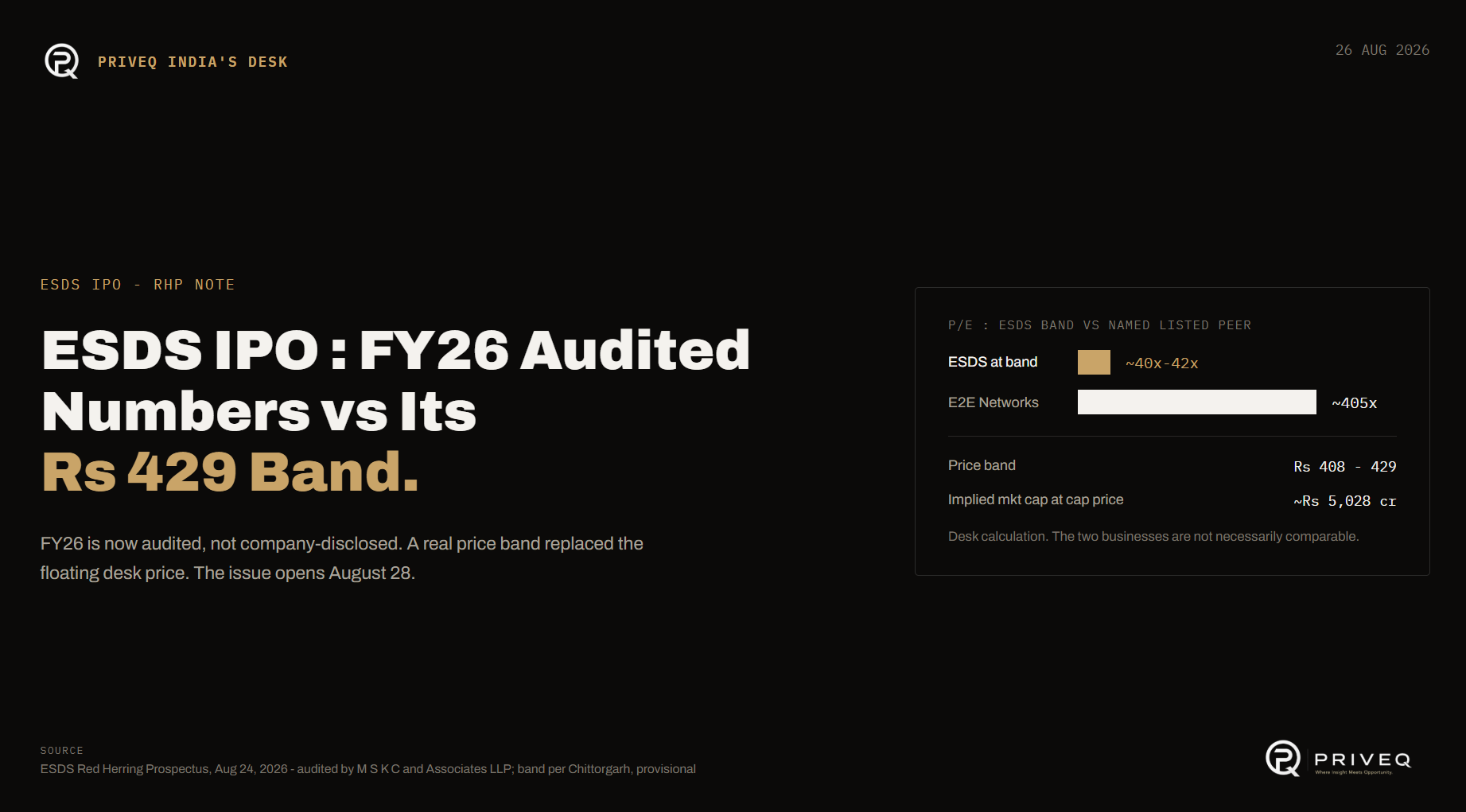
The financial story that number brings with it is a strong one on paper. Revenue grew 30.7% to Rs 472.2 crore, EBITDA margin expanded to 49.6%, and PAT more than doubled to Rs 120.8 crore, all now backed by FY26 audited financials rather than a company slide deck. At the top of the price band, that prices the fresh-issue-only IPO at roughly 40 to 42 times FY26 earnings, and P/E alone makes this look either expensive or cheap depending on which company you're comparing it to, which is exactly why it's close to the wrong tool on its own. Net out ESDS's roughly Rs 1,210 crore cash pile and the same business prices at closer to 15 to 16 times EV/EBITDA, an ESDS vs E2E Networks comparison that turns out to cut both ways once you look past the headline multiple.
There's also a document-level gap worth sitting with before you read the rest: the RHP does not mention Sharon AI once, even though the ~$1.95 billion GPU deal was the centerpiece of ESDS's own investor presentation two months earlier. We're not going to guess why. What we found instead is that the other side of that deal has already put it on the record, in a US regulatory filing, independent of anything ESDS itself has disclosed.
What Changed Since The DRHP : FY26 Is Now Audited
Our earlier note on ESDS worked from two documents : a DRHP whose audited numbers stopped at a September 2024 stub, and an FY25 annual report that closed most, but not all, of that gap. The one year we couldn't verify against an audit trail was FY26, the year the company was actively pitching to pre-IPO investors on the strength of the Sharon AI contract.
That gap is now closed. The RHP carries a Statutory Auditors' Report dated August 7, 2026, covering the Restated Consolidated Financial Information for Fiscal 2026, 2025, and 2024. FY26 revenue of Rs 472.21 crore and PAT of Rs 120.82 crore, both numbers ESDS had already put in its July 2026 investor presentation, now sit inside an audited document rather than a company slide deck. That's a meaningfully higher bar of reliability than what we had three weeks ago.
One clerical note worth mentioning: the statutory auditor changed during this period, from M/s Shah Khandelwal Jain & Associates, which signed the FY25 annual report, to M S K C & Associates LLP, effective September 30, 2025. The RHP documents this as a routine completion-of-term rotation, not a resignation, and we found nothing in the filing that reads as a red flag around it. We're noting it because a change in auditor between two audited periods is exactly the kind of thing that deserves a plain mention rather than silence, even when it turns out to be nothing.
The Price Band Arrived, And It Isn't Rs 515
Every multiple we published in our last note used ESDS's live desk price of Rs 515, because that was the only price we had. The RHP itself still shows the Price Band as a placeholder, standard practice until the book-building process is complete, but a secondary source (Chittorgarh) now shows a Price Band of Rs 408 to Rs 429, an issue opening August 28, 2026 and closing September 1, 2026, and listing tentatively targeted for September 4.
We cross-checked the one number from that source we could verify independently: the fresh issue size. Chittorgarh shows Rs 720 crore in fresh capital. The RHP itself states the Fresh Issue aggregating up to Rs 7,200 million, which is the same number. That agreement between an independent source and the primary filing is why we're comfortable using the Rs 408-429 band in this note, while still treating it as provisional until the Prospectus formally fixes it.
This is also a fresh-issue-only IPO. There's no offer for sale here, unlike the NSE listing we covered separately, where SBI and SBI Capital Markets were both selling existing shares. Every rupee raised by ESDS goes onto the company's own balance sheet, not into an existing shareholder's pocket.
That band matters because it's meaningfully below the Rs 515 desk price we'd been working with. At the cap price of Rs 429, using the pre-issue share count from the RHP and the fresh shares implied by a Rs 720 crore raise at that price, we get an implied market capitalisation of roughly Rs 5,028 crore, in the same range independently reported by Chittorgarh. At the floor price of Rs 408, that comes down to roughly Rs 4,819 crore.
Why P/E Alone Is The Wrong Tool Here
This is the core of ESDS IPO valuation right now, and P/E is the first number everyone reaches for, but it's also the number most likely to mislead you on this specific IPO, on both sides of the comparison.
Using FY26 audited PAT of Rs 120.82 crore against that implied post-issue share count, ESDS prices out at roughly 40 times earnings at the floor and roughly 42 times at the cap. Those are Priveq desk calculations, not disclosed multiples; the RHP's own P/E and EV/EBITDA tables are still marked "to be updated in the Prospectus" once the Issue Price is fixed.
The RHP itself names ESDS's listed comparable: E2E Networks Limited. As of August 26, 2026, E2E Networks trades at a trailing twelve-month P/E of roughly 405x, on a market capitalisation of about Rs 12,611 crore. But that P/E is itself close to a meaningless number: E2E posted a net loss of Rs 16 crore for the full fiscal year ended March 2026, including three consecutive loss-making quarters, before swinging to a Rs 44 crore profit in the quarter ended June 2026. A P/E built on a trailing-twelve-month earnings base that spent most of the year near zero or negative isn't a comparison, it's an artifact of the denominator. We're flagging this rather than quietly leaning on the "ESDS is ten times cheaper" framing, because that framing only works if you don't look at why E2E's multiple is so large.
That's exactly why P/E shouldn't be the only lens on this IPO. Two better ones, using the same audited FY26 numbers:
EV/EBITDA. ESDS's FY26 balance sheet carries roughly Rs 1,210 crore of net cash (Rs 1,253.4 crore cash against Rs 42.9 crore of total borrowings), so its enterprise value is meaningfully lower than its market capitalisation, not the same number. Against audited FY26 EBITDA of Rs 234.2 crore, that puts ESDS at roughly 15 to 16 times EV/EBITDA across the price band, well below the 40 to 42 times P/E figure everyone will quote on listing day.
EV/Sales. On the same basis, ESDS's implied enterprise value works out to roughly 7.6 to 8.1 times FY26 revenue, against a market-cap-to-revenue ratio of roughly 10.2 to 10.7 times. Both read as rich for a company still ramping a single large contract, but meaningfully less rich than the P/E headline suggests.
Rule of 40. Revenue growth of 30.7% plus an EBITDA margin of 49.6% gets ESDS to roughly 80% on this measure for FY26, well clear of the 40% threshold that's typically treated as healthy for this kind of business.
ESDS financial bridge: audited FY24-FY26, priced against the IPO band
Metric | FY24 (audited) | FY25 (audited) | FY26 (audited) |
|---|---|---|---|
Revenue from operations | Rs 286.5 cr | Rs 361.3 cr | Rs 472.2 cr |
EBITDA margin | 35.6% | 42.9% | 49.6% |
PAT | Rs 13.6 cr | Rs 55.6 cr | Rs 120.8 cr |
Cash and cash equivalents | Rs 2.2 cr | Rs 60.7 cr | Rs 1,253.4 cr |
Total borrowings | Rs 149.0 cr | Rs 62.7 cr | Rs 42.9 cr |
Net cash | Rs (146.8) cr | Rs (2.0) cr | Rs 1,210.5 cr |
P/E at Rs 408-429 IPO band | n/a | n/a | ~40x-42x |
EV/EBITDA at Rs 408-429 IPO band | n/a | n/a | ~15x-16x |
EV/Sales at Rs 408-429 IPO band | n/a | n/a | ~7.6x-8.1x |
Rule of 40 (revenue growth + EBITDA margin) | n/a | n/a | ~80% |
E2E Networks (listed peer, named in RHP), TTM P/E | ~405x (as of Aug 26, 2026; distorted by a near-zero TTM earnings base, including an FY26 net loss of Rs 16 cr) | ||
Source: ESDS Red Herring Prospectus dated August 24, 2026, Restated Consolidated Financial Information audited by M S K C & Associates LLP (auditor's report dated August 7, 2026). Price band of Rs 408-429 per Chittorgarh, cross-verified against the RHP's own fresh issue size of Rs 720 crore; not yet confirmed in the Prospectus. P/E, EV/EBITDA, EV/Sales, net cash, and Rule of 40 are Priveq desk calculations against the provisional band, not figures disclosed by ESDS. E2E Networks P/E, market cap, and quarterly results per Screener.in, August 26, 2026, cited as ESDS's own named listed peer in the RHP; E2E's own EV/EBITDA is not shown here due to insufficient public disclosure of its cash position. The two companies are not necessarily directly comparable.
We'd caution against reading that gap as "ESDS is ten times cheaper than its peer, buy now." E2E Networks and ESDS aren't running identical businesses, they carry different capital structures, and E2E's multiple reflects a market pricing in a growth trajectory that may or may not resemble ESDS's own. The RHP's own peer comparison table is still blank pending the final Issue Price, and that table, once published, will be the more rigorous version of this comparison. What we can say cleanly is that the gap exists, it's large, and it's the first thing worth asking your own questions about rather than the last.
The Rs 576 Crore Capex Plan, And Why EV/MW Still Isn't Ready
We'd said in our last note that a proper EV/MW multiple for ESDS needed to wait for the RHP, because that metric requires a primary-sourced capacity figure the investor deck alone didn't give us with enough rigor. The RHP is here, and we still don't have that number. There is no single disclosed company-wide MW capacity figure anywhere in this filing. So we're not forcing an EV/MW multiple into this note. What the RHP gives us instead is arguably more useful for judging the story right now: an itemised, vendor-quoted capex plan.
Of the Rs 720 crore fresh issue, Rs 576 crore (Rs 5,760.00 million exactly) is earmarked for cloud computing equipment and data centre infrastructure, certified by an independent IT consultant (Apt Data Center Consultants India LLP) against vendor quotations dated July and August 2026. That includes 20 units of GPU cloud servers built on 8x HGX B300 architecture, 3 petabytes of GPU enterprise storage, and new cooling capacity across four data centres: 200 TR at Mohali, 280 TR at Airoli, 800 TR at Bengaluru, and 280 TR at Nashik, 1,560 tons of refrigeration in total. None of that has been ordered yet; the RHP is explicit that these are quotations, not placed orders, valid for four to six months.
That's not an EV/MW multiple. It's a concrete, itemised, third-party-certified expansion plan, and it's the closest primary-sourced proxy we have for how ESDS's own AI infrastructure capacity is actually growing until the company discloses an aggregate MW figure we can build a real multiple on.
The Cash Pile Without A Name Attached
Here's where the Sharon AI omission gets more interesting rather than less. ESDS's cash and cash equivalents jumped from Rs 60.68 crore as at March 31, 2025 to Rs 1,253.39 crore as at March 31, 2026, a swing large enough that it drove a 459% increase in total current assets for the year. The RHP's own Management's Discussion and Analysis section explains this increase in one sentence: it was "primarily driven by an advance received from a new enterprise customer incorporated outside India for a new GPU-as-a-Service contract during the year."
We're not going to claim that sentence is Sharon AI, because the RHP doesn't name it, and naming it ourselves would be exactly the kind of unverified leap this note is trying to avoid. What we can say is that the description lines up in kind and in timing with the deal ESDS itself disclosed by name two months earlier: a GPU-as-a-Service arrangement, with an overseas enterprise customer, landing in the same fiscal year. Whether or not this is the same contract, the cash is real, it's audited, and it's sitting on the balance sheet.
The GPU deal, cross-referenced : named vs unnamed
Source | What it says | Counterparty named? |
|---|---|---|
ESDS investor presentation, July 2026 | ~$1.95 Bn GPU-as-a-Service contract, 8,192 GPUs, 37% gross margin | Yes, Sharon AI |
ESDS RHP, August 24, 2026, full text | No reference to Sharon AI anywhere in the document | n/a, not mentioned |
ESDS RHP, MD&A section | Cash rose ~Rs 1,193 Cr YoY, attributed to "an advance received from a new enterprise customer incorporated outside India for a new GPU-as-a-Service contract" | No, unnamed |
The description in the RHP is consistent in kind and timing with the deal ESDS disclosed by name in July 2026. This is not confirmed as the same contract; Priveq India has not independently verified that the two references describe the same arrangement.
The practical effect either way : Total borrowings fell to Rs 42.92 crore in FY26 from Rs 62.71 crore in FY25, while cash rose more than twentyfold. ESDS moved from being roughly net-debt-neutral at the end of FY25 to holding roughly Rs 1,210 crore of net cash by the end of FY26, funded by operations and this customer advance rather than by the IPO itself, which hasn't happened yet.
Worth adding one more data point here, from ESDS's own July 2026 investor presentation rather than the RHP: the same slide that discloses the ~$1.95 billion end-customer revenue potential also shows an "Advance Received" figure of approximately Rs 1,200 crore, sitting directly under the Sharon AI arrangement, not as a general balance-sheet line. That's within about 1% of the Rs 1,193 crore cash increase the RHP's MD&A attributes to an unnamed overseas GPU-as-a-Service customer. We're still not calling this confirmed, ESDS has not itself connected the two documents in writing, but the magnitude match is tight enough that it's a materially stronger circumstantial link than we had when we first raised this.
Independent Confirmation : Sharon AI's Own SEC Filing
Here's the part that isn't ESDS's word at all. Sharon AI's parent, Sharon AI Holdings Inc. (Nasdaq: SHAZ), is a US-listed company, which means it has its own disclosure obligations independent of anything ESDS chooses to say. On April 1, 2026, Sharon AI Holdings filed an 8-K with the SEC reporting a material event: a services agreement with ESDS Software Solutions Limited and certain of its subsidiaries.
The terms in that filing line up closely with what ESDS itself disclosed two months later in its July investor presentation, from the other side of the same transaction. Total contract value of approximately $1.25 billion, against ESDS's own reconciliation of roughly the same figure as its wholesale cost to Sharon AI. Approximately 8,200 Nvidia B300 GPUs and 17.80 petabytes of storage, against ESDS's own "8,192 B-300" GPU count, a difference small enough to read as rounding across two independent disclosures rather than a discrepancy. A 60-month initial term with a 24-month extension option, matching ESDS's own "3Y+2Y=5Y" framing (with an extension) almost exactly. A target of 99.95% annual uptime. Revenue expected to commence in Q3 2026, with an infrastructure delivery deadline of September 16, 2026, consistent with the "Oct-26" go-live date on ESDS's own slide. Deployment is confirmed as Australian, across Equinix and NextDC facilities in Sydney and Melbourne. The filing also specifies that Sharon AI must post approximately $140 million in letters of credit or bank guarantees, and cannot terminate the arrangement for convenience during the first 36 months, both of which read as downside protection for ESDS specifically.
This matters for one reason above all: it means the Sharon AI deal doesn't rest on ESDS's own investor deck alone. The counterparty has independently put a version of the same numbers on record with a securities regulator, under its own legal exposure for getting them wrong. That's a different, and higher, standard of corroboration than a company's own marketing materials, even when a filing like this one still doesn't explain why the RHP itself is silent on the name.
Independent confirmation : ESDS's own disclosure vs Sharon AI Holdings' SEC 8-K
Deal term | ESDS investor presentation, July 2026 | Sharon AI Holdings SEC 8-K, April 1, 2026 |
|---|---|---|
Total contract value | ~$1.25 Bn (implied wholesale cost, reconciled from ~$1.95 Bn end-customer revenue at 37% GM) | ~$1.25 Bn total contract value, stated directly |
GPU count | 8,192 B-300 GPU units | ~8,200 Nvidia B300 GPUs |
Storage | Not stated on this slide | ~17.80 PB VAST storage |
Contract term | "3Y+2Y=5Y" | 60-month initial term, 24-month customer extension option |
Go-live / revenue start | Go-live Oct-26 | Revenue from Q3 2026; infra delivery deadline Sept 16, 2026 |
Advance / security | ~Rs 1,200 Cr advance received (shown under this deal) | ~$140 Mn in letters of credit/bank guarantees required from Sharon AI |
Source : ESDS Business Updates investor presentation, July 2026, slide 7; Sharon AI Holdings Inc. (Nasdaq: SHAZ) Form 8-K filed with the SEC on April 1, 2026, reporting a material event. Minor numeric differences (e.g. GPU count, contract value rounding) across the two independent disclosures are consistent with normal rounding rather than a substantive conflict. Priveq India has not independently confirmed that the RHP's unnamed customer advance is this specific contract.
What ESDS's Own Ramp Table Shows Beyond FY26
One more thing worth pulling from the July investor presentation, clearly labeled for what it is: company-disclosed, unaudited, and forward-looking, not a figure from the RHP or any audited document. The same slide that discloses the Sharon AI contract value also shows a revenue ramp by fiscal year specific to this arrangement: roughly Rs 1,927 crore in FY27, jumping to roughly Rs 3,875 crore in FY28, holding in the Rs 3,865 crore range through FY29 to FY31, and tapering to roughly Rs 1,938 crore in FY32 as the contract term winds down. Gross margin is shown flat at 37% and PBT margin at 17% (16% in the final year) across the entire period.
We're printing this because it's the only forward-looking figure ESDS itself has put a number on, not because we're endorsing it as likely. A five-year, single-customer ramp table in an investor deck is a projection, not a disclosure of fact, and it depends entirely on Sharon AI executing on its side of a $1.25 billion commitment made by a company that itself only listed on Nasdaq in February 2026. ESDS also flags, separately, a further ~16,000 B300 GPUs "in final-stage discussion" with international customers, which would take total committed capacity toward 24,000 GPUs if it converts. We're assigning that no weight at all until there's a signed contract behind it, which today there isn't.
The Desk View
Four things are genuinely stronger than what we had three weeks ago: FY26 is now audited, the price band gives us a real number to price against instead of a floating desk price, the cash position corroborates that a large GPU-services contract landed and got paid, and the Sharon AI deal itself is now independently confirmed by the counterparty's own SEC filing rather than resting on ESDS's investor deck alone. And on the metric that actually matters more than P/E here, EV/EBITDA sits at roughly 15 to 16 times, not the 40-plus times the earnings multiple alone would suggest, because the net cash pile shrinks the enterprise value without touching the market capitalisation. Rule of 40, for context, comes out to roughly 80% for FY26 (30.7% revenue growth plus a 49.6% EBITDA margin), which is a genuinely strong reading for a business in this sector, on audited numbers.
Two things are still open. The Sharon AI omission from the RHP itself is a fact, not an accusation, but it's a fact worth sitting with before the IPO opens, and we'd rather flag it plainly than pretend a document that size skips a $1.25-1.95 billion contract by accident, especially now that we know the other side of that contract has disclosed it publicly. And EV/MW, the metric ESDS itself says is the right lens for its AI infrastructure business, still isn't computable from anything the company has disclosed publicly. The capex plan tells you where the money is going. It doesn't tell you what capacity comes out the other end.
FAQs
Is ESDS's FY26 revenue and profit now audited?
Yes. The RHP dated August 24, 2026 carries a Statutory Auditors' Report dated August 7, 2026 covering the Restated Consolidated Financial Information for Fiscal 2026, 2025, and 2024, prepared by M S K C & Associates LLP.
What is ESDS's IPO price band?
A secondary source (Chittorgarh) shows Rs 408 to Rs 429 per share, cross-verified against the RHP's own fresh issue size of Rs 720 crore. The RHP itself still marks the Price Band as pending finalisation, so treat this as provisional until the Prospectus is filed.
Is the ESDS IPO a fresh issue or does it include an offer for sale?
It's entirely a fresh issue, Rs 720 crore, with no offer for sale component. All proceeds go to the company, not to existing shareholders.
Why doesn't the RHP mention the Sharon AI deal?
We don't know, and we're not going to guess. What we can confirm is that the RHP's own MD&A attributes a roughly Rs 1,193 crore jump in cash to an advance from an overseas enterprise customer under a new GPU-as-a-Service contract in FY26, a description consistent in kind and timing with the deal ESDS disclosed by name in its July 2026 investor presentation.
Why look at EV/EBITDA instead of just P/E?
Because ESDS's FY26 balance sheet carries roughly Rs 1,210 crore of net cash, which lowers its enterprise value well below its market capitalisation. That puts ESDS at roughly 15 to 16 times EV/EBITDA across the price band, against a P/E of roughly 40 to 42 times. Both are Priveq desk calculations from audited FY26 figures, not disclosed by ESDS.
Why isn't there an EV/MW multiple for ESDS in this note?
Because ESDS hasn't disclosed a company-wide MW capacity figure anywhere we can find in the RHP. What the RHP does give is an itemised, third-party-certified capex plan covering new GPU servers and 1,560 tons of new cooling capacity across four data centres, which is a real but partial proxy.
Is the Sharon AI deal confirmed by anyone other than ESDS itself?
Yes. Sharon AI's Nasdaq-listed parent, Sharon AI Holdings Inc. (SHAZ), filed an 8-K with the SEC on April 1, 2026 disclosing the same services agreement, independently of anything ESDS has said. The contract value, GPU count, storage, term length, and uptime target in that filing all line up closely with ESDS's own July 2026 disclosures.
What We Can And Cannot Stand Behind
We can stand behind : The FY26 revenue, EBITDA, and PAT figures cited here, all sourced from the audited Restated Consolidated Financial Information in the RHP dated August 24, 2026. The auditor transition details, the fresh-issue-only structure, and the capex plan figures, all directly from the same filing. The absence of "Sharon AI" as a search term anywhere in the RHP text we reviewed. The terms of the Sharon AI contract itself (value, GPU count, storage, term, uptime target, Australian deployment), corroborated independently by Sharon AI Holdings' own SEC 8-K filing dated April 1, 2026.
We can partially stand behind : The Rs 408-429 price band and IPO opening dates, sourced from Chittorgarh and cross-verified against the RHP's own fresh issue size, but not yet confirmed by the Prospectus itself. Our own P/E and market capitalisation calculations built on that provisional band. The FY27-FY32 revenue ramp figures for the Sharon AI contract, which are ESDS's own disclosed numbers but are unaudited, forward-looking, and contingent on execution by both parties.
We cannot stand behind : A direct company confirmation that the specific overseas customer advance described in the RHP's MD&A is the Sharon AI contract. The magnitude match (Rs 1,200 crore disclosed against the deal in ESDS's own presentation, versus Rs 1,193 crore in the RHP's cash increase) is tight, and the SEC filing independently confirms the underlying contract exists on close to the terms ESDS described, but no document we've reviewed formally ties that specific RHP balance-sheet line to Sharon AI by name. That link remains our own inference from the facts, not a confirmation from either company.
Have a view on the RHP's Sharon AI omission, or the E2E Networks comparison? We're keeping the comment thread on this one open.
Track ESDS and other Pre-IPO names on the Priveq desk before they list. Click here to access our marketplace
Disclaimer : This note is for informational purposes only and does not constitute investment advice. Priveq India is not a SEBI-registered investment advisor. Unlisted and pre-IPO shares carry liquidity, valuation, and regulatory risks distinct from listed securities. Read the Red Herring Prospectus and final Prospectus in full before making any investment decision. Figures marked as desk calculations are Priveq's own estimates and are not disclosed by ESDS Software Solution Limited.