

The Short Version
Evergreen Recyclekaro (India) Limited, an Indian e-waste and battery recycler, reported FY26 consolidated revenue of Rs 432.39 crore, up 97.6%, and trades at Rs 11,27,500 a share on the Priveq desk as of 26 October 2026.
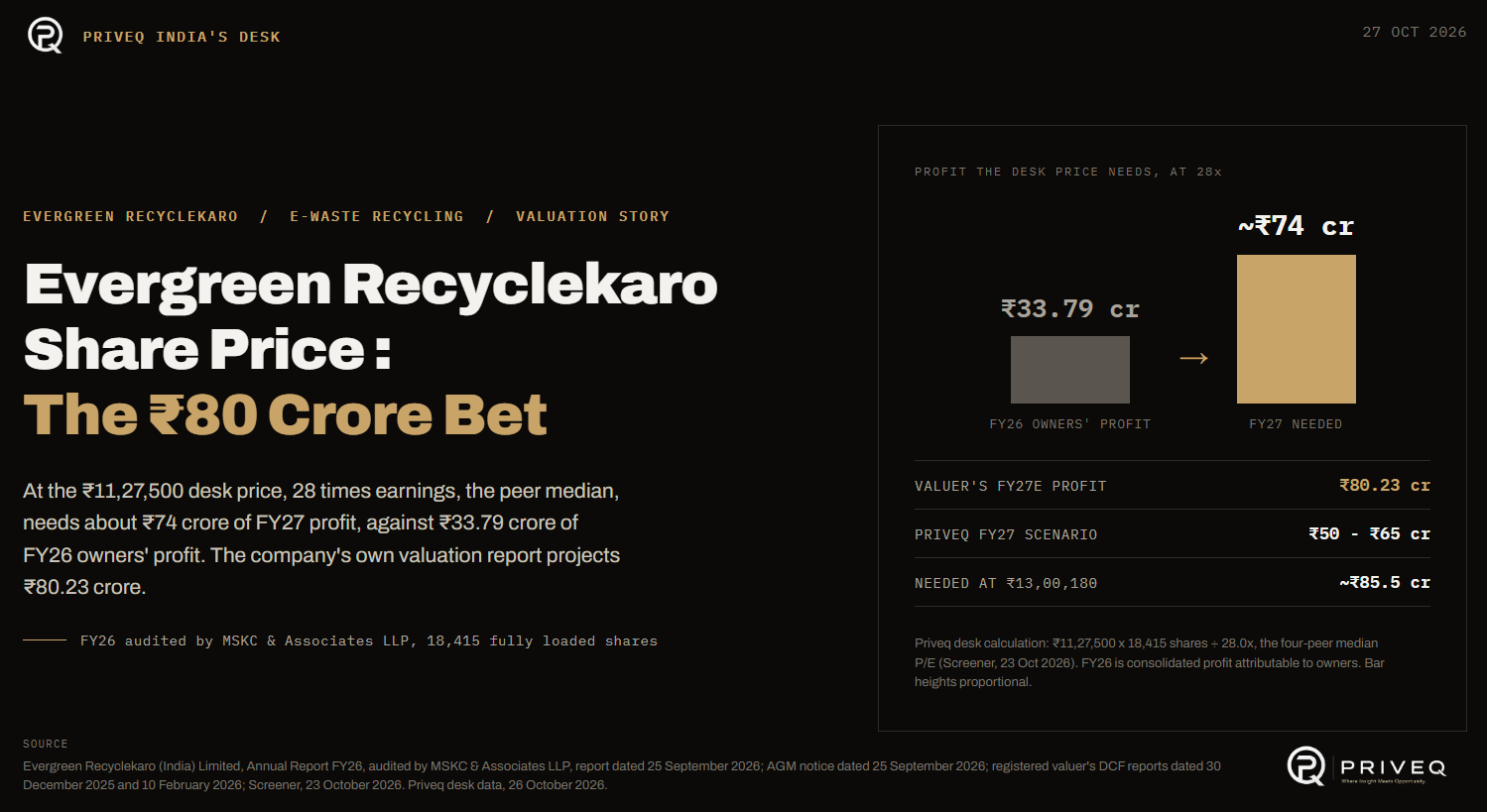
Evergreen Recyclekaro's growth has consumed cash, and the Rs 11,27,500 desk price (26 October 2026) assumes profit more than doubles: at 28 times earnings, the peer median, it needs about Rs 74 crore of FY27 profit against Rs 33.8 crore of FY26 owners' profit.
Our preliminary reference range is Rs 5.5 lakh to Rs 10 lakh a share before any unlisted discount, built on FY27 profit of Rs 50 to 65 crore at 20 to 28 times earnings across 18,415 fully loaded shares. The desk price sits above that range unless FY27 profit passes about Rs 74 crore, against the Rs 80.23 crore in the company's own valuation report.
The proposed Rs 13,00,180 placement (387 shares, AGM vote on 2 November 2026) is a higher bar: on 18,415 shares it needs about Rs 85.5 crore of FY27 profit at 28 times, or 29.8 times the valuer's own Rs 80.23 crore, and the report behind that price is not public. It can be justified only if FY27 profit comes in near or above the valuer's plan, or if buyers pay a premium for a thinly held growth company, and the filings alone cannot show either.
The variable that moves the call most is FY27 profit delivery, which the 2 November 2026 AGM and the subsidiaries' FY26 filings will begin to test.
Company Data Block
Company: Evergreen Recyclekaro (India) Limited (Evergreen Recyclekaro)
Sector: E-waste and battery recycling (urban mining)
Latest audited year: FY26, year ended 31 March 2026 (Ind AS; first-time adoption, transition date 1 April 2024)
Key figures (consolidated): revenue from operations Rs 432.39 crore (FY25 Rs 218.78 crore); profit after tax Rs 34.33 crore (FY25 Rs 18.67 crore), of which Rs 33.79 crore attributable to owners and Rs 0.54 crore to non-controlling interests (FY25 all to owners); total equity Rs 317.96 crore
Key figures (standalone): revenue from operations Rs 338.85 crore (FY25 Rs 183.70 crore); profit after tax Rs 24.75 crore (FY25 Rs 15.42 crore)
Desk price: Rs 11,27,500 per share as of 26 October 2026; minimum lot 1; face value Rs 10
Valuation lens: P/E on FY27 profit scenarios, cross-checked with cash conversion and the valuer's discounted cash flow (derived by Priveq)
Primary sources: FY26 annual report; AGM notice dated 25 September 2026; MCA filings (Forms PAS-3, MGT-14, AOC-1 and others, including subsidiary filings)
Identifiers: CIN U93030MH2010PLC211127 (MCA filings); equity ISIN INE0HAD01019 (as shown on the Priveq Marketplace page, not yet checked against depository records)
Last verified: 25 October 2026
For the live desk snapshot, see Evergreen Recyclekaro on Priveq Marketplace.
What Evergreen Recyclekaro Does
Evergreen Recyclekaro (India) Limited recycles electronic and battery waste into metals, and its FY26 annual report records consolidated revenue from operations of Rs 432.39 crore, against Rs 218.78 crore a year earlier (consolidated statement of profit and loss, Annual Report FY26). The company says the growth came mainly from a higher yield of copper, gold and palladium out of high-grade printed circuit boards (directors' report, page 20).
Evergreen Recyclekaro is a public limited company with CIN U93030MH2010PLC211127 (MCA filings), converted from private status with effect from 1 April 2025. The FY26 accounts are its first under Ind AS, with a transition date of 1 April 2024, so FY25 is a restated comparative. MSKC & Associates LLP signed an unmodified standalone audit opinion on 25 September 2026.
The company states its physical footprint in the directors' report on page 20:
Parent capacity : increased from 7,500 to 24,500 tonnes a year, to become operational in phases.
Evergreen Lithium Recycling Private Limited : increased from 4,200 to 10,000 tonnes a year, also in phases.
Recovery rate : "over 95%" with a target of 98% (company-stated; the basis of the percentage is not given).
Next step : a plan to invest in rare earth and critical mineral extraction, which also appears as the stated object of the placement proposed at the 2 November 2026 AGM.
The group, as the FY26 accounts describe it:
Evergreen Lithium Recycling Private Limited: wholly owned subsidiary; recycling of lithium battery waste.
Evergreen Vaahan Recycling Private Limited: 51.00% owned at 31 March 2026 (50.99% in the AOC-1), down from 100% a year earlier. On 19 June 2025 Evergreen Recyclekaro sold 60.50% to SKYRA Pte. Ltd., and on 12 November 2025 it took up a further 11.50% in a rights issue, ending at 51% (consolidated Note 1). The annual report describes the group's business only as recycling of e-waste, and gives no separate description of Vaahan's activity.
MBB Recycle Destiny Private Limited: 51.00% owned from 31 March 2026, previously an associate. The group already held 41.18%, and added 9.83% on 31 March 2026 (consolidated Note 1). The same note dates the earlier purchases 26 May 2026 and 25 July 2026, which fall after the year end and look like typing errors for 2025; Priveq flags this rather than correcting it. The annual report gives no separate description of MBB's activity.
Shyam Oxides Private Limited: 51.03% owned from 31 March 2026; makes litharge (lead oxide), including job work, at a plant in Vapi, Gujarat (MCA filings).
Evergreen Gulf Recycling Hub LLC: associate. Evergreen Advanced Technotech Private Limited, held through a wholly owned subsidiary, has not started operations and is not consolidated.
Evergreen Recyclekaro's leadership changed shape during FY26. Rajesh Ramloutan Gupta became chairman and managing director for five years from 20 December 2025, and Rupesh Chitte and Rajiv Sanghvi are whole-time directors. The chief financial officer role is described inconsistently in the annual report. The directors' report says Vinod Singh was appointed on 4 November 2025 and resigned on 8 January 2026, and that Ananthram Rao took the post on 25 September 2026, the day the accounts were signed. The related-party note (Note 40B) instead lists Vinod Singh as appointed on 1 April 2024 and ceasing on 4 November 2025. Who held the role between January and September 2026 is not stated in the pages Priveq read, and the MCA director and KMP filings that would settle the dates could not be opened. Priveq states both versions as disclosed and draws no conclusion.
Net read: Evergreen Recyclekaro is a fast-growing recycler that has doubled in a year while changing its legal form, its accounting framework, its finance leadership and its group perimeter at once. Each change is ordinary alone; together they mean FY26 is a new baseline, not a trend line.
How The Business Actually Works
Evergreen Recyclekaro earns its margin in the gap between what it pays for scrap and what the recovered metal sells for: cost of materials was Rs 294.02 crore on standalone revenue of Rs 338.85 crore in FY26, or 86.8% (standalone statement of profit and loss, derived). That leaves a gross-margin proxy of about 16.3%, derived as one minus cost of materials adjusted for the Rs 10.29 crore build in inventory, over revenue. The company does not report a gross margin.
How a recycler of this kind works, in order (general industry process, not company disclosure, except where marked):
Collect and buy scrap. Printed circuit boards, e-waste and battery waste come in from collectors, producers and bulk generators. What Evergreen Recyclekaro pays, and on what terms, is not disclosed; the cost of materials line is the only window.
Dismantle, shred and separate. Material is broken down and separated by type and grade. The company says grade matters: its growth came from "high-grade" boards.
Recover metal. Copper, gold, palladium and other metals are extracted. The company states a recovery rate of over 95% and a target of 98% (company-stated).
Sell the metal, and certificates. The standalone company sells finished goods (Rs 338.70 crore in FY26). In FY25 it also sold EPR certificates (Rs 4.76 crore); in FY26 it sold none, while holding Rs 25.09 crore of EPR certificates in inventory, up from Rs 11.78 crore (standalone Note 27 and the inventories note).
Get paid, and fund the gap. Receivables stood at Rs 95.17 crore net at year end, equal to about 103 days of revenue, and inventory at Rs 101.00 crore (derived).
The mechanics a reader should hold on to:
Price taker. Metal prices are set outside the company. Revenue moves with metal prices and recovery yield, not only with tonnes processed.
Inventory is a price bet. Inventory equals about 130 days of cost of goods consumed (derived). A fall in metal prices between purchase and sale hits margin on stock already held; a rise helps it. Whether the company hedges is not stated in what Priveq read.
Working capital sets the pace. Standalone cash conversion cycle is about 148 days: receivable days of 103 on revenue, plus inventory days of 130 on cost of goods consumed, less payable days of 84 on the same cost (derived from year-end balances and rounded separately; each is computed from disclosed balances, not taken from a third party).
Capital intensity. Capital expenditure was Rs 9.63 crore in FY26 against revenue of Rs 338.85 crore; the heavy outflow was working capital, not plant (standalone cash flow statement).
Regulation shapes demand. The E-Waste (Management) Rules 2022 and extended producer responsibility (EPR) targets create the volume of formally recycled waste and a certificate market. The Market section sets out the targets and the open definitions.
Group structure. Subsidiaries do different things: lithium battery recycling, lead oxide manufacturing, and others. Money moves between parent and subsidiaries as loans and equity. See the Subsidiaries section.
Where it could break:
A metal price fall while the company holds roughly four months of inventory.
Receivable stress. Net receivables doubled in a year (Rs 48.80 crore to Rs 95.17 crore), and the company carries an expected credit loss allowance of Rs 8.21 crore.
Customer loss. Four customers made up 44.6% of FY26 consolidated revenue (two made up 44.3% of standalone revenue).
Unit economics are not disclosed. The company does not state realisation per tonne, recovery by metal, or margin by product, and Priveq does not estimate them.
Net read: Evergreen Recyclekaro is a thin-margin, working-capital-heavy metal recycler whose profit depends on spreads it does not control. The business is not complicated; the cycle is long, and the cash it ties up is the reason profit has run ahead of cash flow.
Product And Revenue Segmentation
Evergreen Recyclekaro's consolidated revenue from operations was Rs 432.39 crore in FY26, of which Rs 428.77 crore was sale of finished goods, Rs 3.47 crore sale of EPR certificates and Rs 0.15 crore other operating revenue (consolidated Note 27, Annual Report FY26, page 123). Four customers each above 10% of revenue accounted for Rs 192.75 crore of it, or 44.6% (derived). The company reports a single business segment under Ind AS 108 (standalone Note 38), so there is no disclosed revenue split by product, and Priveq does not estimate one.
What the filings do disclose:
Product mix (consolidated): sale of finished goods Rs 428.77 crore; EPR certificates Rs 3.47 crore in FY26 against Rs 9.92 crore in FY25; other operating revenue Rs 0.15 crore. The standalone company sold no EPR certificates in FY26 (Rs 4.76 crore in FY25), so the FY26 certificate sales sit in a subsidiary. A product-wise split of finished goods is not disclosed in the annual report.
Geography (consolidated): Rs 392.20 crore in India and Rs 36.57 crore outside India (8.5% of finished-goods sales), with no exports in FY25. Standalone exports were Rs 10.57 crore, so about Rs 26 crore of exports sit in the subsidiaries (derived).
Customers (consolidated): four customers above 10% of revenue totalled Rs 192.75 crore, or 44.6% (derived); in FY25 two customers were above 10%, at Rs 39.14 crore (17.9%). Standalone shows two such customers at Rs 149.98 crore (44.3%), so two more sit in the subsidiaries. The customers are unnamed. Their share of receivables is not disclosed in the pages Priveq read.
Customer advances: payments in advance from customers, which the company treats as contract liabilities, rose from Rs 4.06 crore to Rs 24.22 crore (consolidated Note 27C), six times in a year. That is cash customers paid before delivery, a partial offset to the receivable build.
Evergreen Recyclekaro Revenue Mix, Geography And Customer Concentration, FY26 And FY25 (Rs crore, converted from Rs million in the filings (1 crore = 10 million))
Line | Standalone FY26 | Standalone FY25 | Consolidated FY26 | Consolidated FY25 |
|---|---|---|---|---|
Revenue from operations | 338.85 | 183.70 | 432.39 | 218.78 |
Sale of finished goods | 338.70 | 178.93 | 428.77 | 208.85 |
EPR certificates | nil | 4.76 | 3.47 | 9.92 |
Other operating revenue | 0.16 | 0.01 | 0.15 | 0.01 |
Sales in India | 328.13 | 178.93 | 392.20 | 208.85 |
Sales outside India | 10.57 | nil | 36.57 | nil |
Customers above 10% of revenue (unnamed) | 2 customers, 149.98 | 1 customer, 23.98 | 4 customers, 192.75 | 2 customers, 39.14 |
Share of revenue from those customers (derived) | 44.3% | 13.1% | 44.6% | 17.9% |
Export share of finished-goods sales (derived) | 3.1% | nil | 8.5% | nil |
Payments in advance from customers | not read | not read | 24.22 | 4.06 |
Source: Annual Report FY26: standalone Note 27, page 77; consolidated Note 27, page 123. Shares derived by Priveq as customer revenue divided by revenue from operations. Standalone Note 38 states a single business segment. Customer counts are as disclosed; the customers are not named.
Four customers above 10% of revenue accounted for Rs 192.75 crore in FY26. Concentration rose from two customers at 17.9% to four at a combined 44.6% in a single year, in the same year that net receivables doubled. Priveq has not seen how much of the Rs 95.17 crore standalone receivable balance (Rs 124.58 crore consolidated) sits with those accounts, and it is the first thing worth asking the company.
Revenue by group entity, FY26 (parent's AOC-1 and standalone statements, Rs crore):
Evergreen Recyclekaro standalone: 338.85
Evergreen Lithium Recycling: 68.23 (its turnover; the parent's AOC-1)
Evergreen Vaahan Recycling: 26.00
MBB Recycle Destiny: 2.43
Shyam Oxides: no contribution to FY26 consolidated revenue, as control passed on 31 March 2026
Consolidated revenue: 432.39, which is Rs 3.12 crore below the sum of the four entities above (435.51), a gap of eliminations or other adjustments that Priveq derived and the company does not itemise.
Lithium alone is about 15.7% of the sum of entity turnovers (derived), so it is the second engine of the group by size, but the parent is still about 78% of it.
Related-party sales to subsidiaries exist: the standalone company sold Rs 4.48 crore to Evergreen Lithium Recycling in FY25 (parent's related-party note). In FY26 the standalone company sold Rs 1.80 crore to subsidiaries (related-party note, Annual Report FY26, page 82), which may account for about Rs 1.80 crore of the Rs 3.12 crore gap above; the rest is unexplained. The same note shows loans to key managerial personnel outstanding at year end of Rs 1.05 crore for the chairman and managing director and Rs 0.35 crore for a whole-time director.
Net read: Evergreen Recyclekaro's revenue is one product family sold to a handful of buyers, mostly in India. The concentration number matters more than any segment split would, because it tells a reader how much of FY27 depends on two relationships.
Market Size, Demand And Growth
The government told Parliament on 9 March 2026 that India had generated 14.15 lakh tonnes of e-waste "so far" in FY26 and recycled 9.79 lakh tonnes (Lok Sabha reply, as relayed by PTI), so these are part-year figures, not a full-year count. The Ministry's replies in Parliament give full-year generation of 12.54 lakh tonnes in FY24 and 13.97 lakh tonnes in FY25 (PIB, July and August 2025). Recycled volume for FY25 is reported two ways: 9.88 lakh tonnes (Rajya Sabha reply of 24 July 2025, summed from state-wise figures, 70.7% of generation) and 11.59 lakh tonnes (the March 2026 reply, as relayed). Priveq shows both and does not reconcile them; the later figure may be a revision. FY24 recycled volume was 7.78 lakh tonnes (62%). Because FY26 is interim and FY25 has two values, Priveq draws no year-on-year conclusion about recycled volume.
Priveq chose these market metrics for this business: Volume generated against volume recycled (the formal-versus-informal gap), capacity against mandated demand, and a value pool for the metals inside the waste. TAM, SAM and SOM are used in adapted form because the reported volume and the value pool come from different bases and cannot be multiplied together. Where a metric needs data no source provides, it is left out.
Two credible sources size the same thing very differently, and Priveq does not reconcile them:
CPCB estimate (Parliament replies, PIB, 2025): about 12.5 lakh tonnes generated in FY24 and 14.0 lakh tonnes in FY25, built from sales data and product life, with recycled volume taken from authorised recyclers' reports.
NITI Aayog (via Down To Earth, 4 May 2026): about 62 lakh tonnes generated in FY24, rising to about 140 lakh tonnes by 2030, with about 10% recycled formally and formal capacity of about 20 lakh tonnes. This is an estimate of what actually arises, including the informal chain. The Ministry's own reply of 13 February 2025 gives registered recycler capacity of 22.09 lakh tonnes a year across 322 recyclers (PIB), close to NITI's capacity figure.
The gap is about five times. Evergreen Recyclekaro sells into the formal chain, so in Priveq's reading the CPCB basis is the closer comparator and the NITI figure is the potential. The definitional gap goes into the could-not-confirm list at the end.
Third-party forecasts for the segment run from 6.3% to 9.7% a year, depending on the publisher and the scope: IMARC puts India's e-waste recycling market at about US$1.7 billion in 2025 and about US$3.0 billion in 2034 (CAGR 6.34% over 2026 to 2034), TechSci quotes a headline CAGR of 9.71% to 2030 for waste electrical and electronic equipment recycling, and Mordor puts India's battery recycling market at US$152.68 million in 2025 and US$235.57 million in 2030 (CAGR 9.06%). These are syndicated estimates with undisclosed methods, not guidance.
India E-Waste Market Size, Demand And Capacity Reference Points (Third-Party Estimates Unless Marked) (Tonnes, US dollars or Rs crore as stated; every row dated and attributed)
Measure | Figure | Basis and as-of | Tier |
|---|---|---|---|
E-waste generated, India | FY24 12.54 lakh tonnes; FY25 13.97; FY26 14.15 so far (part year) | FY24 and FY25: Rajya Sabha reply 24 Jul 2025 (PIB, CPCB estimate); FY26: Lok Sabha reply 9 Mar 2026, as relayed by PTI | 1/2 (government reply) |
E-waste recycled, India | FY24 7.78 lakh tonnes (62%); FY25 9.88 (Jul 2025 reply) or 11.59 (Mar 2026 reply); FY26 9.79 so far (part year) | Same replies; the two FY25 values conflict and are not reconciled; no full-year FY26 figure yet | 1/2, conflict shown |
NITI Aayog estimate of generation | about 62 lakh tonnes (FY24), about 140 lakh tonnes by 2030 | Down To Earth, 4 May 2026; different definition from the CPCB figures | 3 |
NITI estimate of formal recycling | about 10% recycled formally; formal capacity about 20 lakh tonnes | Same source | 3 |
Registered recycler capacity, India | 22.09 lakh tonnes a year, 322 recyclers (as of 9 Feb 2025) | Rajya Sabha reply 13 Feb 2025, PIB | 1/2 (government reply) |
Embedded value of India's e-waste | Rs 51,000 crore; Rs 30,600 crore technically recoverable | Same source | 3 |
Global e-waste | 62 million tonnes (2022) to 82 million tonnes (2030); 22.3% documented as collected and recycled in 2022 | UN Global E-waste Monitor 2024, as reported by Waste Management World, 22 Aug 2024 | 2/3 |
India e-waste recycling market value | US$1.7 billion (2025), about US$3.0 billion (2034); CAGR 6.34% (2026-34) | IMARC Group; single-publisher estimate | 3 |
Other syndicated forecasts | WEEE recycling CAGR 9.71% to 2030 (headline only); battery recycling US$152.68 million (2025) to US$235.57 million (2030), CAGR 9.06% | TechSci Research (report not opened); Mordor Intelligence; each a single-publisher estimate | 3 |
Evergreen planned capacity | 24,500 tonnes a year (parent) and 10,000 tonnes a year (Lithium subsidiary), phased | Directors' report, Annual Report FY26, page 20 (company-stated) | 1, company-stated |
Planned capacity as a share of registered recycler capacity | 1.6% | 34,500 divided by 22.09 lakh tonnes; capacity, not volume processed; utilisation not read | Derived |
Planned capacity as a share of part-year FY26 recycled volume | 3.5% | 34,500 divided by 9.79 lakh tonnes (interim); definitions differ | Derived |
Group FY26 revenue against NITI technically recoverable value | 1.4% | Rs 432.39 crore divided by Rs 30,600 crore; a scale reference, not a market share | Derived |
Source: Sources as listed per row; Priveq arithmetic shown in the basis column. Syndicated forecasts are single-publisher estimates with undisclosed methods and are not company guidance. The CPCB and NITI figures size the same thing about five times apart and are not reconciled here.
Reading the table for Evergreen Recyclekaro:
Scale reference (derived): the planned capacity of 34,500 tonnes a year is about 1.6% of the 22.09 lakh tonnes of registered recycler capacity (PIB, February 2025) and about 3.5% of the part-year FY26 recycled volume. It is capacity, not tonnes processed; utilisation was not read. Evergreen Recyclekaro has room to grow within the formal chain without needing the market to grow at all.
Value pool (derived): against NITI's technically recoverable value of Rs 30,600 crore, the group's Rs 432.39 crore of revenue is a scale reference of about 1.4%, not a market share, because revenue includes metals bought and sold at market prices.
Growth, not market: the company's 97.6% growth is ten times or more the 6.3% to 9.7% market range. The company attributes it to higher yield of copper, gold and palladium from better boards, which is yield and price rather than market growth, plus capacity added. The acquisitions contributed nil to FY26, so none of the growth is acquired.
Regulatory pull: under the E-Waste (Management) Rules 2022, extended producer responsibility targets are 60% for FY24 and FY25, 70% for FY26 and FY27 and 80% from FY28, measured by weight of electrical and electronic equipment a producer placed on the market in an earlier year, set by the product's average life (Schedule III, wording confirmed from a published reproduction of the rules: 60% of the quantity of EEE placed in the market in year Y-X, where X is the product's average life; Priveq did not open the Gazette PDF itself). The March 2024 amendment (G.S.R. 164(E), read in full) lets the Central Pollution Control Board fix a price band for exchanging EPR certificates, from 30% to 100% of the environmental compensation for non-fulfilment. The rupee-per-kilogram figures sit in CPCB guidelines, not the Gazette. A 2025 news report puts the September 2024 guideline at Rs 22 to Rs 74 a kilogram for consumer electronics and Rs 34 to Rs 112 for IT equipment, but Priveq has not read the CPCB document, the guidelines were reportedly revised in August 2025, and so it does not rely on those figures; the band has been challenged in the Delhi High Court by several producers. Under the Battery Waste Management Rules 2022 (Gazette text read), the collection target for automotive batteries is 90% from 2025-26, and the recovery target for electric-vehicle and portable batteries is 90% from 2026-27. Amendments to those rules were not checked.
Informality: secondary sources estimate that informal collectors still handle most of the waste, a share said to have fallen from about 99% to about 75% by late 2024 for e-waste and put at about 80% for end-of-life battery scrap in mid-2026. These are Tier 3 estimates.
The number to watch is the full-year FY26 recycled volume once the government publishes it. The part-year figure cannot show whether formal recycling grew or shrank, and the two FY25 values show that the series gets revised. A recycler that doubles revenue is gaining share, yield or price, and the market data cannot yet say which.
Net read: the market is large, under-formalised and growing at a single-digit rate on third-party estimates, so Evergreen Recyclekaro's valuation cannot lean on market growth. It leans on share gain, capacity delivery and metal yield, which are company variables Priveq can test.
Is Evergreen Recyclekaro Profitable, And Is The Profit Turning Into Cash?
Evergreen Recyclekaro's standalone profit after tax rose 60.5% to Rs 24.75 crore in FY26 while its cash from operations was negative Rs 23.39 crore, after negative Rs 43.55 crore in FY25 (standalone statements, Annual Report FY26). Over two years, the company earned Rs 40.18 crore of standalone profit and used Rs 66.94 crore of cash in operations (derived). On a consolidated basis, net cash used in operations was Rs 38.65 crore in FY26 and Rs 39.42 crore in FY25 (consolidated cash flow statement, page 100), so the group as a whole has not yet turned profit into operating cash.
Evergreen Recyclekaro FY26 Results, Standalone And Consolidated (Rs crore, converted from Rs million in the filing (1 crore = 10 million); year ended 31 March)
Line | Standalone FY26 | Standalone FY25 | Consolidated FY26 | Consolidated FY25 |
|---|---|---|---|---|
Revenue from operations | 338.85 | 183.70 | 432.39 | 218.78 |
Profit before tax | 34.12 | 21.34 | 46.38 | 25.25 |
Profit after tax | 24.75 | 15.42 | 34.33 | 18.67 |
of which owners of the company | 24.75 | 15.42 | 33.79 | 18.67 |
of which non-controlling interests | nil | nil | 0.54 | nil |
PAT margin (derived) | 7.30% | 8.40% | 7.94% | 8.53% |
Net cash from operating activities | -23.39 | -43.55 | -38.65 | -39.42 |
Cash and equivalents, year end | 21.89 | 34.29 | 47.10 | 35.39 |
Borrowings, year end | 27.16 | 58.87 | 42.94 | 68.16 |
Inventories, year end | 101.00 | 57.08 | 161.24 | 81.56 |
Trade receivables (net), year end | 95.17 | 48.80 | 124.58 | 58.06 |
Trade payables, year end | 65.52 | 21.65 | 70.27 | 28.83 |
Total equity, year end | 295.39 | 116.76 | 317.96 | 121.30 |
Total assets, year end | 399.66 | 211.26 | 470.05 | 236.26 |
Source: Annual Report FY26: standalone and consolidated statements of profit and loss, balance sheet and cash flow (standalone Notes 18, 19, 27; consolidated statements). FY25 is restated under first-time Ind AS adoption (transition date 1 April 2024). Margins are derived by Priveq. Consolidated profit after tax of Rs 34.33 crore equals Rs 33.79 crore attributable to owners plus Rs 0.54 crore to non-controlling interests. Standalone FY25 non-controlling interests are nil by construction (no subsidiaries consolidated). Standalone FY25 inventories of Rs 57.08 crore are Rs 570.84 million on the FY26 balance sheet's comparative column, which ties to the Rs 43.92 crore inventory build in the FY26 standalone cash flow (101.00 less 57.08).
Growth:
Revenue: standalone revenue from operations grew 84.5% and consolidated revenue 97.6% (derived from Note 27 and the consolidated statement).
Profit: standalone profit after tax grew 60.5%; consolidated profit after tax grew 83.9% (Rs 18.67 crore to Rs 34.33 crore, total basis). Profit grew slower than revenue standalone, so the standalone margin slipped from 8.40% to 7.30%.
Quality of the consolidated profit: it includes a Rs 1.85 crore gain on remeasuring the earlier MBB stake (consolidated Note 36A), about 5.4% of consolidated profit after tax (derived). Small, but non-operating and one-off.
Label check: the directors' report labels total income as revenue from operations, and quotes growth of 83% (standalone) and 97% (consolidated) on that basis. Note 27 revenue from operations is Rs 338.85 crore, up 84.5%. Priveq uses Note 27 throughout and flags this as a presentation difference, not a restatement.
Cash and working capital:
Where the cash went: receivables rose Rs 47.11 crore, inventories rose Rs 43.92 crore and trade payables rose Rs 43.87 crore (standalone cash flow lines). Payables financed almost all the inventory build, and receivables absorbed the profit.
How it was funded: share issue receipts including premium were Rs 133.88 crore, borrowings repaid were Rs 35.85 crore, and share issue expenses were Rs 3.71 crore (standalone cash flow statement). Standalone borrowings fell from Rs 58.87 crore to Rs 27.16 crore. Consolidated borrowings were Rs 42.94 crore against cash of Rs 47.10 crore, a net cash position of about Rs 4.2 crore (derived; leases not netted).
Where it was invested: investments in subsidiaries and Mahalaxmi stood at Rs 112.43 crore against Rs 13.78 crore, though most of the rise is non-cash (shares issued for Shyam Oxides; Rs 40.00 crore of a loan to Lithium converted into equity, a conversion Priveq could not trace in the parent's loan movements). Cash purchases of investments were Rs 46.09 crore.
Audit and presentation points, stated as disclosed:
Unmodified opinion on the standalone accounts, with the predecessor auditor's report on FY24 comparatives and opening balances.
Two limitations the auditor states on the books of account: it could not comment on whether daily electronic back-ups are kept on servers in India, for lack of audit evidence, and the accounting software's audit trail was enabled on 16 September 2023, so it could not comment on whether the audit trail of the earlier period was preserved (standalone report, pages 42 to 44; consolidated report, page 89). Priveq draws no inference.
Bank returns versus books: the company discloses that quarterly returns filed with banks differ from its books of account for inventory, receivables and payables in all four quarters, with reasons stated (standalone Note 20.5).
Bank security is wider than the parent. A further deed of mortgage dated 3 August 2026 in favour of The Federal Bank (registered at Vasai) secures Rs 21.14 crore of additional facilities: for Evergreen Recyclekaro, a cash credit limit raised by Rs 3 crore to Rs 13 crore, a bill discounting limit raised by Rs 2 crore to Rs 9 crore, and an ECLGS term loan of Rs 4.35 crore; for Evergreen Lithium Recycling, cash credit raised by Rs 4 crore to Rs 14 crore and an ECLGS term loan of Rs 2.79 crore; and for Evergreen Vaahan Recycling, a fresh Rs 5 crore working capital limit. The deed sits on top of earlier mortgages the deed itself puts at Rs 30 crore (three land parcels and a fourth group of land at Pali and Apti Khurd in Palghar) and Rs 31 crore (a flat in Thane owned personally by the chairman and managing director, Rajesh Ramloutan Gupta, who is a mortgagor alongside the three companies). The Form CHG-1 filed for this modification states a maximum secured amount of Rs 47.79 crore and a floating charge on current assets; Priveq could not reconcile that figure to the deed's numbers. Separately, a no-dues letter dated 4 November 2025 from Mizuho Capsave Finance confirms repayment of a Rs 4 crore working capital facility sanctioned in June 2024 (Deed of mortgage, Form CHG-1 and no-dues letter, read from the filed documents).
Per-share figures: consolidated basic EPS of Rs 23,462 multiplied by the 14,632 weighted shares gives Rs 34.33 crore, the total profit including the minority share; profit attributable to owners (Rs 33.79 crore) would give about Rs 23,092. Priveq flags this as unreconciled and makes no allegation.
Net read: the FY26 result is a good growth year with a cash problem. Profit is real in the accounts and in the audit opinion, and the company funded its working capital build mostly with fresh equity and supplier credit. What the year does not yet show is a cycle that converts profit into cash, and that is what a buyer at the 26 October 2026 desk price of Rs 11,27,500 is paying for in advance.
Acquisitions And Goodwill
Evergreen Recyclekaro's consolidated balance sheet carried goodwill of Rs 46.82 crore at 31 March 2026, equal to 14.7% of total equity, all from two acquisitions completed on the last day of the year (consolidated Notes 36A and 36B). Neither acquisition contributed to FY26 revenue or profit before tax.
Evergreen Recyclekaro FY26 Acquisitions (Consolidated Note 36) (Rs crore, converted from Rs million in the filing (1 crore = 10 million))
Item | Shyam Oxides Pvt Ltd | MBB Recycle Destiny Pvt Ltd |
|---|---|---|
Date control obtained | 31 Mar 2026 | 31 Mar 2026 |
Stake after the step | 51.03% | 51.00% (from 41.18%) |
Consideration | 52.56 (566 Evergreen shares at Rs 9,28,593) | 3.61 (cash 0.70 plus fair value of earlier stake 2.92) |
Net assets acquired | 16.87 | 1.46 |
Non-controlling interest recognised | 8.26 | 0.72 |
Goodwill | 43.95 | 2.87 |
Goodwill as share of consideration | 83.6% | 79.4% |
Contribution to FY26 consolidated revenue and PBT | nil | nil |
Entity's own FY26 turnover (parent's AOC-1) | 92.20 (appears to be crore; see text) | 2.43 |
Entity's own FY26 profit after tax (parent's AOC-1) | 1.20 (appears to be crore) | -1.01 |
Source: Annual Report FY26, consolidated Note 36A and 36B (pages 126-127), Note 36C (pro forma), Note 41 (investment in Mahalaxmi at fair value through profit or loss, Rs 4.00 crore), Annexure A (AOC-1, page 36); Form PAS-3 for the allotment dated 19 Mar 2026 (MCA filings). Goodwill shares are derived by Priveq. Provisional measurement period applies to the Shyam Oxides accounting. The pending Mahalaxmi swap is described in the text, not tabulated.
Shyam Oxides. Evergreen Recyclekaro issued 566 shares at Rs 9,28,593, valued at Rs 52.56 crore, for 51.03% of Shyam Oxides Private Limited, a litharge maker in Vapi. The deal was done in shares, so no cash left the company. The goodwill of Rs 43.95 crore is 83.6% of the consideration, and the accounting is provisional.
What the price implies, derived by Priveq as an observation and not a verdict:
Implied 100% value: about Rs 103 crore (Rs 52.56 crore divided by 51.03%).
Against Shyam's FY25 accounts (filed on MCA, Indian GAAP, amounts in Rs thousand): net worth of Rs 15.00 crore, so about 6.9 times book; profit of Rs 2.06 crore as stated in its notes (the profit and loss line shows Rs 2.78 crore), so about 50 times or 37 times earnings depending on the line used.
Against FY26: the parent's AOC-1 shows turnover of 92.20 and profit after tax of 1.20 for Shyam. The AOC-1 header says millions, but the figures only tie to the acquisition note if they are in crore (total assets of 19.97 scaled by ten gives the Rs 199.69 million in Note 36B). Net assets of Rs 17.24 crore at 51.03% give Rs 8.80 crore, and Rs 52.56 crore less that is Rs 43.76 crore, close to the Rs 43.95 crore goodwill booked; in millions it would not reconcile. Priveq reads the figures as crore, which would mean FY26 profit of about Rs 1.20 crore and an implied multiple of about 86 times. The labelling remains an open item for the company to confirm.
Cross-check on that reading: pro forma revenue if both deals had closed on 1 April 2025 was Rs 527.01 crore against actual consolidated revenue of Rs 432.39 crore (Note 36C), a Rs 94.62 crore difference. Shyam's turnover of Rs 92.20 crore plus MBB's Rs 2.43 crore comes to Rs 94.63 crore, within Rs 0.01 crore. The crore reading holds.
Currency of payment: Evergreen paid in its own shares at the same Rs 9,28,593 round price used for cash investors. The cost of the deal in real terms depends on what those shares are worth, which is the question this piece is about.
What the shareholders' agreement says (dated 8 January 2026, among Evergreen Recyclekaro, Shyam Oxides and the Patel family promoters). It confirms the deal: 21,431 of Shyam's 42,000 shares (51.03%) bought at Rs 24,524 each, paid for with 566 Evergreen Recyclekaro shares (445 to Navin Patel, 81 to Kailas Patel, 40 to Shyam Patel) worth Rs 52,55,83,638. It records a valuation of Shyam Oxides of Rs 103,00,08,000 from a registered valuer, Ankit Kumar Jain, in a report dated 2 January 2026, which matches the implied Rs 103 crore above. The family keeps 48.97% of Shyam (Navin Patel 16,161 shares, 38.5%, derived). Evergreen can appoint the majority of directors while it holds at least 51%, and it holds a veto over matters such as dividends, new borrowing, mergers, spending above Rs 50 lakh and the terms of any IPO. Each party is locked in on 75% of its shareholding in Evergreen Recyclekaro for three years from 8 January 2026. As drafted the clause says "each Party" and "its shareholding in Evergreen", so Priveq reads it as restricting the Patel family's 566 new shares until January 2029; the wording is loose and the company has not confirmed it.
MBB Recycle Destiny. Evergreen Recyclekaro raised its stake from 41.18% to 51.00% on 31 March 2026 for Rs 0.70 crore in cash, and remeasured the earlier stake at Rs 2.92 crore, booking a Rs 1.85 crore gain and Rs 2.87 crore of goodwill. MBB reported turnover of Rs 2.43 crore and a loss of Rs 1.01 crore in FY26 (AOC-1). It is small and loss-making.
Mahalaxmi Metal Works and Alloys. A further swap is pending. Evergreen Recyclekaro already holds unquoted Mahalaxmi shares worth Rs 4.00 crore at fair value (Note 41). Under the second corrigendum to the January 2026 EGM notice, it will issue 173 shares at Rs 9,28,593 (Rs 16.06 crore) for 2,15,344 Mahalaxmi shares and put in Rs 10.00 crore of cash for 1,34,049 fresh Mahalaxmi shares, taking its stake to 51.08% on completion. Completion is planned in FY27 (directors' report). The AGM notice shows the 173 shares inside a non-promoter line of the pre-placement table even though they had not been allotted by 31 March 2026.
Net read: Evergreen Recyclekaro has bought scale, mostly with paper. The goodwill rests on the assumption that the Rs 9,28,593 share price used as currency was fair, and that Shyam's thin-margin lead oxide business will earn more under the group than it does today. Both are open until Shyam's FY26 accounts and a full year of consolidation are available.
Subsidiaries And The Lithium Loan Conversion
Evergreen Lithium Recycling Private Limited reported FY26 turnover of Rs 68.23 crore, up 72.4%, and profit after tax of Rs 6.48 crore, up 92.9%, in the parent's AOC-1 (FY25: Rs 39.57 crore and Rs 3.36 crore from its own filed accounts, which are on an Indian-GAAP basis; the comparison mixes bases and is indicative). Its FY26 accounts have not yet been filed on MCA.
On 31 March 2026 the subsidiary allotted 3,22,062 equity shares to Evergreen Recyclekaro at Rs 1,242 a share, Rs 40.00 crore in total, by converting an intra-group loan (Form PAS-3 and board resolution, MCA filings).
What the documents show:
Loan terms: a facility of up to Rs 50 crore from the parent, in tranches, for working capital and expansion; tenure five years unless converted; interest at 7.5% a year; the parent may convert all or part into equity at fair market value set by a registered valuer (loan agreement stamped 9 April 2025). The subsidiary's shareholders approved the conversion route on 2 June 2025.
Conversion price: the registered valuer used net asset value, a book-value floor, to reach Rs 1,242 a share on 28 February 2026 (net assets Rs 23.48 crore on 1,89,002 shares), having rejected comparable-company methods for lack of listed comparables. The same valuer used a discounted cash flow method for the parent's Rs 9,28,593.
Effect: after the allotment, Evergreen Recyclekaro holds 5,10,964 of 5,11,064 shares (99.98%; the AOC-1 shows 100%). The parent's investment in the subsidiary is Rs 53.77 crore, up from Rs 13.77 crore. The parent's loan to the subsidiary fell from Rs 6.56 crore to Rs 1.43 crore (parent's related-party note).
Interest income: the parent booked Rs 0.49 crore of interest from the subsidiary in FY26 (related-party note).
Priveq reads the conversion as a capital reallocation inside the group. It moves Rs 40.00 crore from loan to equity, it does not change consolidated assets, and the NAV-based price says nothing about what the subsidiary would fetch from an outside buyer. Priveq makes no earnings multiple out of it. The source of the Rs 40.00 crore of cash the parent lent is not stated in the filings and Priveq does not tie it to the investor raise.
How the subsidiary runs, from its last filed accounts (FY25, Rs lakh converted to crore): inventory Rs 24.26 crore and receivables Rs 14.89 crore against revenue of Rs 39.57 crore, so about 224 inventory days and 137 receivable days on revenue (derived), funded by short-term borrowings of Rs 15.75 crore and a parent loan; cash was Rs 0.01 crore. Raw materials consumed were 85% of revenue. EPR certificate sales were 13.1% of the subsidiary's FY25 revenue, while consolidated EPR certificate revenue in FY26 was Rs 3.47 crore, 0.8% of consolidated revenue, down 65% from Rs 9.92 crore (derived). How the subsidiary's certificate revenue is treated in consolidation is an open item.
Other group entities:
Evergreen Vaahan Recycling (50.99%): FY26 turnover Rs 26.00 crore, profit after tax Rs 0.88 crore (AOC-1); the parent's loan balance to it was Rs 4.02 crore at year end (FY25 Rs 1.45 crore).
MBB Recycle Destiny: parent's loan Rs 0.68 crore (new in FY26).
Wound up or sold: Zero Solarycle Private Limited was struck off; Evergreen Metals LLP is shown as liquidated or sold in the AOC-1.
Net read: the three consolidated subsidiaries add about 22% to the sum of group entity turnovers, and two of them are profitable, but they are also working-capital businesses funded from the parent. The group's FY27 profit depends on Lithium continuing to grow at 70% and on Shyam and MBB turning from contribution of nil into contribution of something, and none of their FY26 accounts have been filed yet.
Corporate History And Capital Structure
Evergreen Recyclekaro's issued equity grew from 13,921 shares at 31 March 2025 to 16,169 at 31 March 2026, an increase of 16.2%, with the issue price rising from about Rs 7.01 lakh to Rs 9.28 lakh within the year (Note 18; directors' report, page 23). The company was incorporated in 2010 (CIN, MCA filings), became a public limited company on 1 April 2025, and amended its memorandum at the AGM on 10 December 2025 and at the EGM on 20 January 2026 (Forms SH-7, MCA filings). Authorised capital is 5,00,00,000 shares of Rs 10 (Rs 50 crore), against 50,000 shares earlier (Note 18).
The directors' report lists 2,248 equity shares issued in FY26, and the table below ties to it exactly (288 plus 272 plus 400 plus 722 plus 566 equals 2,248):
Evergreen Recyclekaro Share Issue Ladder, April 2025 To The Proposed Placement (Issue price per equity share in Rs, including Rs 10 face value (price-convention check below))
Date | Event | Shares | Price per share (Rs) | Basis and source |
|---|---|---|---|---|
27 Nov 2024 and 2 Apr 2025 | Series Seed CCPS issued (265 and 128 units) | 393 CCPS | premium stated as 7,01,304 | Note 18(C)(ii); converted 5 Dec 2025 into 400 equity shares |
1-2 Apr 2025 | Equity issued for cash | 288 | 7,01,314 | Form PAS-4 offer letter, item 2.13, gives 7,01,314; the directors' report table, page 23, reads 7,01,304, the premium alone |
10 Jun-25 Jul 2025 | Equity issued for cash | 272 | 7,01,314 | Same table; Note 18 calls this a premium |
5 Dec 2025 | CCPS converted into equity | 400 | nominal on the additional shares | Note 18(C)(ii) |
10 Feb-31 Mar 2026 | Equity issued for cash (seven allotments) | 722 | 9,28,593 | Same table; Form PAS-3 filings, MCA filings; DCF valuation by a registered valuer |
19 Mar 2026 | Shares issued to acquire Shyam Oxides | 566 | 9,28,593 | Form PAS-3 (other than cash), MCA filings; Note 36B |
26 Oct 2026 | Priveq desk price | not applicable | 11,27,500 | Priveq desk, indicative |
Proposed; AGM 2 Nov 2026 | Preferential placement to 22 allottees | 387 | 13,00,180 | AGM notice item 4; DCF valuation by a registered valuer, report not yet public |
Source: Annual Report FY26 (Note 18, Directors' report page 23); AGM notice dated 25 Sep 2026 (item 4); Form PAS-3 filings (MCA filings); Priveq desk. Step sizes between rungs are derived: 9,28,593 is 32.4% above 7,01,314; 11,27,500 is 21.4% above 9,28,593; 13,00,180 is 15.3% above 11,27,500 and 40.0% above 9,28,593. Prices before April 2025 (FY25 issues of 375 shares) were not read. The directors' report labels these amounts issue price; Note 18 calls the same amounts premium.
The issue price climbed in two steps in under a year before the placement now proposed. It rose 32.4% from the April to July 2025 rounds to the February to March 2026 rounds, and the proposed Rs 13,00,180 is 40.0% above that second step. The Rs 9,28,593 price and the proposed Rs 13,00,180 rest on discounted cash flow reports by one registered valuer; the report behind the Rs 7.01 lakh rounds was not read. The price-driver section, later in this piece, covers what moved them.
Price-convention check:
Issue price versus premium. The directors' report and Form PAS-3 give the 2026 amounts as issue price (Rs 10 face value plus Rs 9,28,583 of premium equals Rs 9,28,593). Note 18 of the audited accounts calls Rs 7,01,314 and Rs 9,28,593 a premium. Priveq uses issue price including face value throughout and carries the Note 18 wording as a labelled discrepancy.
The note's own count. Note 18 says 1,288 shares were issued at Rs 9,28,593; the 1,288 is 566 swap shares plus 722 cash shares, and the 722 reconciles to the allotment table.
The last two cash allotments. The seven cash allotments of 10 February to 31 March 2026 tie to their returns: 97, 185, 94, 98 and 96 shares to 11 March (570, matching the offer letter's item 2.13 rows), then 98 shares on 30 March (Rs 9,10,02,114, to three companies) and 54 shares on 31 March (Rs 5,01,44,022, to one individual), for 722 in all. The two March returns show issued capital of 16,115 and 16,169 shares, which closes the gap between the 16,017 shares in the offer letter on 26 March and the 16,169 in Note 18. The offer was for up to 379 shares, so 152 of them (Rs 14.11 crore) had been allotted by 31 March 2026, and the AGM notice's pre-placement count of 16,169 issued shares implies no further allotment under it by 25 September 2026 (derived).
No prior preferential allotments claimed. The AGM notice states "not applicable" for preferential allotments in the year, while the directors' report table lists several. Priveq carries this as an open discrepancy.
Promoters: promoter holding fell from 72.45% at 1 April 2024 to 70.50% at 31 March 2025 and 56.89% at 31 March 2026 on issued shares (Note 18F, page 73). Rajesh Ramloutan Gupta holds 8,855 shares, down 75 from 8,930, and Catseye System & Solution Private Limited holds 343, down 541 from 884, a combined decrease of 616 shares, or 6.3% of the promoters' holding. The note's own "change during the year" column shows (0.84%) and (61.20%) for the two promoters and (62.04%) for the total, which adds the two percentages together; the true decline in promoter shares is 6.3%, and most of the fall in promoter percentage comes from new shares being issued to others. Only these two holders are above 5%. Who acquired the 616 shares is not in the pages Priveq read, and the MCA shareholder list for the FY26 annual return is a spreadsheet that could not be previewed.
The Rs 7.01 lakh price has a documented origin. Note 18 records that the company allotted 265 Series Seed compulsorily convertible preference shares under a Share Subscription and Shareholders' Agreement dated 27 November 2024, at a face value of Rs 10 plus a premium of Rs 7,01,304, which is an issue price of Rs 7,01,314. A further 128 Series Seed shares followed on 2 April 2025 on similar terms, and the 393 outstanding were converted into 400 equity shares on 5 December 2025 (Note 18C, page 73). The price rests on a discounted cash flow report by registered valuer Bhavesh M Rathod (valuation date 31 July 2024, report dated 31 August 2024), which values the equity at Rs 950.00 crore on 13,546 shares and is attached to the Form MGT-14 filed on 17 April 2025.
What FY25 looked like in securities terms. The company secretary's Form MGT-8 certificate for FY25 (dated 17 March 2026) lists the allotments that year: 375 equity shares between 23 October 2024 and 29 January 2025 at Rs 7,01,304 (the certificate's own column heading is "issue price"; the filings elsewhere call this the premium and Rs 7,01,314 the issue price), 265 Series Seed CCPS between 28 November and 5 December 2024 at the same figure, and 1,500 non-convertible debentures of Rs 1 lakh each (Rs 15 crore) on 2 and 21 January 2025. The 375 shares tie exactly to the rise in issued equity from 13,546 to 13,921. The annual return for FY25 uses a count of 210 shareholders from depository (BENPOS) data, as of a date the letter does not state. In a letter to the Registrar the company says its transfer agent's category split summed to 117 holders, and it booked the 93-holder difference under "Individual - Male" so the annual return would validate. It also confirms two ISINs: INE0HAD01019 for equity and INE0HAD03023 for the CCPS. The company converted from private to public with effect from 1 April 2025, and a new statutory auditor, MSKC & Associates LLP, was appointed on 15 April 2025 to fill the vacancy left by Naik Mehta & Co.
Three share counts exist for the same company, and the difference matters for every per-share number in this piece:
16,169: shares issued at 31 March 2026 (Note 18).
17,127: the registered valuer's fully diluted count at 31 January 2026 (14,881 issued plus 2,246 ESOP), which is also the share count on the Marketplace page. It is stale by 1,288 shares allotted between 10 February and 31 March 2026.
18,415: the pre-placement base in the AGM notice (16,169 plus the 2,246 ESOP line). Priveq uses 18,415 as the fully loaded base for every per-share figure in this piece, and 18,802 after the proposed placement.
Evergreen Recyclekaro Equity Share Bases And Holding Before And After The Proposed Placement (Number of equity shares of Rs 10 face value; debentures and other non-convertible instruments excluded)
Item | Shares | Share of base | Note |
|---|---|---|---|
Issued at 31 Mar 2026 (Note 18) | 16,169 | 100.0% | Promoters 9,198 (56.89%) |
Add: ESOP line in the AGM notice | 2,246 | 12.20% of 18,415 | Options expensed in FY26; scheme detail not read |
Pre-placement base in the AGM notice | 18,415 | 100.0% | Used by Priveq as the fully loaded base |
Promoters | 9,198 | 49.95% | Notice table |
Non-promoters (including the ESOP line) | 9,217 | 50.05% | Notice table |
Proposed placement | 387 | 2.06% of 18,802 | 22 allottees; no promoter, director or KMP subscribing |
Post-placement base | 18,802 | 100.0% | Notice table |
Promoters | 9,198 | 48.92% | Notice table |
Non-promoters | 9,604 | 51.08% | Notice table |
Valuer's fully diluted count at 31 Jan 2026 | 17,127 | not applicable | 14,881 issued plus 2,246 ESOP; also the figure on the Marketplace page; stale by 1,288 shares |
Promoters on issued shares only, post-placement | 9,198 of 16,556 | 55.56% | Derived by Priveq (16,169 plus 387) |
Source: AGM notice dated 25 Sep 2026, item 4 pre and post issue table; Annual Report FY26 Note 18; DCF valuation reports dated 30 Dec 2025 and 10 Feb 2026 (registered valuer). Reconciliation (derived): 16,169 less 1,288 shares allotted 10 Feb-31 Mar 2026 gives 14,881 issued at 31 Jan 2026; plus 2,246 gives 17,127; plus 1,288 gives 18,415. The notice classifies 173 Mahalaxmi swap shares inside a non-promoter line although they were not allotted by 31 Mar 2026; the arithmetic does not separate them.
The ESOP line: the 2,246 shares sit inside the non-promoter side of the notice's table. The accounts show that options were granted and expensed (Rs 0.45 crore of share-based payment expense in FY26 and a reserve of the same amount, from nil), and none were exercised into equity by 31 March 2026 (Notes 18, 19 and 31). The scheme's grant, vesting and exercise terms were not in the pages Priveq read. At about Rs 2,000 of fair value an option, the expense is small against a share worth lakhs, which suggests either a partial grant or a pool only partly granted. Priveq labels that an inference. If the 2,246 were excluded, every per-share figure in this piece would be about 14% higher; Priveq uses the notice's own base and treats the ESOP treatment as unconfirmed.
The proposed placement: 387 shares at Rs 13,00,180 (premium Rs 13,00,170), for Rs 50.32 crore, to 22 proposed allottees, by special resolution at the AGM on 2 November 2026 (Sections 42, 55 and 62(1)(c) of the Companies Act, 2013). No promoter, director or key managerial person intends to subscribe. The notice names the objects as capital expenditure on a project under the National Critical Mineral Mission (recycling and recovery of rare earth and critical minerals, including capacity, process and land), research and development, working capital and general corporate purposes, with no split of amounts. The price rests on a discounted cash flow report by the same registered valuer, relevant date 31 August 2026. Priveq has not seen that report: nothing on it was on MCA filings as of 21 October 2026, which is expected, because the special resolution is not yet passed.
At Rs 13,00,180, the post-placement value on 18,802 shares is about Rs 2,445 crore (derived), against about Rs 2,120 crore at the 26 October 2026 desk price of Rs 11,27,500 on the same base.
Net read: Evergreen Recyclekaro has priced equity at about Rs 7.01 lakh, at Rs 9.29 lakh and now at a proposed Rs 13.0 lakh within two years, and its promoters hold barely half the company on the fully loaded base. The share count is the first place a reader can go wrong, so the rest of this piece fixes it at 18,415 and says so every time.
Why Did The Evergreen Recyclekaro Share Price Rise From Rs 7 Lakh To Rs 13 Lakh?
Evergreen Recyclekaro's issue price has moved from Rs 7,01,314 in the rounds of April to July 2025 to a proposed Rs 13,00,180 in the AGM notice dated 25 September 2026, a rise of 85.4% (derived), and the filings show three separate pricing events behind it, not one trend.
Three pricing events sit behind the climb, and all three rest on a discounted cash flow report:
Rs 7,01,314, DCF on a 31 July 2024 report (November 2024 to July 2025). Evergreen Recyclekaro signed a Share Subscription and Shareholders' Agreement on 27 November 2024 for Series Seed compulsorily convertible preference shares (CCPS) at a premium of Rs 7,01,304 on Rs 10 face value, which is Rs 7,01,314 (Note 18C). It issued 560 equity shares for cash at the same price between 1 April and 25 July 2025, about Rs 39.27 crore, and 128 more CCPS on 2 April 2025, about Rs 8.98 crore (derived; Form PAS-4 offer letter, item 2.13). On 5 December 2025 the 393 CCPS outstanding converted into 400 equity shares. The price comes from a 16-page report by a registered valuer, Bhavesh M Rathod (IBBI/RV/06/2019/10708), dated 31 August 2024 with a valuation date of 31 July 2024, filed with the Form MGT-14 of 17 April 2025: equity value Rs 950.00 crore on 13,546 shares, Rs 7,01,314.19 a share, on a WACC of 21.03%. The report is on a scanned PDF and Priveq read it page by page.
Rs 9,28,593, DCF by a second valuer (February to March 2026). From 10 February 2026 the company issued shares at Rs 9,28,593 on a registered valuer's discounted cash flow (DCF) report: 722 shares for cash, about Rs 67.04 crore (derived), and 566 shares valued at Rs 52.56 crore to buy 51.03% of Shyam Oxides on 19 March 2026. The step from the first rung to this one is a change of valuer, share base and cost of capital, and it lifted the price 32.4% (derived).
Rs 13,00,180, proposed (relevant date 31 August 2026). The AGM notice proposes 387 shares to 22 allottees for Rs 50.32 crore, again on a DCF report by the same valuer. The report is not public. The price is 40.0% above the second rung (derived).
Evergreen Recyclekaro Price Rungs, Implied Equity Value And Multiples (Issue price in Rs per share including Rs 10 face value; equity value in Rs crore; multiples are derived by Priveq)
Rung | Price per share (Rs) | Share base used | Implied equity value | On FY25 owners' profit (18.67) | On FY26 owners' profit (33.79) | On valuer FY27E profit (80.23) |
|---|---|---|---|---|---|---|
1. Series Seed and later equity, Nov 2024 to Jul 2025 (DCF, valuation date 31 Jul 2024) | 7,01,314 | 13,921 issued at 31 Mar 2025 | 976.3 | 52.3x | 28.9x | 12.2x |
2. DCF round and Shyam Oxides swap, 10 Feb to 31 Mar 2026 (second valuer's DCF) | 9,28,593 | 17,127 (valuer fully diluted, 31 Jan 2026) | 1,590.4 (valuer's figure, after 20% discount) | 85.2x | 47.1x | 19.8x |
Priveq desk price, 26 Oct 2026 (indicative) | 11,27,500 | 18,415 (AGM notice base) | 2,076.3 | 111.2x | 61.4x | 25.9x |
3. Proposed placement, AGM 2 Nov 2026 (DCF, relevant date 31 Aug 2026; report not public) | 13,00,180 | 18,415 before; 18,802 after the placement | 2,394.3 before; 2,444.6 after | 128.2x | 70.9x | 29.8x |
Source: Price ladder: Annual Report FY26 Note 18 and directors' report page 23; Form PAS-4 offer letter item 2.13 and Forms PAS-3 (MCA filings); AGM notice dated 25 Sep 2026 item 4; Priveq desk. Dates and events are in Table 5. Profit: consolidated statement of profit and loss, profit attributable to owners (FY25 is the restated Ind AS comparative). Valuer FY27E profit: valuation reports of 30 Dec 2025 and 10 Feb 2026. Equity value is price multiplied by the share base shown, except rung 2, which is the valuer's own equity value; share bases differ by rung and the table does not hide that. Multiples on a profit figure later than the price date (for example rung 1 on FY26 profit) are shown for comparison only.
The Priveq desk price of Rs 11,27,500 (26 October 2026, indicative) sits between the second and third rungs: 21.4% above the DCF-round price and 13.3% below the proposal (derived).
What the climb is made of. Rs 7,01,314 on the 13,921 shares in issue at 31 March 2025 implied equity of about Rs 976.3 crore; Rs 13,00,180 on the 18,415-share base implies about Rs 2,394.3 crore, a factor of 2.45 (derived). That factor splits three ways:
Owners' profit up 1.81 times: Rs 18.67 crore in FY25 to Rs 33.79 crore in FY26 (consolidated statement of profit and loss).
The multiple paid on trailing profit up 1.36 times: from 52.3 times to 70.9 times (derived).
The share count up 1.32 times: 13,921 to 18,415, which takes the 2.45 times gain in equity value down to 1.85 times per share, or the 85.4% above.
On a log split, about two-thirds of the equity value gain is earnings growth and one-third is a higher multiple (derived). Two cautions on the arithmetic. The start base is issued shares only, while the end base carries the 2,246-share ESOP line from the notice; on issued shares alone at both ends (13,921 and 16,169), equity value rises 2.15 times and the trailing multiple moves from 52.3 times to 62.2 times. And FY25 profit is the restated Ind AS comparative in the FY26 report, which a 2025 investor would not have seen in that form.
The multiple is the part to question. A trailing multiple of 70.9 times looks ordinary only against the forecast: Rs 2,394.3 crore is 29.8 times the valuer's FY27E profit of Rs 80.23 crore (derived). The Rs 13 lakh price is a price on the projection, not on profit already earned.
Three discounted cash flow reports sit behind the first two rungs. The 2024 report supports Rs 7,01,314. Two reports by a second valuer give Rs 9,28,593 to the rupee. Of the two later reports, the first has a valuation date of 30 November 2025 and was attached to the Form PAS-3 returns filed on 11 and 20 March 2026. The second has a valuation date of 31 January 2026 and sits in the filing set of 27 March 2026 that carries the Form PAS-4 offer letter.
The Three Discounted Cash Flow Reports Behind Rs 7,01,314 And Rs 9,28,593, Side By Side (Rs crore unless stated, as printed in the reports; ratios in the last rows are derived by Priveq)
Item | 2024 report (Rs 7,01,314) | Report 1 (Rs 9,28,593) | Report 2 (Rs 9,28,593) |
|---|---|---|---|
Valuation date; method | 31 Jul 2024; DCF only (100% weight); registered valuer Bhavesh M Rathod, IBBI/RV/06/2019/10708 | 30 Nov 2025; DCF, going concern, fair value, regulatory purpose | 31 Jan 2026; same method and premise (purpose not re-read) |
Report date and UDIN | 31 Aug 2024; 24119158BKAFPY4412 | 30 Dec 2025; 26402763YWLFSR4512 | 10 Feb 2026; 26402763MCWJWT2409 |
Where it sits in MCA filings | Attached to the Form MGT-14 filed 17 Apr 2025 (with the Form PAS-4) | Attached to Form PAS-3 filings of 11 and 20 Mar 2026 | Attached to the 27 Mar 2026 filing set that carries the Form PAS-4 offer letter |
Cost of capital (WACC) and terminal growth | 21.03%; 3% (H-model; 30% high growth for 5 years per management) | 37.36%; 2% | 36.15%; 2% |
Stub period projected | 1 Aug 2024 to 31 Mar 2025 (8 months): EBITDA 53.42; free cash flow to firm -35.47 | 1 Dec 2025 to 31 Mar 2026: revenue 251.84, profit after tax 33.62 | 1 Feb to 31 Mar 2026: revenue 183.11, profit after tax 29.52 |
Projections (Reports 1 and 2 are identical to each other) | EBITDA FY26E / FY27E / FY28E / FY29E 109.52 / 172.57 / 241.59 / 332.65; free cash flow to firm 10.05 / 61.15 / 92.16 / 128.87; capex 78.03 in the stub, 3.00 in FY26E, nil after | Revenue 873.50 / 1,422.92 / 2,253.76; PAT 80.23 / 133.61 / 244.66; capex 306.00 / 156.50 / 11.50; change in working capital -182.52 / -211.12 / -316.24; free cash flow to firm -369.97 / -173.40 / -24.91 | Same as Report 1 |
Present value of explicit cash flows | 111.49 | -445.02 | -467.16 |
Present value of terminal value | 884.20 | 2,281.87 | 2,490.42 |
Net present value | 995.69 (enterprise value) | 1,836.85 | 2,023.26 |
Adjustments: cash, ESOP, other assets, less debt | -45.81 long-term debt, +0.11 cash = -45.70 | +0.24 cash, +0.0007 ESOP, +3.05 fixed deposit, -27.06 debt = -23.77 | +4.14 cash, +0.0022 ESOP, +6.89 surplus assets, -46.29 debt = -35.26 |
Equity value before discount | 950.00 (no illiquidity discount shown) | 1,813.08 | 1,988.00 |
Illiquidity discount (20%) | none shown | -362.62 | -397.60 |
Equity value | 950.00 | 1,450.46 | 1,590.40 |
Fully diluted shares | 13,546 | 15,620 | 17,127 |
Value per share (Rs) | 7,01,314.19 | 9,28,593.13 | 9,28,593.34 |
Issue price recommended (premium Rs 9,28,583 plus Rs 10) | 7,01,314 (premium 7,01,304 plus Rs 10, per PAS-4) | 9,28,593 | 9,28,593 |
Present value of terminal value as a share of NPV (derived) | 88.8% (of enterprise value) | 124.2% | 123.1% |
Stub-period profit as a share of audited FY26 owners' profit of 33.79 (derived) | not applicable | 99.5% | 87.4% |
Equity value and share count, change from Report 1 to Report 2 (derived) | not applicable | equity 9.65% | shares 9.65% |
Equity value, change from the 2024 report (derived) | base | +52.7% | +67.4% |
Source: Valuation reports of a registered valuer (IBBI registered), valuation dates 31 Jul 2024 (first column, a different valuer, read from a scanned 16-page PDF attached to the MCA filing of 17 Apr 2025), 30 Nov 2025 and 31 Jan 2026 (the other two, as attached to MCA filings of 11, 20 and 27 Mar 2026) (DCF annexures, printed pages 24 and 25 of the first report). Fixed deposit is read from the line labelled FD in the first report. Whether the projections are standalone or consolidated was not read in the pages opened. The stub-period ratio uses consolidated profit attributable to owners (Rs 33.79 crore); against standalone profit of Rs 24.75 crore the ratios are 135.8% and 119.3%.
What the 2024 report adds to the picture (all derived from its annexures unless stated):
The cost of capital rose sharply while the price rose. The 2024 report discounts at 21.03% (cost of equity 21.67%, built from a 14.67% base and a 7.00% company-specific risk premium; 95.27% equity weight). The 2025 and 2026 reports discount at 37.36% and 36.15%. Equity value still moved from Rs 950.00 crore to Rs 1,450.46 crore (+52.7%) and Rs 1,590.40 crore (+67.4%), which means the projections, not the discount rate, carried the later prices.
Terminal value dominates every report. In the 2024 report Rs 884.20 crore of the Rs 995.69 crore enterprise value (88.8%) is terminal value, built on a model in which management expects 30% growth for five years after FY29 before settling at 3%.
No market cross-check in any report. The 2024 valuer applied DCF at 100% weight and did not use net asset value or market multiples, citing the absence of comparable companies; the 2024 report also notes the valuer had provisional key numbers as on 31 July 2024, not a full set of financial statements.
Projection versus outcome. The 2024 report projected EBITDA of Rs 53.42 crore for the eight months to 31 March 2025 and Rs 109.52 crore for FY26. The Annual Report FY26 shows full-year FY25 standalone EBITDA of Rs 26.75 crore and FY26 standalone EBITDA of Rs 40.05 crore (consolidated Rs 33.14 crore and Rs 55.23 crore; the board report's EBITDA includes other income). The company grew fast, but at roughly 37% of the 2024 valuer's FY26 EBITDA on a standalone basis (derived), the model's first two years were not met.
A profit-linked conversion term sits inside the Series Seed. Annexure 2 says the CCPS convert one-for-one if audited FY25 profit after tax is at least Rs 23 crore, and into more shares in proportion (Rs 23 crore divided by audited profit) if it is lower. FY25 profit in the FY26 report is Rs 15.42 crore standalone and Rs 18.67 crore consolidated, yet the 393 CCPS converted into 400 shares, a ratio of about 1.018. On the formula that corresponds to audited profit near Rs 22.6 crore (derived). Priveq could not reconcile that figure with the reported profit, which may be a different measure, and lists it as an open item.
What the two reports show:
Different inputs, same price. The cost of capital is 37.36% in the first and 36.15% in the second, the stub periods differ, net adjustments are -Rs 23.77 crore against -Rs 35.26 crore, and the fully diluted share count is 15,620 against 17,127. Equity value and share count both rose 9.65%, so the value per share is Rs 9,28,593.13 in one and Rs 9,28,593.34 in the other. The filings do not say why a second report was prepared. Priveq records the match as an observation and draws no inference from it.
All of the value sits after FY29E. Free cash flow to firm is negative in each projected year, so the present value of explicit cash flows is negative (-Rs 445.02 crore and -Rs 467.16 crore) and the terminal value is 124.2% and 123.1% of net present value (derived). Priveq did not re-derive the 36% to 37% cost of capital.
The projections are steep. FY27E revenue of Rs 873.50 crore is 2.02 times FY26 consolidated revenue, FY27E profit is 2.37 times FY26 owners' profit, and profit compounds at 93.5% a year from FY26 to FY29E (derived). FY27E capex of Rs 306.00 crore is 31.8 times FY26 standalone capex of Rs 9.63 crore.
The stub is a first test. The first report projects Rs 33.62 crore of profit for the four months to March 2026 and the second Rs 29.52 crore for the two months to March 2026. The audited FY26 consolidated profit attributable to owners for the whole year is Rs 33.79 crore, so the stubs equal 99.5% and 87.4% of it (derived). For them to have held, nearly all of FY26's profit would have had to fall in the last two to four months. Priveq has not read quarterly results and has not confirmed whether the projections are standalone or consolidated, so it labels this an observation, not a finding.
Inverting the Rs 13,00,180 price, as a scenario. Because the report behind it is not public, Priveq tested what it would have to contain. Holding the January 2026 adjustments (-Rs 35.26 crore) and the 20% discount fixed, Rs 13,00,180 on 18,415 shares needs a net present value of about Rs 3,028 crore, against Rs 2,023.26 crore in the second report, a factor of 1.50. Rolling the second report forward seven months to 31 August 2026 at its own 36.15% cost of capital adds 19.7% on its own, to about Rs 2,422 crore. The remaining uplift of about 25% would have to come from higher projections, a lower cost of capital or a different terminal assumption, and Priveq cannot say which until the report is filed. The test assumes the new report uses the notice's 18,415 shares.
Three cross-checks on the Rs 9,28,593 price:
Shyam Oxides, paid in the same shares. At Rs 9,28,593 the 566 shares imply about Rs 103.0 crore for 100% of Shyam Oxides, about 86 times its FY26 profit of about Rs 1.20 crore on the reading of its AOC-1 set out in the Acquisitions section (derived).
An institutional investor in both rounds. The offer letter lists AIG Direct LLC as an allottee on 20 June 2025 at Rs 7,01,314 (214 shares) and on 11 March 2026 at Rs 9,28,593 (96 shares, with one individual). Priveq records it and does not read it as an endorsement or the reverse.
Promoter shares moved in the same window. Promoter holding fell by 616 shares in FY26. Catseye System & Solution Private Limited went from 884 to 343 shares between 31 March 2025 and 10 February 2026, and Rajesh Ramloutan Gupta from 8,930 to 8,855 between 10 February and 31 March 2026 (Note 18F and the second valuation report's shareholding table; derived timing). Buyers and prices were not read, and the MGT-7 shareholder list could not be opened.
Net read: Evergreen Recyclekaro's price climb is part earnings, part multiple and part method. About two-thirds of the equity value gain is profit that is in audited accounts, and the rest rests on a valuer's model whose value sits entirely in the years after FY29E. Of the 50% uplift in value that Rs 13 lakh needs over the second report, about 20% comes from the passage of time alone (scenario) and a further 25% is not explained by anything Priveq can see.
What Moves Growth And Margins
Evergreen Recyclekaro kept about 16.3 paise of gross margin on each rupee of standalone revenue in FY26 (derived from the standalone statement of profit and loss), so a 1% fall in its output prices with no matching fall in input costs would cut FY26 standalone profit by about Rs 2.54 crore, or 10.2% (derived scenario).
Eleven drivers matter. The table sets each one against what the filings show.
Evergreen Recyclekaro Growth And De-growth Drivers: Scorecard (Direction is Priveq's reading of the effect on profit; tags are disclosed, derived, scenario or third-party)
Driver | Direction | What the filings and sources show | Tag |
|---|---|---|---|
Metal prices and recovery yield | Either | Company attributes FY26 growth mainly to higher yield of copper, gold and palladium from high-grade circuit boards; cost of materials net of the inventory change was 83.7% of standalone revenue | Disclosed; derived |
Input pass-through on stock held | Either | Inventory is about 130 days of cost of goods consumed; a 10% fall in output prices with no input pass-through would cost 102% of FY26 standalone profit (Table 10) | Derived; scenario |
Capacity ramp-up | Up, unproven | Parent capacity 7,500 to 24,500 tonnes a year and Lithium subsidiary 4,200 to 10,000, in phases; valuer's FY27E capex of Rs 306.00 crore is 31.8 times FY26 standalone capex of Rs 9.63 crore | Company-stated; derived |
Working capital and funding | Down risk | Cash conversion cycle about 148 days; consolidated operating cash flow -Rs 38.65 crore in FY26; valuer's free cash flow to firm sums to -Rs 568.28 crore over FY27E to FY29E | Derived |
Customer concentration | Down risk | Four customers above 10% of revenue made up 44.6% of FY26 consolidated revenue (two made up 44.3% standalone); customers unnamed | Disclosed; derived |
EPR certificate income | Either | Consolidated certificate revenue fell to Rs 3.47 crore from Rs 9.92 crore; Rs 25.09 crore of certificates sat in standalone inventory (24.8% of inventories); the price band is under legal challenge | Disclosed; derived |
Regulatory targets | Up | Producer recycling targets rise from 70% (FY26, FY27) to 80% from FY28 under Schedule III of the E-Waste (Management) Rules 2022; enforcement is the swing factor | Tier 1/2; Gazette PDF not opened |
Acquisition integration | Up, unproven | Shyam Oxides and MBB contributed nil to FY26; goodwill Rs 46.82 crore; Mahalaxmi pending | Disclosed |
Lithium subsidiary growth | Up | Turnover Rs 68.23 crore, up 72.4%; profit after tax Rs 6.48 crore (parent's AOC-1); its FY26 accounts are not yet filed | Disclosed (AOC-1) |
Battery chemical prices | Either | Lithium, nickel and cobalt prices matter to battery recycling economics; Evergreen's exposure by metal is not disclosed | Third-party; not read |
Currency and interest rates | Minor / not read | Exports were 8.5% of consolidated finished-goods sales; hedging policy not read; standalone finance cost Rs 3.41 crore on borrowings of Rs 27.16 crore | Disclosed; derived |
Source: Annual Report FY26 (directors' report page 20; standalone and consolidated Notes 27, 36; standalone statement of profit and loss and cash flow); parent's AOC-1 (Annexure A, page 36); valuation reports of a registered valuer on MCA filings; E-Waste (Management) Rules 2022 as amended (Schedule III from a published reproduction). Direction and tags are Priveq's.
Commodity prices first, because they set the spread. Evergreen Recyclekaro says FY26 growth came mainly from a higher yield of copper, gold and palladium from high-grade circuit boards (directors' report, page 20). Reference points, not a forecast: Engelhard prices relayed by S&P Platts on 12 October 2026 put gold at US$4,180 an ounce and palladium at US$1,204 an ounce on 1 October 2026, and Goldman Sachs' base case, reported by Reuters on 18 December 2025, was gold at US$4,900 an ounce by December 2026 and copper averaging US$11,400 a tonne in 2026. Evergreen Recyclekaro does not disclose its metal mix, so these prices cannot be turned into a revenue estimate, and Priveq does not forecast metal prices.
The sensitivity that matters most is the one to metal prices. The table holds every other cost and the tax rate fixed and varies how much of an output price move reaches the cost of materials.
Evergreen Recyclekaro FY26 Profit Sensitivity To Output Prices, By Share Of The Move Passed Through To Input Costs (Change in profit after tax in Rs crore, with the change as a share of FY26 standalone profit after tax of 24.75; Priveq scenario, not guidance)
Scenario | No pass-through (0%) | Half passed through (50%) | Fully passed through (100%) |
|---|---|---|---|
Output prices fall 10% | -25.36 (-102%) | -14.74 (-60%) | -4.12 (-17%) |
Output prices fall 5% | -12.68 (-51%) | -7.37 (-30%) | -2.06 (-8%) |
Output prices rise 5% | +12.68 (+51%) | +7.37 (+30%) | +2.06 (+8%) |
Output prices rise 10% | +25.36 (+102%) | +14.74 (+60%) | +4.12 (+17%) |
Cross-check on consolidated FY26 (materials 81.5% of revenue), prices fall 10% | -32.37 (-94% of 34.33) | not computed | -5.98 (-17% of 34.33) |
Source: Priveq scenario built on the FY26 standalone statement of profit and loss: revenue Rs 338.85 crore, cost of materials net of the inventory change Rs 283.73 crore, other costs held fixed, tax at the statutory 25.17% on the change, volumes unchanged. Pass-through is the share of the output price move that also moves the cost of materials. Stock timing is ignored (inventory is about 130 days, so the real effect lags and can be larger or smaller in a given year). The consolidated cross-check applies the same method to consolidated figures and the consolidated profit after tax of Rs 34.33 crore; the 50% cell was not computed.
Reading the grid:
The range is wide. A 10% fall in output prices costs 102% of FY26 standalone profit if input costs do not move and 17% if they move one for one. Where Evergreen Recyclekaro sits between the two depends on purchase terms and stock timing that it does not disclose.
Stock timing sets the lag. Inventory is about 130 days of cost of goods consumed (derived), so a price move works through margin over roughly four months, not instantly.
The group result is similar. On consolidated FY26 figures a 10% fall costs Rs 32.37 crore at no pass-through and Rs 5.98 crore at full pass-through (derived), which is 94% and 17% of consolidated profit after tax, close to the standalone read.
Certificates are a small second price exposure. Rs 25.09 crore of EPR certificates sat in standalone inventory at year end, up from Rs 11.78 crore (24.8% of inventories), while certificate sales were nil standalone and Rs 3.47 crore consolidated in FY26. The price band for exchanging certificates is under challenge in the Delhi High Court by several producers (as reported; status not verified).
Funding and execution are the other half of the question.
The model needs cash the company does not have. The valuer's free cash flow to firm sums to -Rs 568.28 crore across FY27E to FY29E (derived). Against that sit the proposed Rs 50.32 crore and consolidated cash of Rs 47.10 crore at 31 March 2026, which leaves a gap of about Rs 470.86 crore before interest (derived). Funded entirely with equity at Rs 13,00,180, the gap would mean about 3,621 new shares, or 19.7% of 18,415 (scenario).
Capacity is not volume. Planned capacity of 34,500 tonnes a year across the parent and the Lithium subsidiary is a plan; utilisation was not read.
Two relationships carry the sales. Two customers made up 44.3% of FY26 standalone revenue, and their share of receivables is not disclosed.
Checked and found minor or not read. Currency exposure looks small (exports were 8.5% of consolidated finished-goods sales), standalone finance cost was Rs 3.41 crore, and no hedging policy was found in the pages read.
Net read: Evergreen Recyclekaro earns a spread it does not control and must fund a plan several times its present size. Metal prices move profit more than any other single driver, and the growth plan moves the funding need more than any other. Neither is visible in a trailing P/E, which is why the next sections price on FY27 profit and then ask who pays for it.
How Does Evergreen Recyclekaro's Valuation Compare With Gravita And Pondy?
Evergreen Recyclekaro's closest listed comparables traded at 22.2 to 53.2 times trailing earnings at the close of 23 October 2026, with a median of 28.0 and a mean of 32.9 across four names (Screener, secondary data; derived medians). Four listed names bracket Evergreen Recyclekaro.
Listed Peers And Evergreen Recyclekaro: Valuation And FY26 Results (Rs crore except P/E; peer figures from Screener at the close of 23 Oct 2026 (Tier 3, secondary); P/E is trailing as Screener reports it)
Company | Business (general description) | Market cap | P/E | FY26 sales | FY26 profit | Profit growth | FY26 operating cash flow |
|---|---|---|---|---|---|---|---|
Gravita India | Lead-led metal recycler (consolidated) | 9,914 | 25.3 | 4,265 | 378 | +20.8% | 169 |
Pondy Oxides and Chemicals | Lead-led metal recycler and oxide maker (consolidated) | 3,180 | 22.2 | 2,958 | 132 | +128% | -44 |
Eco Recycling | E-waste recycling (standalone) | 735 | 30.7 | 48 | 24 | +4% (24 against 23) | 13 (standalone) |
Namo eWaste Management | E-waste recycling (NSE SME, consolidated) | 762 | 53.2 | 195 | 14 | +75% (14 against 8) | 5 (consolidated) |
Four-peer median and mean P/E | 28.0 and 32.9 | ||||||
Median and mean without Namo eWaste | 25.3 and 26.1 | ||||||
Evergreen Recyclekaro at the desk price (Rs 11,27,500 on 26 Oct 2026, x 18,415 shares) | E-waste and battery recycler (consolidated) | 2,076 | 61.4 on FY26 owners' profit (derived) | 432.39 | 33.79 | +81.0% | -38.65 |
Evergreen Recyclekaro at the desk price on the valuer's FY27E profit | 25.9 (derived, forward) | 873.50 (valuer) | 80.23 (valuer) |
Source: Screener company pages, accessed 23 Oct 2026 (secondary data provider; not an audited source). Growth figures for the two smaller peers are derived from rounded crore figures, and their operating cash flow is as Screener shows it (Eco Recycling standalone, Namo eWaste consolidated). Evergreen Recyclekaro: Annual Report FY26 and Table 7. Trailing peer P/Es and Evergreen's forward row are not like for like, and Priveq says so in the text. Business descriptions are general industry descriptions, not drawn from the peers' filings in this pass.
The four, and why each only partly fits:
Gravita India: the large, established metal recycler, with sales of Rs 4,265 crore, profit of Rs 378 crore growing 20.8% and positive operating cash flow of Rs 169 crore. Its P/E is 25.3. It is lead-led and about ten times Evergreen Recyclekaro's revenue.
Pondy Oxides and Chemicals: the closest in shape, because profit rose 128% to Rs 132 crore while operating cash flow was -Rs 44 crore, a growth year that consumed cash, as Evergreen Recyclekaro's did. Its P/E is 22.2, the lowest of the four.
Eco Recycling: an e-waste recycler with standalone sales of Rs 48 crore and an operating margin of about 60%; its debtor days stretched from 80 to 119. Operating cash flow was Rs 13 crore on profit of Rs 24 crore. Its P/E is 30.7 on a very small base, and consolidated figures were not read.
Namo eWaste Management: an SME-board e-waste recycler with thin float and a P/E of 53.2. Consolidated operating cash flow was Rs 5 crore on profit of Rs 14 crore. Priveq shows it and does not anchor on it. Without it the median is 25.3 and the mean 26.1.
Where Evergreen Recyclekaro sits against them:
On cash conversion it is the weakest. Operating cash flow as a share of FY26 profit was about 45% for Gravita, 54% for Eco Recycling and 36% for Namo eWaste, and negative for Pondy (derived from rounded figures), against -113% for Evergreen Recyclekaro on consolidated profit after tax.
On trailing profit it is the most expensive. The desk price of Rs 11,27,500 (26 October 2026) on 18,415 shares is about 61.4 times FY26 owners' profit (derived), above all four peers, Namo included.
On the valuer's forward profit it looks ordinary. The same price is 25.9 times the valuer's FY27E profit of Rs 80.23 crore (derived), under the peer trailing median. The comparison mixes a forward number with trailing ones, and what it really asks is whether Rs 80.23 crore is reachable.
Scale and listing both cut against it. Evergreen Recyclekaro is unlisted and a fraction of the size of Gravita and Pondy, which are lead-led, while the two e-waste names are far smaller still.
The cash pattern has a precedent. Pondy shows the market will pay about 22 times for profit growth that has not yet turned into operating cash, but not materially more.
Priveq takes 28 times, the four-peer median, as the top of its earnings-multiple range and 20 times, just under the lowest peer, as the bottom. The unlisted discount is a separate step, shown in the next section.
Net read: the peer set says a recycler with proven profit trades at 22 to 31 times and that 53 times is reserved for a thin-float SME. Evergreen Recyclekaro's price needs the market to treat it as a growth name on a plan, which the peers do not themselves evidence.
What FY27 Profit Does The Evergreen Recyclekaro Share Price Need?
Evergreen Recyclekaro's reference range is Rs 5.43 lakh to Rs 9.88 lakh a share before any unlisted discount (Priveq scenario), built on FY27 profit of Rs 50 to 65 crore at 20 to 28 times earnings across 18,415 fully loaded shares, against a desk price of Rs 11,27,500 on 26 October 2026. The Short Version rounds the corners to Rs 5.5 lakh and Rs 10 lakh.
How the range is built:
Profit of Rs 50 to 65 crore is 1.48 to 1.92 times FY26 owners' profit of Rs 33.79 crore. Profit grew 1.81 times in FY26, so the range runs from growth slower than FY26's to growth a little faster. The valuer's Rs 80.23 crore needs 2.37 times, and its own stub projections did not obviously hold, so Priveq keeps it as a separate case rather than the base.
20 to 28 times brackets the listed peers: the lowest is 22.2 and the four-peer median is 28.0.
18,415 shares is the notice's pre-placement base, including the 2,246-share ESOP line, whose treatment is unconfirmed. Excluding it would lift every per-share figure by about 14%.
The unlisted discount is shown as separate rows at 10%, 20% and 30%, never in the headline. The valuer applied 20%.
The grid below holds the share base at 18,415.
Evergreen Recyclekaro Valuation Grid: FY27 Profit Scenarios, Earnings Multiples And Unlisted Discounts (Rs lakh per share on 18,415 shares; last column in Rs crore of equity value (derived); Priveq scenario, not a forecast)
Row | 20x | 24x | 28x | Equity value, Rs crore (20x to 28x) |
|---|---|---|---|---|
Value per share in Rs lakh on 18,415 shares, before any unlisted discount | ||||
FY27 profit Rs 50 crore | 5.43 | 6.52 | 7.60 | 1,000 to 1,400 |
FY27 profit Rs 57.5 crore | 6.24 | 7.49 | 8.74 | 1,150 to 1,610 |
FY27 profit Rs 65 crore | 7.06 | 8.47 | 9.88 | 1,300 to 1,820 |
FY27 profit Rs 80.23 crore (valuer's projection) | 8.71 | 10.46 | 12.20 | 1,605 to 2,246 |
Unlisted discount applied to the corners (columns now read 10%, 20% and 30%) | ||||
Low corner (Rs 50 crore at 20x), 5.43 before discount | 4.89 | 4.34 | 3.80 | |
High corner (Rs 65 crore at 28x), 9.88 before discount | 8.89 | 7.91 | 6.92 | |
Valuer's projection at 20x, 8.71 before discount | 7.84 | 6.97 | 6.10 | |
Valuer's projection at 28x, 12.20 before discount | 10.98 | 9.76 | 8.54 | |
Source: Priveq scenario: FY27 profit multiplied by an earnings multiple, divided by 18,415 fully loaded shares (AGM notice base). 20 to 28 times brackets the listed peers (lowest 22.2, median 28.0; Table 11). FY27 profit of Rs 50 to 65 crore is 1.48 to 1.92 times FY26 owners' profit of Rs 33.79 crore; the valuer projects Rs 80.23 crore. Discount rows show the unlisted discount as a separate step; it is not in the headline range. Adding the proposed Rs 50.32 crore of proceeds and 387 new shares moves the corners to 5.59 and 9.95.
Reading the grid:
Midpoint. Rs 57.5 crore at 24 times gives Rs 7.49 lakh, or Rs 5.99 lakh after a 20% unlisted discount (derived). This is the middle of the grid, not a target.
Error bar. Each Rs 10 crore of FY27 profit is worth Rs 1.09 lakh a share at 20 times, Rs 1.30 lakh at 24 times and Rs 1.52 lakh at 28 times (derived), so profit delivery moves the answer more than the multiple does.
What the desk price needs. To support Rs 11,27,500 (26 October 2026) on 18,415 shares with no unlisted discount, FY27 profit must reach Rs 103.8 crore at 20 times, Rs 86.5 crore at 24 times or Rs 74.2 crore at 28 times, which is 3.07, 2.56 and 2.19 times FY26 owners' profit. With a 20% discount the requirements are Rs 129.8, Rs 108.1 and Rs 92.7 crore.
The valuer's own case. At 28 times, Rs 80.23 crore of profit gives Rs 12.20 lakh; at 24 times Rs 10.46 lakh; at 20 times Rs 8.71 lakh. The desk price equals that projection at 25.9 times, with no discount for being unlisted.
After the proposed placement. Adding Rs 50.32 crore of proceeds and 387 shares moves the corners to Rs 5.59 lakh and Rs 9.95 lakh, so new money lifts the corners by 2.9% and 0.7% (derived).
Is the Rs 13,00,180 placement justified? Only conditionally. The proposal prices the company at Rs 2,394.3 crore before the new money (Rs 13,00,180 on 18,415 shares), and the case for it rests on profit that has not yet been earned:
What it needs. FY27 profit of Rs 119.7 crore at 20 times, Rs 99.8 crore at 24 times or Rs 85.5 crore at 28 times, which is 2.53 times FY26 owners' profit even at the peer median. On the valuer's Rs 80.23 crore it is 29.8 times, above the 22 to 31 times of the listed peers, with no unlisted discount (derived).
What would make it fair. FY27 profit near or above Rs 85 crore, which is about 7% above the valuer's own plan; or a premium paid for growth, scarcity and a thin float (a negotiated price among 22 allottees can include one); or the Rs 50.32 crore of proceeds and the Shyam and Mahalaxmi deals adding value that the two earlier DCF reports (dated 30 November 2025 and 31 January 2026) did not see.
What cannot be tested. The report behind Rs 13,00,180 is not public, so its profit path, discount rate and discount for being unlisted cannot be compared with the two reports that support Rs 9,28,593.
For orientation, the scenarios below show what FY27 profit would mean at 20, 24 and 28 times on 18,415 shares. These are Priveq scenarios, not forecasts.
Rs 40 crore of FY27 profit: Rs 4.34 lakh, Rs 5.21 lakh and Rs 6.08 lakh a share.
Rs 60 crore: Rs 6.52 lakh, Rs 7.82 lakh and Rs 9.12 lakh.
Rs 80.23 crore (the valuer's plan): Rs 8.71 lakh, Rs 10.46 lakh and Rs 12.20 lakh.
The desk price of Rs 11,27,500 sits inside the valuer's-plan case at 25.9 times; Rs 13,00,180 sits above its top.
Three things the earnings-multiple method does not capture, and which cut in opposite directions:
Cash. Consolidated operating cash flow was -Rs 38.65 crore on profit of Rs 34.33 crore in FY26 (derived conversion of -113%), and the valuer's own model burns Rs 568.28 crore. A multiple of profit that has not converted to cash deserves a smaller number than the same multiple on cash profit.
Dilution. The model implies about Rs 471 crore of further funding. If raised as equity at the proposed price, the 3,621 new shares would take about 19.7% of the current base (scenario), which is value shared with the next investors, not created for the present ones.
Optionality. The rare earth and critical mineral project, the Lithium subsidiary's 72.4% turnover growth, the pending Mahalaxmi stake and the planned capacity are real options that a P/E on FY27 profit prices at nothing. Priveq cannot size them from the filings, and does not.
What would move the range up: FY27 interim results annualising above Rs 65 crore, operating cash flow turning positive, customer concentration falling, and a 13 lakh valuation report whose assumptions can be tested. What would move it down: a metal price fall with no pass-through, receivables growing again faster than revenue, and a funding round at a lower price.
Net read: Evergreen Recyclekaro deserves a price built on profit it has earned and growth it can fund, which on Priveq's scenarios is Rs 5.43 to 9.88 lakh before an unlisted discount, with the middle near Rs 7.5 lakh. The price makes sense only if FY27 profit reaches about Rs 74 to 86 crore, so the market is underwriting the valuer's plan, and the plan, not the business as it stands, is what the price is paying for. The Rs 13,00,180 placement needs the plan met in full or a premium on top.
The Desk View
Evergreen Recyclekaro's desk price of Rs 11,27,500 on 26 October 2026 is about 14.1% above the top of Priveq's reference range of Rs 9.88 lakh and 2.1 times its bottom of Rs 5.43 lakh (derived). Three points drive that view.
The price runs ahead of earned profit. At 61.4 times FY26 owners' profit it is above all four listed peers. FY26 was a real year, with revenue up 97.6%, an unmodified audit opinion and owners' profit of Rs 33.79 crore, and the company disclosed most of what Priveq checked plainly. Strengths stated, the price still needs profit of Rs 74.2 crore at the peer median, 2.2 times what the company has earned.
The price needs the valuer's plan almost whole. Rs 74.2 crore is 92.5% of the valuer's Rs 80.23 crore at 28 times with no unlisted discount, and 108% of it at 24 times. The valuer's stub projections were large against the audited year, and all of the DCF value sits after FY29E.
The cash has not shown up, and the plan needs a lot of it. Operating cash flow was negative in FY25 and FY26, and the model's free cash flow is negative through FY29E. Each funding step so far has been at a higher price than the last, and the next one is the proposal at Rs 13,00,180.
The view : Priveq reads Evergreen Recyclekaro's fair value on current evidence at Rs 5.43 to 9.88 lakh a share before an unlisted discount, with the middle near Rs 7.5 lakh, and the desk price of Rs 11,27,500 (26 October 2026) sits above it. The error bar is about Rs 1.3 lakh a share for every Rs 10 crore of FY27 profit. The one variable that would change the view is FY27 profit delivery and its conversion to cash, which the 2 November 2026 AGM and the subsidiaries' FY26 filings begin to test.
The desk price reflects unlisted market-driven activity, not an independent Priveq valuation call, and it can stay above a reference range for as long as buyers underwrite the plan.
What This Means, By Situation
Priveq is not registered with SEBI to give investment advice, so these are what to watch, not what to do.
If you already hold shares.
Your price rung. A holder from the April to July 2025 rounds is carrying a paper gain of 60.8% at the desk price and 85.4% at the proposed price (derived), and a DCF-round holder is 21.4% above cost at the desk price.
What a new round does. The 387 proposed shares are 2.06% of the post-placement base (derived), and the valuer's model implies further rounds after that.
What matters most to the value. FY27 profit and cash conversion, then the funding path.
If you are evaluating a first position.
Use one share base. Per-share figures here use 18,415 shares. The company's own papers carry 16,169, 17,127, 18,415 and 18,802, and a figure on the wrong one can be off by 14% or more.
Price the plan, not the year. The desk price needs Rs 74.2 crore of FY27 profit at 28 times, and the valuer's Rs 80.23 crore is the only projection on record.
Mind the liquidity. The valuer applied a 20% illiquidity discount to its own value, and Priveq shows 10%, 20% and 30% discounts as separate rows.
If you are advising a client.
Ask the company for: the valuation report behind Rs 13,00,180, and how the audited FY25 profit was measured for the Series Seed conversion term; the basis of the projections (standalone or consolidated); customer shares of receivables; and the confirmed chief financial officer dates.
Read the discrepancies in the could-not-confirm list below before relying on any single number.
What to watch, by date:
27 October 2026: cut-off date for e-voting on the AGM resolutions.
30 October to 1 November 2026: remote e-voting window.
2 November 2026, 4:30 pm IST, by video conference: the AGM, with the Rs 13,00,180 placement as item 4.
After the vote: Form MGT-14 for the special resolution is due within 30 days of it passing under Section 117 of the Companies Act (derived), and the valuation report with a relevant date of 31 August 2026 may appear in that filing set, as the earlier reports did in March 2026.
After allotment: Form PAS-3 for the 387 shares, which would confirm the price, date and allottees.
From late October 2026: FY26 accounts of Evergreen Lithium Recycling, Evergreen Vaahan Recycling, MBB Recycle Destiny and Shyam Oxides, if and when they are filed; Shyam's will settle the units question on its AOC-1 figures.
The FY26 annual return (Form MGT-7): the shareholder list that would show who took the 616 promoter shares.
Government data: full-year FY26 recycled volume, once published.
FAQs
What is Evergreen Recyclekaro really worth per share, and is Rs 13 lakh justified?
Priveq's preliminary reference range is Rs 5.43 lakh to Rs 9.88 lakh a share before any unlisted discount, on 18,415 shares. The range comes from FY27 profit of Rs 50 to 65 crore at 20 to 28 times earnings, with the middle near Rs 7.5 lakh, and it is a scenario, not a forecast. After a 20% unlisted discount the range is Rs 4.34 lakh to Rs 7.91 lakh. The desk price of Rs 11,27,500 (26 October 2026) makes sense only if FY27 profit reaches about Rs 74.2 crore at 28 times, close to the valuer's own Rs 80.23 crore plan. The proposed Rs 13,00,180 needs about Rs 85.5 crore at 28 times, or 29.8 times the valuer's plan, so it is justified only if the plan is met or beaten, or buyers pay a premium for growth; the report behind it is not public.
What is the Evergreen Recyclekaro unlisted share price today?
The Priveq desk price is Rs 11,27,500 per share as of 26 October 2026, indicative and subject to change. Desk prices reflect unlisted market-driven activity and move with demand and supply. Confirm the live price with the desk before any transaction.
Is the Rs 13,00,180 Evergreen Recyclekaro placement approved?
No, the Rs 13,00,180 placement is only a proposal, and shareholders vote on it at the AGM on 2 November 2026. No approval or allotment exists as of 25 October 2026. The notice dated 25 September 2026 proposes 387 shares to 22 allottees for Rs 50.32 crore. The valuation report behind the price, with a relevant date of 31 August 2026, is not yet public.
Are Evergreen Recyclekaro's FY26 numbers audited?
Yes, MSKC & Associates LLP signed an unmodified audit opinion on Evergreen Recyclekaro's standalone FY26 accounts on 25 September 2026. The consolidated accounts carry a separate audit report. The auditor states two limitations on the books of account, on server back-ups and the audit trail before 16 September 2023, and the first year under Ind AS makes FY25 a restated comparative.
What is still unverified about Evergreen Recyclekaro?
- Several items are open, and Priveq lists them in full in the could-not-confirm section. The main ones:
The report behind Rs 13,00,180 is not public, and the profit figure used for the Series Seed conversion (about Rs 22.6 crore implied against Rs 15.42 crore reported) is unreconciled.
The chief financial officer's dates differ between the directors' report and the related-party note.
Who bought the promoters' 616 shares, and at what price, is not in the pages read.
The treatment of the 2,246-share ESOP line is unconfirmed.
The FY26 accounts of the subsidiaries had not been filed on MCA as of 25 October 2026.
What does a DCF with a 20% illiquidity discount mean for Evergreen Recyclekaro's price?
A DCF discounts projected cash flows to today, and a 20% illiquidity discount then cuts that value because the shares cannot be sold freely. In Evergreen Recyclekaro's second report, equity value before discount was Rs 1,988.00 crore, the discount Rs 397.60 crore and the result Rs 1,590.40 crore, or Rs 9,28,593 a share. The terminal value is 123% of net present value, so the price rests on years after FY29E.
How does Evergreen Recyclekaro's valuation compare with Gravita and Pondy?
At the desk price Evergreen Recyclekaro trades at about 61.4 times FY26 owners' profit, against 25.3 for Gravita and 22.2 for Pondy. The peer figures are Screener's at the close of 23 October 2026. On the valuer's FY27E profit the same price is 25.9 times. The listed peers are larger, lead-led and, in Pondy's case, also growing profit without operating cash flow.
How do I buy Evergreen Recyclekaro unlisted shares?
Evergreen Recyclekaro shares are unlisted, so you buy through the Priveq desk on WhatsApp at +91 82874 66698 or its Marketplace page. The minimum lot is 1 share and the face value is Rs 10 (Priveq desk, 26 October 2026). Unlisted shares are illiquid, so confirm the price, lock-in and settlement terms with the desk first.
Why did the Evergreen Recyclekaro share price rise from Rs 7 lakh to Rs 13 lakh?
The issue price rose 85.4% because owners' profit grew 81% and the multiple paid on profit rose, partly offset by a larger share count. A DCF-based Rs 7,01,314 (valuation date 31 July 2024, WACC 21.03%) gave way to a second valuer's Rs 9,28,593 in February 2026 and a proposed Rs 13,00,180. The proposed price is 29.8 times the valuer's FY27E profit, so it rests on the projection.
Should I be worried that Evergreen Recyclekaro's profit is not turning into cash?
It is the main open question, so it deserves attention without being a verdict. Consolidated operating cash flow was -Rs 38.65 crore in FY26 on profit of Rs 34.33 crore, and the company funded the gap with new equity and supplier credit. Receivables doubled and customer concentration rose. FY27 operating cash flow is the test.
What could hurt Evergreen Recyclekaro's margins?
Metal prices are the biggest single risk, because Evergreen Recyclekaro earns about 16.3 paise of gross margin on each rupee of standalone revenue. A 10% fall in output prices with no input pass-through would cost about 102% of FY26 standalone profit, and about 17% with full pass-through. Receivable stress, customer loss and a late capacity ramp are the next three risks.
What We Can And Cannot Stand Behind
Three buckets, built from how each number was sourced.
Primary-sourced and verified
FY26 results: consolidated revenue of Rs 432.39 crore, profit after tax of Rs 34.33 crore (Rs 33.79 crore to owners), standalone profit of Rs 24.75 crore, and the cash flow lines, all read from the audited statements.
The price ladder: the prices, share counts and dates of the Rs 7,01,314 and Rs 9,28,593 rounds, tied to the directors' report table (2,248 shares in FY26) and the Forms PAS-3 and PAS-4.
The two valuation reports: every figure in Table 8 was read from the DCF annexures (the 2024 report from a scanned PDF, with its projection page checked against the page image), and the arithmetic of all three ties to the rupee.
The AGM notice terms: 387 shares at Rs 13,00,180, Rs 50.32 crore, 22 allottees, the objects, and the dates.
The audit: an unmodified standalone opinion, signed 25 September 2026, with the two limitations stated.
Indicative or derived, and why
Implied equity values and multiples: price times a share base, so they depend on the base chosen; Priveq uses the notice's 18,415 and the ESOP treatment is unconfirmed.
The 2.45 times split: uses issued shares at the start and the notice base at the end, and restated FY25 profit; both limits are stated beside it.
Stub ratios and the inversion of the Rs 13,00,180 price: they assume things the filings do not state (the projections' perimeter, the new report's share count and adjustments).
Promoter timing: derived from two shareholding snapshots, with buyers and prices unread.
Peer data: from Screener, a secondary provider, as trailing P/Es at one date.
The valuation grid, discount rows and funding-gap dilution: Priveq scenarios, not forecasts.
The sensitivity grid: a scenario built on one year's cost structure, ignoring stock timing.
The desk price: indicative and market-driven, not an independent valuation.
Market figures: third-party estimates that disagree with each other, as the Market section shows.
Could not confirm
Price basis: the report behind Rs 13,00,180; why a second report was issued at the same price as the first; and the audited FY25 profit used in the Series Seed conversion ratio (about Rs 22.6 crore implied, Rs 15.42 crore reported).
Projections: whether the valuer's projections are standalone or consolidated.
Authority for the 2024 to January 2025 allotments: the 375 shares allotted between 23 October 2024 and 29 January 2025 sit before the Form MGT-14 of 17 April 2025 that carries the 2024 valuation report and offer letter; Priveq has not seen an earlier special resolution for them and cannot say whether one exists.
Debenture count: the FY25 MGT-8 lists 1,500 debentures of Rs 1 lakh allotted in January 2025, while the Annual Report notes read 1,000 and 200; Priveq did not reconcile the two.
Charge amount: the Form CHG-1 states a maximum secured amount of Rs 47.79 crore, while the further deed of mortgage states Rs 21.14 crore of additional facilities on top of Rs 30 crore and Rs 31 crore of earlier mortgage debt; Priveq could not reconcile the two.
Chief financial officer: dates differ between the directors' report (appointed 4 November 2025, resigned 8 January 2026) and Note 40B (1 April 2024 to 4 November 2025); a person signed on 25 September 2026; no MCA filing opened names the officer for the interim.
Promoters: who took the 616 shares, and the MGT-7 shareholder list.
Share counts: the ESOP scheme terms; the 20-share gap between the offer letter's pre-offer pattern (18,243) and 16,017 plus 2,246 (18,263); the CCPS conversion ratio (393 to 400).
Price-convention items: Note 18 calls the amounts premium where the directors' report and PAS-3 call them issue price; Note 18 says 1,288 shares where 722 reconciles; the April 2025 rows read Rs 7,01,304 in the directors' report and Rs 7,01,314 in the offer letter, with consideration computed on the premium; the AGM notice says no preferential allotments in the year while the table lists several.
Presentation items: Shyam Oxides AOC-1 units (crore read; header says millions); the consolidated EPS numerator; consolidated cash flow starting from a profit before tax that differs by the minority share; the directors' report labelling total income as revenue.
Group items: the Rs 40.00 crore Lithium loan conversion, not traceable in the parent's loan movements; MBB's earlier purchase dates falling after the year end; no description of Vaahan's or MBB's activity in the annual report; none of the subsidiaries' FY26 accounts is filed.
Revenue detail: the product-wise split of finished goods, customer shares of receivables, and the names of the four large customers.
Market and regulation: the five-times gap between CPCB and NITI generation estimates, two FY25 recycled volumes (9.88 and 11.59 lakh tonnes), EPR Schedule III read from a reproduction and not the Gazette PDF, the CPCB rupee-per-kilogram guideline unread, the Battery Waste Management Rules amendments unchecked, and the status of the Delhi High Court challenge unverified.
Primary Sources
Documents read, with locators. Where a filing has no public document link, we give the form and filing date so it can be pulled from the MCA portal.
Company documents
Annual Report FY26 (PDF, company website; Priveq-hosted copy): directors' report, pages 20 and 23; standalone statements and Notes 18, 19, 20.5, 27, 31, 38, 40B; consolidated statements and Notes 1, 27, 36A to 36C, 41; auditor's reports, standalone pages 42 to 44 and consolidated page 89; AOC-1, Annexure A, page 36.
AGM notice dated 25 September 2026: item 4 (preferential placement, pre- and post-issue table) and e-voting dates. Company documents are listed on its shareholder information page.
EGM notice of 13 January 2026 (PDF) and its corrigenda (first, second), including the Mahalaxmi swap; corrigendum for the notice.
Registry filings (Ministry of Corporate Affairs, MCA portal)
MCA filings of Evergreen Recyclekaro (CIN U93030MH2010PLC211127): Forms PAS-3 filed 11 March 2026, 20 March 2026 and 31 March 2026 (allotted 30 March; allotted 31 March) (the attachments to the 11, 20, 30 and 31 March returns read); Form PAS-4 offer letter in the 27 March 2026 filing set (items 2.6, 2.13, 2.18, 4.3); Form MGT-14 filings of 3 January, 9 February, 27 March and 16 June 2026 (resolutions only), and the MGT-14 filed 17 April 2025; Form SH-7 filed 22 January and 17 February 2026. Where a link is shown, the document is a copy hosted by Priveq because the MCA portal does not give the public a direct link.
Valuation reports of registered valuers (IBBI registered, attached to MCA filings): Bhavesh M Rathod, valuation date 31 July 2024, report date 31 August 2024 (IBBI registration IBBI/RV/06/2019/10708, UDIN 24119158BKAFPY4412, read from the signature page of the scan) (attached to the Form MGT-14 filed 17 April 2025); a second valuer, valuation date 30 November 2025, report date 30 December 2025, UDIN 26402763YWLFSR4512; valuation date 31 January 2026, report date 10 February 2026, UDIN 26402763MCWJWT2409.
Company letters and certificates (via the company's own copies): Form MGT-8 for FY25 by RA Gala & Associates dated 17 March 2026 (with the Form MGT-7 annual return), the company's clarification letters to the Registrar on Forms MGT-7 and SH-7, and Federal Bank sanction approvals of 9 June and 19 June 2026.
MCA charge filing and bank documents: Form CHG-1 modifying the Federal Bank charge (instrument dated 4 August 2026), the further deed of mortgage dated 3 August 2026 (read; not hosted because it carries personal data of individuals), and a Mizuho Capsave Finance no-dues letter dated 4 November 2025.
Shyam Oxides shareholders' agreement: dated 8 January 2026 among Evergreen Recyclekaro, Shyam Oxides and its promoters, read from a scanned copy (clauses 2, 3, 10, 13 and 14; not hosted because it carries personal data of individuals), with the valuation report of Ankit Kumar Jain dated 2 January 2026 cited in it (the report itself was not seen, so it is not linked).
Other Priveq-hosted copies of documents cited in the piece: Annual Report FY25 and Annual Report FY24; EGM of 20 January 2026, extract on the authorised capital increase; amended memorandum of association after the AGM of 10 December 2025 and the EGM of 20 January 2026; board resolution of 19 March 2026 on the Shyam swap allotment of 566 shares; Form PAS-4 attached to the MGT-14 of 17 April 2025; the offer letters to Shyam Oxides and Mahalaxmi Metal Works and Alloys; Forms PAS-3 of 10 February, 11 February, 21 February and 27 February 2026; Federal Bank vehicle-loan board resolution of 1 October 2025, Federal Bank charge board resolution and Evergreen Lithium Recycling finance committee resolution of 21 January 2026; Form SH-7 of March 2026; Shyam Oxides Form MGT-7A.
MCA filings of subsidiaries and acquired companies: Evergreen Lithium Recycling (the loan agreement stamped 9 April 2025 is an attachment to the March 2026 PAS-3 below and is not separately hosted; FY25 accounts, Form AOC-4; AOC-4 XBRL; March 2026 allotment, Form PAS-3); Shyam Oxides (FY25 accounts, Form AOC-4).
Regulation and Parliament
E-Waste (Management) Rules 2022 and the March 2024 amendment (G.S.R. 164(E)): consolidated copy hosted by the Tamil Nadu Pollution Control Board. Battery Waste Management Rules 2022 as notified by the Ministry of Environment, Forest and Climate Change.
Rajya Sabha reply of 13 February 2025: Rajya Sabha debates record and PIB release.
Rajya Sabha reply of 24 July 2025: PIB release.
Secondary sources, used for peers, markets and reference prices and labelled as such
Peer figures (Screener, accessed 23 October 2026): Gravita India, Pondy Oxides and Chemicals, Eco Recycling, Namo eWaste Management.
Reference metal prices: Engelhard prices as relayed in the S&P Global Platts corrected data note (12 October 2026); Goldman Sachs forecasts as reported by Reuters on 18 December 2025 (copy carried by Kitco).
Market size and generation: IMARC, India e-waste recycling market; Mordor Intelligence, India battery recycling market; TechSci Research, WEEE recycling market; Down To Earth, 4 May 2026; the Lok Sabha reply of 9 March 2026 as relayed by PTI; and a published reproduction of Schedule III of the E-Waste (Management) Rules.
Talk to the desk: WhatsApp +91 82874 66698 | support@priveq.in | View Evergreen Recyclekaro on the Priveq Marketplace
Disclaimer : This piece reflects Priveq India's (Priveq Investech Private Limited, Priveq.in) own research, based on primary filings, regulatory disclosures, and the company's own audited financial statements as detailed above. It is not investment advice, and does not allege any wrongdoing, misstatement, or violation by Evergreen Recyclekaro (India) Limited; the cash flow trends, valuation reports and share-count differences noted in this piece are read directly from the company's own public disclosures and filings. Priveq Investech Private Limited is not registered with the Securities and Exchange Board of India (SEBI) as a stock broker, investment adviser, or research analyst. This piece is independent desk research and commentary, not "research" as defined under the SEBI (Research Analysts) Regulations, 2014, and should not be construed as investment advice from a SEBI-registered entity. Priveq transacts as a named counterparty in the unlisted shares discussed here, including Evergreen Recyclekaro (India) Limited, and may hold or deal in these shares before, during, or after publication; our commercial interest and the views in this piece sit in the same place, and should be weighed accordingly. Desk prices are indicative, subject to change without notice, and should be confirmed directly with the desk before any transaction. Unlisted securities are illiquid, carry a high risk of loss, and may be difficult to value or sell; prices move sharply and without notice. Readers should independently verify all figures against the company's own filings and consult qualified financial and legal advisors before transacting. Past performance and price appreciation referenced here are not indicative of future results.