


The Short Version
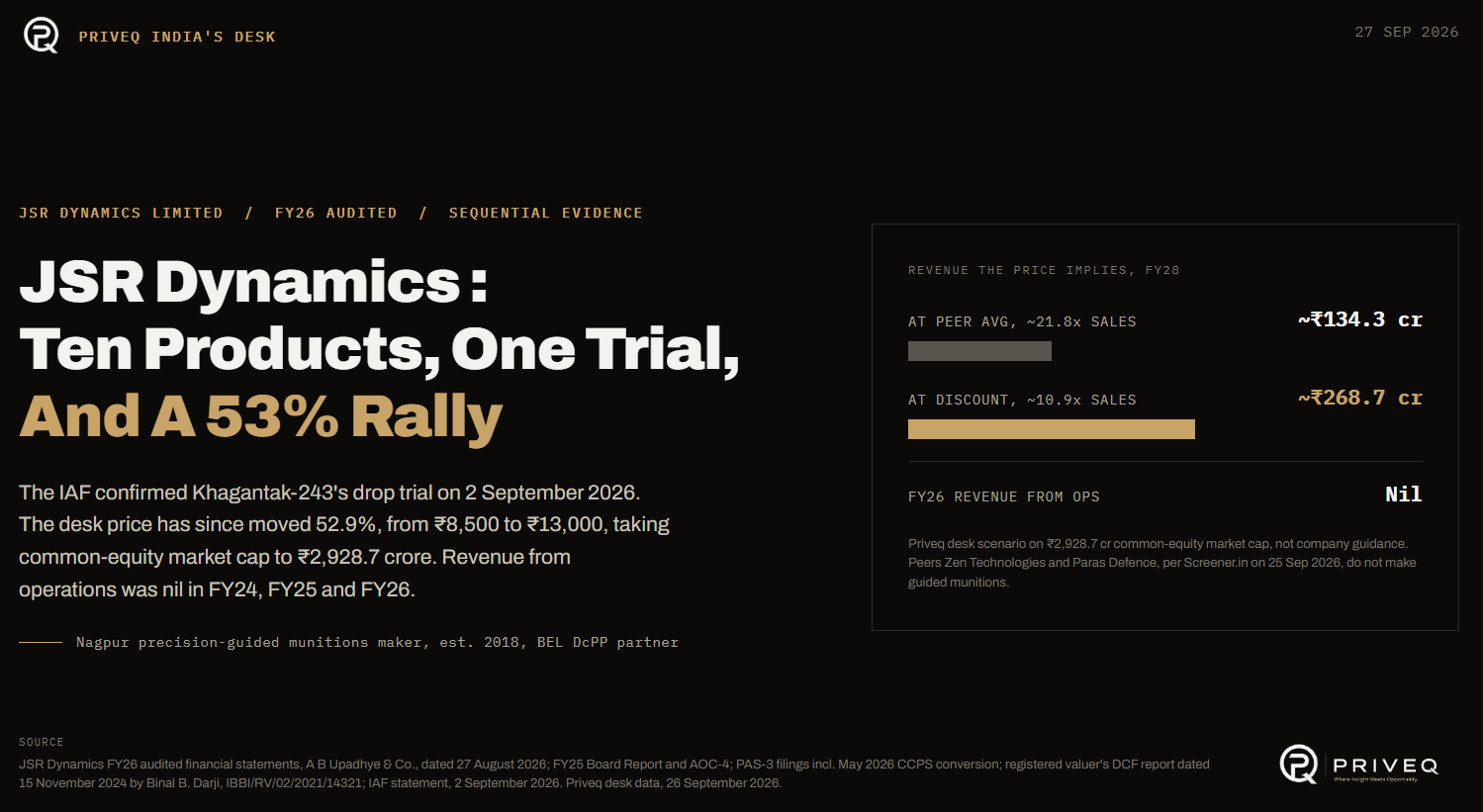
JSR Dynamics' Khagantak-243 long-range glide bomb cleared its Indian Air Force drop trial on September 2, 2026, confirmed directly by the IAF's own statement, validating the 300 kg-class weapon under the February 2025 Bharat Electronics Limited (BEL) - JSR Dynamics production contract. JSR Dynamics' desk price has rallied from Rs. 8,500 on test day to Rs. 13,000 as of September 26, a 52.9% move that lifts its common-equity market cap from roughly Rs. 1,914.9 crore to Rs. 2,928.7 crore in three and a half weeks (the combined value across all its share classes, equity, CCPS, and CRPS together, is a separate, larger Rs. 8,134.3 crore figure, covered later in this note). The range figure nearly every outlet is citing for Khagantak-243, 140 to 180 km, traces to a JSR Dynamics statement from February 2020, not to this week's test or the company's own current spec sheet, which states 120+ km. This note works through what the IAF actually confirmed, what JSR Dynamics' broader ten-product pipeline is worth to the re-rating, what JSR Dynamics' market cap actually is once non-convertible preference shares are excluded, and what the company's own IBBI-valuer DCF already got wrong about FY25.
Event: IAF drop trial, Khagantak-243 Long Range Glide Bomb Date: September 2, 2026 Source: Indian Air Force (@IAF_MCC), official statement Primary Metric Affected: Validates Khagantak-243 under the Feb 2025 BEL-JSR Dynamics DcPP production contract; JSR Dynamics desk price +52.9% since the test (Rs. 8,500 to Rs. 13,000)
Attribute | Priveq Verified Data |
|---|---|
Legal Entity | JSR Dynamics Limited, converted from a private limited company on April 30, 2026; precision-guided munitions |
Desk Price | Rs. 13,000 (Sept 26, 2026), up 52.9% since the Sept 2 IAF trial |
Product Pipeline | 10 product lines; 1 with a confirmed test (Khagantak-243) |
Revenue From Operations | Nil, FY24 through FY26 |
FY26 Result | Net profit of Rs. 2.31 crore (non-operating income only); FY25 was a Rs. 2.18 crore net loss against an Rs. 18.75 crore DCF projection |
Market Cap Basis | Rs. 2,928.7 crore (common equity, headline figure); Rs. 8,134.3 crore (all classes combined, not standard market cap) |
What The IAF Actually Confirmed, And What It Didn't
The Indian Air Force's own statement on Khagantak-243, posted via its official account (@IAF_MCC) on September 2, 2026, reads in full: "Precision. Power. Pride. A significant milestone for the #IAF and Indian Industry. The Indian Air Force successfully conducted the drop of an indigenously designed & developed Long Range Glide Bomb (Khagantak-243). The Trials met all objectives scaling new peaks of lethality through Atmanirbhar Bharat."
That statement is notably thin on specifics. It does not name the test location, the aircraft used, or a range figure. Everything beyond it, Pokhran as the location, the Su-30MKI as the launch platform, is media reporting layered on top of a deliberately spare official line, plausible and consistent across outlets, but not itself IAF-confirmed. JSR Dynamics' own site confirms the Su-30MKI as the LRGB family's integration platform as a design fact, which is a different claim than confirming it was the aircraft used in this specific trial.
What is solidly established: Khagantak-243 is a 300 kg-class stand-off precision glide bomb, meaning it is released well outside the range of enemy air defenses and then glides, unpowered, to its target using guided fins rather than an engine, developed by JSR Dynamics (airframe, control systems) in partnership with Bharat Electronics Limited (electronics, guidance), carrying a Mk 81 general-purpose warhead with roughly 125 kg of explosive fill, under a Development-cum-Production Partner (DcPP) model where BEL holds the IAF's prototype-and-production contract secured at Aero India 2025 (February 2025), with JSR Dynamics as the originating designer.
The Range Number Everyone's Citing Is Six Years Old
Nearly every outlet covering this week's test, Drishti IAS, NewsX, SSBCrack, India Defence Wire among them, states Khagantak-243's range as 140 to 180 km. That number did not come from Tuesday's trial. It traces back to a JSR Dynamics press statement from February 6, 2020, reported by ANI and Business Standard, where the company's Managing Director, Air Marshal (Retd.) S.B. Deo, described an early Khagantak concept: "The missile is an air-launch weapon with a range of 180 km when released from a height of 12 km," with theorized extended variants reaching 297 km. No independent test data backed that 2020 claim at the time.
JSR Dynamics' own current published specification sheet, pulled directly from its site as of this piece's research, states the Long Range Glide Bomb family, which includes the K-243 variant tested this week, achieves 120+ km when released from 12 km at Mach 0.85, a lower and more recent figure than the six-year-old claim still being recycled. One aviation-industry outlet, MiGFlug, independently flagged the same gap, noting the circulating range figures are "brochure or media numbers, not a measured result from this drop." The IAF's own statement disclosed no range figure for this specific test at all.
Source | Range Claim | Date | What It Actually Confirms |
|---|---|---|---|
JSR Dynamics press statement (via ANI) | 180 km (theorized to 297 km on extended variants) | Feb 6, 2020 | An early-concept company claim, six years old, no independent test data |
JSR Dynamics current spec sheet (jsrdynamics.in) | 120+ km | Current (Sept 2026) | The company's own live, published specification for the LRGB family |
Media coverage of Sept 2, 2026 test | 140-180 km (widely repeated) | Sept 2026 | Not sourced to the IAF's statement or JSR Dynamics' current spec sheet |
IAF official statement | Not disclosed | Sept 2, 2026 | Only that the trial met its objectives, no range given |
This does not mean Khagantak-243 underperforms, there is no confirmed measured range from this trial either way. It means the specific number circulating in this week's news cycle is unverified against both the actual test and the company's own current disclosure, and readers treating "140-180 km" as this week's confirmed result are working from a six-year-old marketing line.
JSR Dynamics Is Not A One-Bomb Bet
JSR Dynamics, established in 2018 and based in Nagpur, lists ten product lines on its own site, spanning airborne, ground-launched, and precision-guidance systems. Khagantak-243 is the only one with a confirmed IAF production contract and a confirmed test to date, the rest sit at varying, mostly undisclosed stages of development or trial.
Product | Segment | Confirmed Status (as of Sept 2026) |
|---|---|---|
Khagantak-243 (LRGB family) | Air-launched glide bomb, 300 kg class | IAF production contract (Feb 2025); drop trial cleared (Sept 2026) |
K-1260 / K-720 / K-450 (LRGB family) | Air-launched glide bomb, 540-1,350 kg class | Listed on company spec sheet; no disclosed test or contract |
Jet Powered Bomb (JPB) | Powered glide bomb, 290 km class | Product page live; no disclosed test or contract |
Jet Powered Loitering Munition (JPLM) | Loitering munition | Product page live; no disclosed test or contract |
Long Range Powered Precision Guided Munition (LRP2GM) | 400 kg-class cruise missile | Won Indian Navy Open Challenge 8.0; BEL MOU signed; no disclosed contract yet |
Miniature Ground Launch Decoy (MGLD) | Aerial decoy | Product page live; no disclosed test or contract |
210-260mm Rocket Guidance Kit | Guided rocket kit | Selected under MoD iDEX/ADITI challenge; no disclosed contract |
Guided Mortar, 180mm Tail Control Rocket, Rato Booster Motor, 122mm Guided Rocket | Ground-launched precision munitions | Product pages live; no disclosed test or contract |
Two other product lines carry meaningful jargon worth unpacking for readers outside defense circles. The Jet Powered Loitering Munition (JPLM) is what is commonly called a "kamikaze drone," a weapon that flies to a target area, circles or "loiters" while it identifies a target, and then dives in to destroy it, rather than being aimed and fired once like a conventional missile. The 210-260mm Rocket Guidance Kit is a range-extension kit, a bolt-on guidance and wing package that converts an existing unguided bomb or rocket into a precision-guided, longer-range weapon without needing an entirely new airframe.
Two validations beyond Khagantak-243 are independently confirmed: JSR Dynamics won the Indian Navy's Open Challenge 8.0 with its LRP2GM cruise missile design (per idrw.org), and was selected under the Ministry of Defence's iDEX/ADITI innovation challenge to develop range-extension kits for 250 kg bombs. In May 2026, Boundless Capital took an undisclosed minority stake in the company, amount and post-money valuation not published anywhere we could find, including paid aggregator databases.
Order Book And Contract Pipeline
What JSR Dynamics has actually secured, beyond Khagantak-243 itself, is confirmed directly from the company's own channels:
The IAF production contract for Khagantak-243 under the DcPP model with Bharat Electronics Limited, secured at Aero India 2025 (February 2025)
Winner, Indian Navy Open Challenge 8.0, for the LRP2GM cruise missile
Selected under the Ministry of Defence's iDEX/ADITI 1.0 challenge for 250 kg bomb range-extension kits
An MoU with Yantra India Limited (Nagpur) for development of guided rockets
A second manufacturing facility commissioned in Yelahanka, Bangalore, alongside the Nagpur headquarters, reported consistently by two independent outlets, though not yet named on the company's own site
What we could not confirm, despite checking JSR Dynamics' own site, its media page, both of Bharat Electronics Limited's recent earnings-call transcripts, and multiple news sources, is a rupee value for the order book. Third-party research notes have separately reported an order book of roughly Rs. 1,000 crore (split across the Indian Air Force, Indian Navy, and BEL) and a further Rs. 5,000 crore+ under negotiation, but neither JSR Dynamics nor its named clients have disclosed an order book value anywhere we could trace, including in the original note that first stated the figure. Some coverage of the company's May 2026 funding round also mentions DRDO programmes and ISRO-linked initiatives without further detail.
One distinct, unrelated figure is also worth flagging separately so it doesn't get conflated with the order book: some coverage cites a projection of "over 1,000 units" of Khagantak-243 eventually entering IAF service, a unit count, not a rupee value, and one that traces to the same 2021-2022 production timeline already identified elsewhere in this note's research as unreliable.
Net read : The confirmed pipeline, an IAF production contract, a Navy design win, an MoD innovation-program selection, and a named industry MoU, is real and independently verifiable. The rupee figures attached to it in wider circulation are not, and shouldn't be read as more solid than the underlying primary record supports.
The Market Has Repriced It By More Than Half Since The Test
JSR Dynamics Limited carries paid-up share capital of Rs. 6,25,71,350 against a Rs. 10 face value, per its Ministry of Corporate Affairs filing, implying 62,57,135 shares outstanding. The company converted from a private limited company to a public limited company on April 30, 2026, per its own FY26 audited financial statements; its CIN as a private company was U29113MH2018PTC318834, Priveq has not independently verified the post-conversion CIN.
Sept 2, 2026 (test day) | Sept 21, 2026 | Sept 26, 2026 (today) | Change since test | |
|---|---|---|---|---|
Desk price | Rs. 8,500 | Rs. 11,100 | Rs. 13,000 | +52.9% |
Common-equity market cap | ~Rs. 1,914.9 crore | ~Rs. 2,500.7 crore | ~Rs. 2,928.7 crore | +~Rs. 1,013.8 crore |
All classes combined (equity + CCPS + CRPS) | ~Rs. 5,318.6 crore | ~Rs. 6,945.4 crore | ~Rs. 8,134.3 crore | +~Rs. 2,815.7 crore |
Shares outstanding: 22,52,877 common equity (including CCPS converted May 2026); 62,57,135 across all classes combined. Market cap is a Priveq-derived figure, not company-disclosed; see Table 6 for the full capital-structure reconciliation.
Market cap here is a derived figure (Priveq calculation from MCA-filed paid-up capital and the desk price), not a company-disclosed number. The common-equity row is the one this note treats as JSR Dynamics' actual market cap; the second row exists because some secondary-market platforms quote the larger, all-classes figure instead, folding in a non-convertible preference-share block that carries no equity upside (see the next section for why). On a common-equity basis, JSR Dynamics has added roughly Rs. 1,013.8 crore in market cap in three and a half weeks since the test, more than half its pre-test value again.
What The Market Cap Actually Represents : Equity, CCPS, And CRPS
JSR Dynamics has raised capital across three separate security classes, common equity, Compulsorily Convertible Preference Shares (CCPS), and Cumulative Redeemable Preference Shares (CRPS), and only the first two participate in common-equity upside the way a desk price implies. CRPS is confirmed, via the company's own FY25 XBRL-tagged regulatory filing, as a fixed-return, redeemable instrument, meaning it carries no conversion right into equity and no claim on future upside beyond its stated redemption terms. Lumping it into a share count and multiplying by the desk price overstates what common equity is actually worth, which is why this note treats the equity-only figure, not the combined total across all 62,57,135 shares, as JSR Dynamics' market cap.
How the CCPS itself has been priced over time :
CCPS Priced Over Time, Valuation Round To Today's Desk Price
Milestone | Date | Price Per Share | Change From CCPS Round |
|---|---|---|---|
CCPS allotment (IBBI-valuer DCF fair value) | Jan-Feb 2025 round (valuation dated Nov 15, 2024) | Rs. 6,513.70 | Baseline |
Desk price, test day | Sept 2, 2026 | Rs. 8,500 | +30.5% |
Desk price, post-test | Sept 21, 2026 | Rs. 11,100 | +70.4% |
Desk price, today | Sept 26, 2026 | Rs. 13,000 | +99.6% (~2.0x) |
A large share of the CCPS class converted into ordinary equity on May 13, 2026, per JSR Dynamics' own PAS-3 return of allotment: 2,52,477 of the company's 2,56,735 outstanding CCPS converted to equity at face value, ranking pari-passu with existing equity shares, leaving 4,258 CCPS still unconverted. That single filing added 405 new direct equity allottees in one stroke, and combined with equity already transferred on the secondary market outside that filing, Priveq's own count of the resulting shareholder base runs to roughly 409 holders, above the 200-holder ceiling Section 2(68) of the Companies Act sets for a private company. JSR Dynamics did in fact convert from a private limited company to a public limited company shortly after, the Registrar of Companies issued a fresh Certificate of Incorporation on April 30, 2026, per the company's own FY26 audited financial statements.
Reconciling the full capital structure, and what each slice is worth at today's desk price :
JSR Dynamics' Capital Structure, And What Each Slice Is Worth
Security Class | Shares Outstanding | Source | Value At Rs. 13,000 |
|---|---|---|---|
Equity (including converted CCPS) | 22,52,877 | PAS-3 filings (2021, 2022, 2025) + May 2026 conversion | Rs. 2,928.7 crore |
CRPS (non-convertible, redeemable) | 40,00,000 | FY25 AOC-4, XBRL-tagged shareholding disclosure | Rs. 5,200.0 crore |
CCPS (unconverted) | 4,258 | May 2026 PAS-3, balance after conversion | Rs. 5.5 crore |
Total (all classes combined) | 62,57,135 | Ties to FY25 AOC-4 balance sheet aggregate | Rs. 8,134.3 crore |
This note uses the top row, Rs. 2,928.7 crore common equity, as JSR Dynamics' headline market cap throughout. Some secondary-market platforms quote figures in the broader Rs. 5,600-8,100 crore range instead, consistent with treating the full share count, common equity and preference shares together, as one undifferentiated total rather than separating what actually carries equity upside.
Read strictly as common equity, including the CCPS that converted in May 2026, JSR Dynamics' market cap is roughly Rs. 2,928.7 crore. That is the figure this note uses as its headline throughout. Add the non-convertible CRPS block back in and it becomes roughly Rs. 8,128.7 crore; add the small unconverted CCPS balance and it reaches the full Rs. 8,134.3 crore, the combined value across all 62,57,135 shares of every class, consistent with the share count JSR Dynamics' own MCA filings support and with how some secondary-market platforms appear to quote the stock instead of separating equity from preference capital.
Net read : JSR Dynamics' actual common-equity market cap is Rs. 2,928.7 crore, not the larger Rs. 8,134.3 crore combined figure that lumps in a non-convertible preference instrument with fixed redemption terms and no equity upside. Some secondary-market platforms quote the larger, undifferentiated number; this note doesn't, and that distinction is worth carrying into every other number in this piece that touches market cap.
Is JSR Dynamics' Rs. 6,514 Valuation Realistic? What The DCF Actually Projected
JSR Dynamics' CCPS was priced at Rs. 6,513.70 per share in a Discounted Cash Flow (DCF) valuation using the Maintainable Profit Method, prepared by an IBBI Registered Valuer (Binal B. Darji, IBBI/RV/02/2021/14321) and dated November 15, 2024. A DCF values a company today by projecting its future free cash flows, discounting them back to the present at a rate reflecting the company's risk, and then adjusting for cash on hand, illiquidity, and any fresh capital being raised alongside the valuation. Today's Rs. 13,000 desk price is therefore not an isolated number, it can be measured directly against what that same valuer projected less than two years ago.
In one line : Rs. 13,000 divided by Rs. 6,513.70 is 1.996x, essentially double the DCF's fair value, in about 22 months, of which only three and a half weeks followed the IAF trial.
The DCF's five-year projection, in full :
Rs. Lakhs Unless Noted | FY25 | FY26 | FY27 | FY28 | FY29 | Perpetuity |
|---|---|---|---|---|---|---|
Profit After Tax (PAT) | 1,875 | 31,129 | 57,325 | 74,742 | 79,647 | - |
Free Cash Flow (FCF) | 20,370 | 860 | 22,805 | 63,542 | 60,014 | 2,29,963 |
Discounted Cash Flow | 19,501 | 691 | 14,121 | 30,294 | 22,030 | 84,413 |
Bridge To Equity Value | Rs. Lakhs |
|---|---|
Sum of Discounted Cash Flows | 1,71,050 |
Add : Cash And Cash Equivalents | (645) |
Less: Discount For Lack Of Control And Marketability (10%) | (17,105) |
Post-Money Equity Value | 1,53,300 |
Less: Fresh Fund Raise Alongside Valuation | (23,000) |
Pre-Money Equity Value | 1,30,300 |
Number Of Shares | 20,00,400 |
Equity Value Per Share | Rs. 6,513.70 |
Source: IBBI Registered Valuer's DCF report (Maintainable Profit Method), Binal B. Darji, IBBI/RV/02/2021/14321, dated November 15, 2024.
JSR Dynamics FY25 And FY26 Profit: Valuer's Projections vs. Actual Results. Two of the DCF's five projected years, FY25 and FY26, are now closed, audited years, which means both can be checked rather than debated. For FY25, the valuer projected Rs. 18.75 crore in profit after tax; the company's actual, audited result was a net loss of Rs. 2.18 crore, a shortfall of Rs. 20.93 crore. For FY26, the valuer projected a much larger Rs. 311.29 crore in profit after tax, implying Khagantak-243 production would have scaled sharply by the second year of the forecast; the company's actual, audited FY26 result was a Rs. 2.31 crore profit built entirely on a government grant, a forex gain, and interest income, not sales, a shortfall of Rs. 308.98 crore against that projection. Across the two years of the forecast that can now be checked, the DCF projected a cumulative Rs. 330.04 crore in profit; the company has actually made about Rs. 0.13 crore combined, roughly 0.04% of what was projected, in the first two years of the five-year projection the Rs. 6,513.70 fair value depends on.
Year | Valuer's Projection (Nov 2024 Report) | Actual Result (Audited) | Gap |
|---|---|---|---|
FY25 | Rs. 18.75 crore (profit) | Rs. 2.18 crore (net loss) | Rs. 20.93 crore shortfall |
FY26 | Rs. 311.29 crore (profit) | Rs. 2.31 crore (profit, non-operating income only) | Rs. 308.98 crore shortfall |
Two-year cumulative | Rs. 330.04 crore | Rs. 0.13 crore | Rs. 329.91 crore shortfall |
This does not mean the DCF's remaining years (FY27 through FY29) are wrong, they depend on Khagantak-243 production actually ramping under the BEL contract, and the IAF drop trial that would validate that ramp hadn't happened yet when this report was written in November 2024. But two consecutive years missed this badly, the second by a wider absolute margin than the first, is a reason to treat the remaining three years of projected profit as exactly that, a projection, and not as a number the valuation's Rs. 6,513.70 fair value, or today's near-doubling of it, should be read as having already confirmed.
Peer Multiples: Sector Backdrop, Not A JSR Dynamics Valuation Proof. The peer comparison later in this note (Zen Technologies, Paras Defence) is useful context for what growth-stage Indian defense-tech names currently trade at, but it cannot independently confirm JSR Dynamics' own fair value. For any single company, Price/Sales is mathematically identical to PAT Margin multiplied by P/E, so running a peer's margin and P/E back through a revenue estimate to "check" a market cap figure will tend to reproduce that same market cap by construction, not validate it. We use the peer figures below only to show what the market currently pays for growth conviction in this sector, not as independent proof that JSR Dynamics' own price is fair.
Net read : The DCF gives JSR Dynamics a documented, professionally valued starting point, and today's price is a clean, checkable multiple of it. But the two years of that projection we can already check against audited results have both missed by a wide margin, on the profit line the entire valuation is built on, and the more recent miss is larger in absolute terms than the first. That is a materially different risk picture than "the valuer said Rs. 6,514 and the market says Rs. 13,000," and worth weighing before treating either number as settled.
JSR Dynamics' FY24-FY26 Financials : What The Company's Own Filings Show
JSR Dynamics has recorded no revenue from operations in FY24, FY25, or FY26, its three most recently closed and audited years. The Rs. 1.08 crore and Rs. 3.65 crore the company reported as "Total Revenue" in FY24 and FY25 was entirely interest income, per its own FY25 Board Report, which notes: "Sales operations to begin soon... Revenue mainly came from interest income due to delayed product deliveries." FY26 doesn't break that pattern, its own audited accounting policy note states plainly: "The company has not yet commenced sales; hence, no revenue has been recognized." What changed in FY26 is the bottom line, not the top line: the company swung to a Rs. 2.31 crore net profit, its first profit in three years, but it came entirely from a Rs. 5.15 crore government grant, a Rs. 0.94 crore foreign-exchange gain, and Rs. 1.62 crore of fixed-deposit interest, not from product sales. That's consistent with an early-stage defense manufacturer still moving through the development-to-production cycle rather than one already monetizing its pipeline, the same forward-bet framing the desk price already reflects.
The full picture, cross-checked against the company's FY25 AOC-4 balance sheet and its FY26 audited financial statements:
Total Revenue (all non-operating): Rs. 7.72 crore (FY26), Rs. 3.65 crore (FY25), Rs. 1.08 crore (FY24)
Profit/(Loss) Before Tax: a profit of Rs. 1.98 crore (FY26), a loss of Rs. 1.97 crore (FY25), a profit of Rs. 8.20 lakh (FY24)
Net Profit/(Loss) After Tax: a profit of Rs. 2.31 crore (FY26), a loss of Rs. 2.18 crore (FY25), a profit of Rs. 6.40 lakh (FY24)
Total Assets: Rs. 268.98 crore (FY26), Rs. 237.98 crore (FY25), Rs. 173.58 crore (FY24)
Total Shareholders' Funds: Rs. 131.34 crore (FY26), Rs. 129.03 crore (FY25), Rs. 4.87 crore (FY24); the FY25 jump was driven by the Jan-Feb 2025 CCPS capital raise, not by operations, while FY26's smaller increase reflects the year's profit alone, no new capital was raised in FY26
Particulars | FY26 (Year Ended Mar 31, 2026) | FY25 (Year Ended Mar 31, 2025) | FY24 (Year Ended Mar 31, 2024) |
|---|---|---|---|
Revenue From Operations | Nil | Nil | Nil |
Total Revenue (Non-Operating Only) | Rs. 7.72 crore | Rs. 3.65 crore | Rs. 1.08 crore |
Profit/(Loss) Before Tax | Rs. 1.98 crore | (Rs. 1.97 crore) | Rs. 8.20 lakh |
Net Profit/(Loss) After Tax | Rs. 2.31 crore | (Rs. 2.18 crore) | Rs. 6.40 lakh |
Earnings Per Share, Basic & Diluted | Rs. 11.54 | (Rs. 10.90) | Rs. 0.11 |
Total Assets | Rs. 268.98 crore | Rs. 237.98 crore | Rs. 173.58 crore |
Total Shareholders' Funds | Rs. 131.34 crore | Rs. 129.03 crore | Rs. 4.87 crore |
Source: JSR Dynamics' FY25 Board Report, FY25 AOC-4 filing (Ministry of Corporate Affairs), and FY26 audited financial statements (A B Upadhye & Co., Chartered Accountants, dated August 27, 2026). Figures in brackets denote losses. The FY25 shareholders' funds increase reflects the Jan-Feb 2025 CCPS capital raise, not operating performance; FY26's smaller increase reflects that year's profit alone, no new capital was raised. FY26's profit came entirely from a government grant, a foreign-exchange gain, and interest income, not from product sales.
What today's Rs. 2,928.7 crore common-equity market cap, and the DCF's own Rs. 6,513.70 fair value before it, were never priced against anything the company has actually sold, only against what it's expected to sell. FY25's net loss of Rs. 2.18 crore and FY26's Rs. 2.31 crore profit, against the valuer's own Rs. 18.75 crore and Rs. 311.29 crore profit projections for those same two years (see above), are the clearest signal so far of how much execution risk that forward bet still carries, the two years combined have missed the projection by roughly Rs. 330 crore, and FY26's return to profit doesn't soften that reading since it came from a grant, a forex gain, and interest income, not from Khagantak-243 deliveries.
One correction worth making here: the company's own Board Report names its actual export-engagement countries as UAE, Serbia, and Saudi Arabia, with advanced negotiations specifically in Armenia for glide bombs and aircraft integration. That doesn't match the Egypt/UAE/Armenia/Philippines list circulating in third-party coverage, only UAE and Armenia overlap, and this primary-sourced list supersedes that claim.
What This Mcap Is Pricing In : A Forward Revenue Read
JSR Dynamics has no disclosed revenue from operations of any real size through FY24, FY25, or FY26, and its most recent audited year, FY26, was profitable only on paper, a grant, a forex gain, and interest income, not sales (see the DCF section above). So Rs. 2,928.7 crore isn't being priced against a trailing multiple, there is effectively no trailing multiple to price against. It's a forward bet, and the cleanest way to size it is to ask what revenue base the current price would imply if JSR Dynamics eventually traded at a multiple similar to its closest listed peers, treated strictly as sector backdrop, not as proof of fair value (see the "Peer Multiples" note above for why a profit-based cross-check against these same peers would be circular).
To size that, we looked at two listed Indian defense-tech peers trading on growth conviction rather than settled fundamentals, Zen Technologies (training simulators, counter-drone systems) and Paras Defence (aerospace and defense electronics). Neither makes precision-guided munitions like JSR Dynamics, so this is not a clean multiple, flagged explicitly, but both are useful anchors for what the market currently pays for high-growth conviction in Indian defense-tech broadly, on figures verified directly against Screener.in as of September 25, 2026 :
Company | Market Cap | TTM Revenue | TTM PAT (Disclosed) | PAT Margin | P/E | Price/Sales |
|---|---|---|---|---|---|---|
Zen Technologies | Rs. 15,190 crore | Rs. 671 crore | Rs. 197 crore | ~29.4% | 83.6x | ~22.6x |
Paras Defence | Rs. 10,670 crore | Rs. 511 crore | Rs. 96 crore | ~18.8% | 115.0x | ~20.9x |
Revenue lens, a Priveq desk scenario, not company guidance or a forecast. If JSR Dynamics were to eventually command a similar ~21.8x average forward sales multiple, once Khagantak-243 production has scaled and it has real revenue to point to, today's Rs. 2,928.7 crore common-equity market cap alone implies the market is underwriting an eventual annual revenue base of roughly Rs. 134.3 crore. Using a more conservative, early-stage discount to that multiple (roughly half, given JSR Dynamics is unlisted, illiquid, and has exactly one confirmed production contract against these peers' diversified, multi-year order books), the implied revenue ask rises to roughly Rs. 268.7 crore.
The single assumption doing the most work here is the horizon: we're framing this as a bet on FY28 annual revenue, roughly two to three years out, long enough for Khagantak-243 deliveries to actually ramp and for at least one more variant (the LRP2GM cruise missile, already Navy-validated, is the nearest candidate) to move from validation toward a disclosed contract. If that timeline stretches, or if none of the other nine product lines convert into contracts, the same Rs. 2,928.7 crore looks considerably more expensive against a narrower, Khagantak-243-only revenue base, and the DCF's own missed FY25 and FY26 base years (above), missed by a combined roughly Rs. 330 crore, is a reason to weigh that downside case seriously rather than default to the optimistic one.
Management
JSR Dynamics' leadership, per the company's own site:
Air Marshal Shirish Baban Deo (Retd), Chairman & Managing Director. PVSM, AVSM, VM, VSM; commissioned into the IAF fighter stream in 1979, over 4,000 hours of operational and training flying. Held senior command roles including Commanding Officer of the first Aerostat Unit and Air Officer Commanding-in-Chief of both Eastern and Western Air Command, retiring as Vice Chief of the Air Staff on September 30, 2018. Founded JSR Dynamics immediately after retirement.
Mrs. Anjna Deo, Director. Holds a Flying Certificate; 10 years in education; former President of the Air Force Wives Welfare Association (AFWWA).
Mr. Prafulla Kale, Director. Chairman, Jaika Group; Managing Director, Jaika Motors, leading the automobile business since 1973. One of four holders of JSR Dynamics' entire Cumulative Redeemable Preference Share (CRPS) block, per the company's FY25 regulatory filing.
Mr. Gautam Kale, Director. Managing Director, Ketan Motors; Joint MD, Jaika Insurance Brokerage; oversees Hyundai and Audi dealerships in Nagpur. Also a CRPS holder, alongside Mr. Prafulla Kale.
Mr. Dhananjay Vartak, Director. Director across multiple Hermes Group companies and Vanmali Enterprises Pvt. Ltd.
Mr. Sanjay Mitra, Director. Former IAS officer; served as Defence Secretary of India, Secretary of the Ministry of Road Transport & Highways, and Chief Secretary of West Bengal.
Mr. Shailesh Joglekar, Director. Chairman, Bhonsala Military School, Nagpur; CEO, National Cancer Institute.
Air Chief Marshal Pradeep Vasant Naik (Retd), Director. PVSM, VSM; former Chief of the Air Staff; 40 years of service including Air Officer Commanding-in-Chief, Central Air Command, and Vice Chief of the Air Staff.
Lt. Gen. D.B. Shekatkar (Retd), Director. PVSM, AVSM, VSM; 40 years in the Indian Army including the 1965 and 1971 wars and Kargil; chaired the Shekatkar Committee on defense reforms.
Dr. Vijay Chauthaiwale, Director. Pharmaceutical R&D professional, former Vice President (Discovery Research) at Torrent Pharmaceuticals; has headed the BJP's Foreign Affairs Department since 2014.
Net read : The board pairs the founder's own three-decade IAF career with a former Defence Secretary and a former Chief of the Air Staff, alongside the Kale family's automobile-business capital, which also happens to be the company's CRPS financing. That's a real access-and-execution credibility signal, distinct from, and not a substitute for, the unconfirmed order book figures covered above.
The Desk View
1. The breadth is real. This is genuinely not just "Khagantak-243 passed a test." A Nagpur-based, 2018-founded private defense manufacturer has, inside eighteen months, landed an IAF production contract, cleared its first flight test, won a Navy innovation challenge with a second product line, been selected under a MoD innovation program for a third, and attracted institutional capital from Boundless Capital, four independent validations across four different channels, not one. That's a genuinely stronger foundation than a single-product bet, and exactly what a market pricing pure optionality should reward.
2. The price is running ahead of anything the company has actually sold. JSR Dynamics has recorded zero revenue from operations in any of its last three audited years, FY24 through FY26, including the year it turned a paper profit. The Rs. 2,928.7 crore common-equity market cap, and the +52.9% move since the test, are both pricing what happens next, not what has already happened.
3. This is already the equity-only number, don't mistake it for total capital raised. Rs. 2,928.7 crore is common equity, including the CCPS that converted in May 2026, with the company's non-convertible CRPS block deliberately excluded, since it carries no equity upside. If you instead see JSR Dynamics quoted at a figure north of Rs. 5,600-8,100 crore elsewhere, that's the larger, all-classes-combined total (Rs. 8,134.3 crore here), not a bigger market cap, just a different, less standard way of counting.
4. The company's own DCF has now missed two consecutive years, and the second miss is bigger. The valuation underpinning JSR Dynamics' earlier CCPS round projected an Rs. 18.75 crore FY25 profit; the actual result was a Rs. 2.18 crore loss, a Rs. 20.93 crore miss. It then projected a much larger Rs. 311.29 crore FY26 profit; the actual result was a Rs. 2.31 crore profit built on a government grant, a forex gain, and interest, not sales, a Rs. 308.98 crore miss. Two years into a five-year forecast, the DCF projected roughly Rs. 330 crore cumulative profit; the company has made about Rs. 0.13 crore. Today's price is already running at roughly twice that valuer's fair value regardless.
None of this changes the breadth of the underlying story, four independent validations is a genuinely stronger base than a single-product bet. But it does mean the case for today's price rests more on execution across the next three fiscal years than on anything already confirmed, and the range-figure confusion covered above is a reminder that a lot of what's circulating about this company right now is recycled and unverified rather than freshly confirmed, worth knowing before anchoring on any specific number you read elsewhere this week.
FAQs
Did JSR Dynamics' Khagantak-243 pass its Indian Air Force test?
Yes, the IAF confirmed on September 2, 2026 that the Khagantak-243 drop trial met all its objectives. The IAF's own statement did not disclose the test location, aircraft, or achieved range, details widely reported elsewhere but not officially confirmed.
Is the widely reported 140-180 km range for Khagantak-243 confirmed?
No, that figure traces to a JSR Dynamics statement from February 2020, not to this week's test. The company's current published spec sheet states 120+ km, and neither the IAF nor JSR Dynamics has disclosed a measured range from the actual September 2026 trial.
Should I be concerned that JSR Dynamics' market cap has no disclosed revenue behind it?
JSR Dynamics has disclosed no revenue from operations in any audited year through FY26. Its most recent audited result, FY26, was a Rs. 2.31 crore profit, but that came entirely from a government grant, a forex gain, and interest income, not product sales; FY25 was a net loss. The current price reflects a forward bet on future contract execution, and the IBBI valuer's own profit projections have already missed both checkable years, FY25 and FY26, by a combined roughly Rs. 330 crore, worth reading before treating today's price move as backed by anything already confirmed.
What is the Development-cum-Production Partner (DcPP) model?
DcPP is a defense procurement structure pairing a private innovator with a larger public-sector production partner. Here, JSR Dynamics designs the system while Bharat Electronics Limited holds the government production contract and handles manufacturing scale-up and delivery.
How does JSR Dynamics' valuation compare to listed defense-tech peers like Zen Technologies?
JSR Dynamics has no comparable trailing revenue yet, so a direct multiple comparison isn't meaningful today. Zen Technologies and Paras Defence, both listed, trade at roughly 21-23 times trailing sales, useful context for what the market pays for growth conviction in this space, but JSR Dynamics' current price is better read as a forward bet on FY28 revenue than a like-for-like comparison.
Is JSR Dynamics' Rs. 8,134 crore market cap all common equity?
Common equity only. This note's headline market cap, Rs. 2,928.7 crore, counts common equity plus the CCPS that converted into equity in May 2026, and deliberately excludes the company's non-convertible Cumulative Redeemable Preference Share (CRPS) block, which carries no equity upside. Counting every share class together instead, equity, CCPS, and CRPS, produces a larger, less standard Rs. 8,134.3 crore figure, which is closer to what some secondary-market platforms quote.
Did JSR Dynamics meet the profit its own DCF valuation projected for FY25 and FY26?
No, in either year. The IBBI Registered Valuer's November 2024 DCF report projected Rs. 18.75 crore in FY25 profit and Rs. 311.29 crore in FY26 profit. The actual, audited results were a Rs. 2.18 crore net loss (FY25) and a Rs. 2.31 crore profit built entirely on non-operating income (FY26), a combined shortfall of roughly Rs. 330 crore against the two years of the five-year forecast that can now be checked.
Does JSR Dynamics have any revenue from operations?
No. JSR Dynamics recorded no revenue from operations in FY24, FY25, or FY26. The Rs. 1.08 crore, Rs. 3.65 crore, and Rs. 7.72 crore reported as "Total Revenue" in those years was entirely non-operating income, mostly interest, plus a government grant and a forex gain in FY26, not product sales.
Who runs JSR Dynamics?
JSR Dynamics is led by Air Marshal Shirish Baban Deo (Retd), former Vice Chief of the Air Staff, who founded the company after his 2018 retirement. Its board also includes a former Defence Secretary of India and a former Chief of the Air Staff, alongside the Kale family, which also holds the company's CRPS preference capital.
What is JSR Dynamics' order book worth?
Unconfirmed. Third-party research notes report an order book of roughly Rs. 1,000 crore and a further Rs. 5,000 crore+ under negotiation, but neither JSR Dynamics nor its named clients have disclosed an order book value, and this note could not trace the figure to any priarym source.
How many products has JSR Dynamics successfully tested?
While JSR Dynamics markets a pipeline of approximately ten indigenous standoff and precision-guided weapon systems, primary operational disclosures confirm that only one product has advanced through active field or firing trials to date.
What are the primary risks of investing in JSR Dynamics pre-IPO shares?
The primary risk is developmental and procurement overhang : Defence capital equipment in India requires multi-stage Field Evaluation Trials (FET) and Staff Qualitative Requirements (SQRs) approval before translating into binding Ministry of Defence production orders.
Why did JSR Dynamics unlisted share price rally?
JSR Dynamics unlisted shares gained 53% driven by retail and HNI appetite for private defence manufacturers and the marketing of a 10-product precision munitions portfolio, despite commercial execution remaining tied to early-stage trial clearances.
What We Can And Cannot Stand Behind
Primary-sourced and verified:
The September 2, 2026 IAF statement confirming the Khagantak-243 drop trial met its objectives (IAF's own account)
JSR Dynamics' and BEL's roles in developing Khagantak-243, and the February 2025 IAF production contract (Jane's, corroborated by Wikipedia and multiple outlets)
JSR Dynamics' current published range specification of 120+ km for the LRGB family (company's own site)
JSR Dynamics' paid-up share capital and implied share count (MCA filing via ZaubaCorp)
JSR Dynamics' win in the Indian Navy's Open Challenge 8.0, its iDEX/ADITI selection, and its MoU with Yantra India Limited (idrw.org, company's own Media page)
JSR Dynamics' capital structure across equity, CCPS, and CRPS, including the May 2026 CCPS-to-equity conversion (PAS-3 filings, 2021/2022/2025, and FY25 AOC-4 XBRL-tagged shareholding disclosure)
The IBBI Registered Valuer's DCF report, its FY25-FY29 projections, and the Rs. 6,513.70 equity value per share (valuation report annexure)
JSR Dynamics' actual audited results for FY24 through FY26, including nil revenue from operations in every year and FY26's swing to a Rs. 2.31 crore profit built on non-operating income, not sales (company's own FY25 Board Report, FY25 AOC-4 filing, and FY26 audited financial statements, A B Upadhye & Co., dated August 27, 2026)
JSR Dynamics' conversion from a private limited company to a public limited company, effective April 30, 2026 (company's own FY26 audited financial statements)
Zen Technologies' and Paras Defence's current market cap, revenue, PAT, and P/E (Screener.in, verified September 25, 2026)
JSR Dynamics' full board and leadership team (company's own site)
JSR Dynamics' own stated export-engagement countries, UAE, Serbia, and Saudi Arabia, with advanced negotiations in Armenia (company's own FY25 Board Report)
Partially or indirectly corroborated:
The test location (Pokhran) and launch aircraft (Su-30MKI), reported consistently across multiple outlets but not stated in the IAF's own official post
The Boundless Capital investment (confirmed by multiple outlets and Dealroom, but amount and valuation undisclosed anywhere we could find)
Priveq's estimate of roughly 409 total shareholders following the May 2026 CCPS conversion, built from the 405 direct allottees in that filing plus known secondary transfers, not from a single consolidated shareholder register we independently verified in full
The second manufacturing facility in Yelahanka, Bangalore, reported consistently by two independent outlets, not yet named on the company's own site
Could not be confirmed:
Any measured range figure from the actual September 2, 2026 test; the 140-180 km figure being widely cited is not sourced to this trial
Order book value for JSR Dynamics for FY26 (total revenue and profit for FY26 are now known, from the company's own audited financial statements, see above)
The forward revenue range (Rs. 134.3-268.7 crore), explicitly a Priveq desk scenario built on peer sales multiples and an assumed FY28 horizon, not a company projection or an independently confirmed target
The widely-cited Rs. 1,000 crore order book and Rs. 5,000 crore+ pipeline, and reported DRDO/ISRO-linked involvement, traced to third-party research notes with no attribution to any primary source we could locate, including in the note that first stated them
Ready to look closer at JSR Dynamics?
Explore JSR Dynamics on Priveq.
Have a question about this note, or want to flag something we should verify further? Reach out to us on : +918287466698 or support@priveq.in
Disclaimer
This note is for informational purposes only and does not constitute investment advice, a recommendation, or an offer to buy or sell any security. Unlisted shares carry liquidity, valuation, and information-availability risks distinct from listed securities. Figures marked as derived or scenario-based are Priveq's own calculations, not company disclosures or guidance. Please conduct independent due diligence and consult a qualified financial advisor before making any investment decision.