

For nearly a decade, the argument against owning NSE India Limited in the unlisted market was simple. You were paying for a listing that never came.
That argument is finished. SEBI issued its no-objection certificate on 30 January 2026. The governing board approved the offer on 6 February. The Delhi High Court dismissed a challenge to the NOC on 16 February. NSE filed its draft red herring prospectus on 17 June 2026, and global investor roadshows followed.
So the old question is dead and a harder one replaces it. With the listing now a matter of months rather than years, the unlisted price should be converging on whatever NSE actually lists at. The only thing worth working out is whether it has converged, stopped short, or gone past.
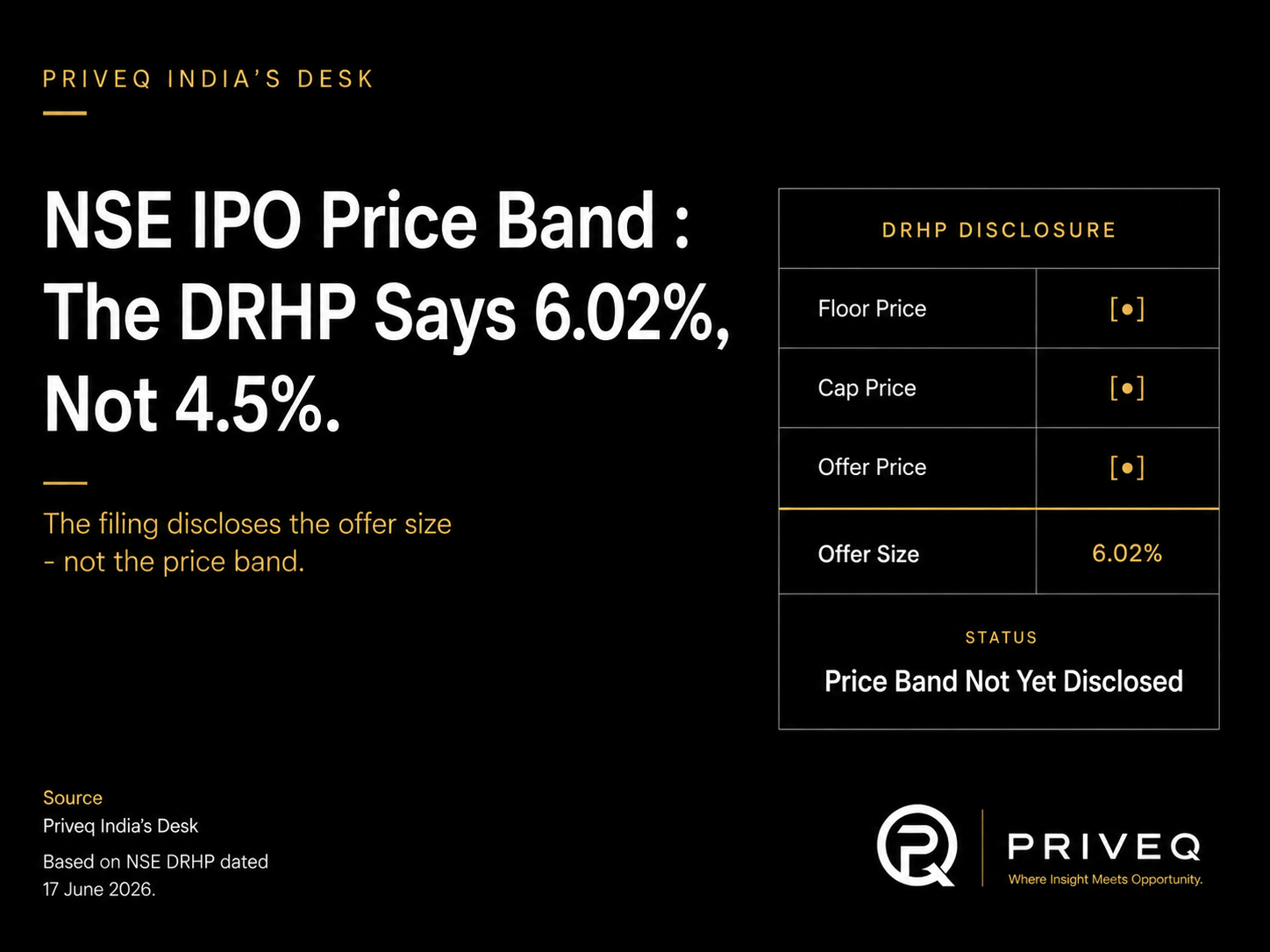
The DRHP gives us almost everything needed to answer that. It gives the share count, three years of restated earnings, the book value, the peer the company itself selected, the exact size of the offer, and the lock-in structure. It does not give a price. Floor, cap and offer price all appear as [●], to be set later.
Which means the band has to be built, not quoted. Below is that work.
The question that actually matters now
Three things decide where NSE lists: what it earns, what multiple that earns, and how much stock hits the market. The DRHP answers the first and third precisely. The second is judgement, and that is where the disagreement lives.
What the DRHP settles, and what it leaves blank
Settled, from the filing:
Equity shares outstanding: 2,475,000,000, face value ₹1 each
Offer: up to 148,905,525 equity shares, pure offer for sale, no fresh issue
The company receives nothing. All proceeds go to selling shareholders
FY26 basic and diluted EPS: ₹41.62. FY25: ₹49.24. FY24: ₹33.56
Net asset value per share as at 31 March 2026: ₹129.75
Revenue from operations FY26: ₹16,601 crore. Total income: ₹18,713 crore
Profit for the year FY26: ₹10,302 crore
Return on net worth FY26: 33.21%. FY25: 45.14%. FY24: 37.60%
The company has no identifiable promoter
Listing venue : BSE, since an exchange cannot list on its own platform
Left blank, from the same filing :
Floor price:
[●]Cap price:
[●]Offer price:
[●]The total size of the offer in rupees, which cannot be computed until the above are set
All three prices are to be determined by the company in consultation with the book running lead managers, through the book building process, once SEBI issues its observations.
Which means every rupee figure circulating in the market today is somebody's back-solve from the share numbers.
Correction : the offer is bigger than reported
Much of the coverage through early 2026 described a dilution of 4% to 4.5%. The DRHP does not support that.
148,905,525 shares against 2,475,000,000 outstanding is 6.02% of the company.
That is not a rounding difference. On any given price, it is roughly a third more stock coming to market than the earlier reporting implied. Anyone still modelling a 4.5% offer is modelling the wrong supply.
The number nobody leads with: FY26 went backwards
Here is the finding that sits in the filing and almost nowhere in the coverage.
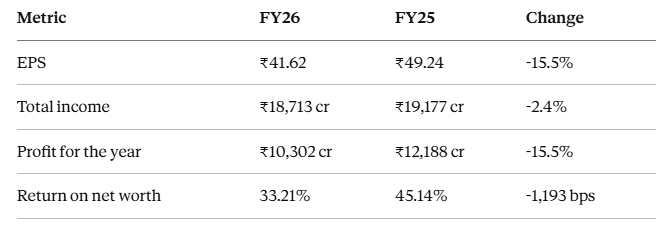
The fair objection is that FY26 carried one-time items: the SEBI settlement and an additional contribution to the core settlement guarantee fund. Both are non-recurring by definition.
So test it against the company's own normalised figures, which strip exactly those out:
Normalised operating EBITDA: ₹12,656 crore in FY26 against ₹13,317 crore in FY25, down 5.0%
Normalised profit before tax: ₹14,121 crore against ₹14,914 crore, down 5.3%
Normalised operating EBITDA margin: 76.23% against 77.69%, down 146 basis points
One-offs explain roughly two thirds of the reported fall. They do not explain all of it. Underlying earnings still declined about 5%, and margins compressed.
For context, the two-year EPS growth rate from FY24 to FY26 is 11.4% annualised, so the longer trend is intact. But FY26 is a down year on both reported and normalised measures, and the trailing multiple everyone will quote is struck on that depressed base.
The peer the company chose, and why we discount it
The DRHP names BSE Limited as its only listed comparable and discloses BSE at a P/E of 66.67 times, computed on its closing price on 12 June 2026. That is convenient for the bull case, and it deserves more scrutiny than it usually gets.
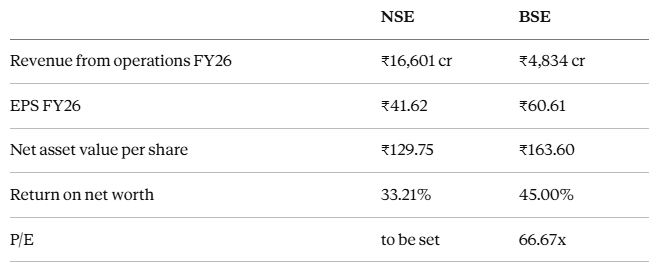
NSE is 3.4 times BSE's revenue and holds the dominant derivatives franchise. Scale and moat argue for a premium.
Three things argue against simply applying 66.67 times:
BSE earned a materially higher return on net worth, 45.00% against 33.21%.
BSE grew into FY26. NSE's normalised profit fell.
BSE's multiple was struck on one day, on a far smaller free float. Applying a small-float multiple to what would be India's largest ever public issue is not a conservative assumption. It is an aggressive one wearing conservative clothing.
The price band the fundamentals support
On FY26 EPS of ₹41.62 and 2,475,000,000 shares:
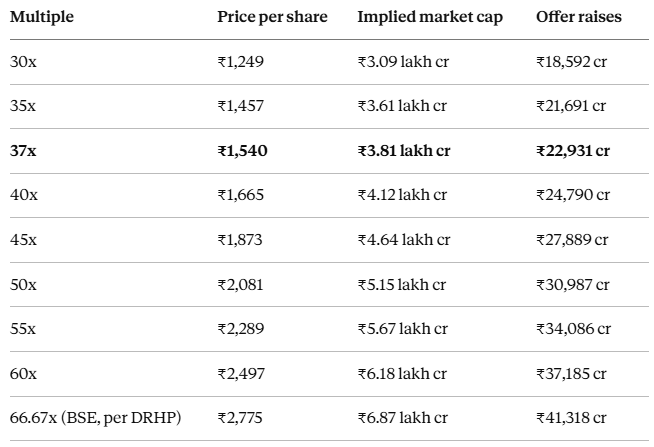
Book value gives a second route. At a NAV of ₹129.75, a price of ₹2,081 is 16.0 times book. ₹1,873 is 14.4 times. Neither is cheap on any absolute measure, which is worth stating plainly : this is a quality franchise argument, not a value argument.
There is a third input the multiple tables ignore, and it may matter more than either. Absorption.
At ₹2,081 the offer raises about ₹31,000 crore. That is larger than the ₹27,870 crore Hyundai Motor India issue, the largest in Indian history. Twenty book running lead managers have to place it. On a book that size, banks price to clear rather than to maximise, because a devalued listing for the country's own exchange is a reputational event and not merely a commercial one. That pressure pushes the band down, not up.
Our scenarios, weighted for that:
Desk base case: ₹1,457 to ₹1,665, or 35x to 40x, raising ₹21,700 to ₹24,800 crore. We weight this at 37x, or ₹1,540 a share, implying ₹3.81 lakh crore.
Market case: ₹1,831 to ₹1,998, or 44x to 48x, raising ₹27,300 to ₹29,700 crore
Aggressive case: ₹2,081 to ₹2,289, or 50x to 55x, raising ₹31,000 to ₹34,100 crore
A word on where 37x comes from, because the number is doing a lot of work. It is our judgement, not an output. We arrive at it by starting from the franchise quality, discounting for an earnings base that declined in FY26, discounting again for a return on net worth well below the listed comparable, and discounting a third time for an offer that would be the largest in Indian history and must be priced to clear. Reasonable analysts will land elsewhere. We would rather show you the anchor and let you disagree with it than present a band and imply it was derived.
Now note where that lands relative to the market. On our desk, NSE is clearing at ₹2,080 a share as at 18 July 2026.
At that level the paper is being marked at 50.0 times FY26 earnings, 16.0 times book, and an implied equity value of ₹5.15 lakh crore. The offer at that price would raise about ₹30,970 crore.
So the position is unambiguous, and we will state it against our own book. The unlisted market is not trading at a discount to our base case. It is 35% above it. At ₹2,080 a buyer is paying 50 times a depressed earnings base, and is underwriting either a peer-level multiple that the FY26 return profile does not currently support, or an FY27 earnings recovery that no disclosure yet confirms.
The scenarios above rest on FY26 reported earnings, and that is the assumption most likely to be wrong. If FY27 earnings normalise and the one-off items do not repeat, the picture changes materially. At an EPS of ₹49.24, the FY25 level, our 37x anchor produces ₹1,822 rather than ₹1,540, and ₹2,080 becomes 42.2 times rather than 50.0 times. That single variable moves the conclusion more than any other, and nothing in the DRHP forecasts it.
Why the ₹30,000 crore figure proves nothing
The most repeated number in the coverage is an issue size of about ₹30,000 crore. It is worth understanding where it comes from, because it is being used as evidence and it is not evidence.
The DRHP states share numbers only. It does not state a rupee issue size. The ₹30,000 crore figure is derived by taking the unlisted market valuation of roughly ₹5 lakh crore and multiplying it out.
So when the unlisted price is then checked against that issue size and found to agree, nothing has been confirmed. The unlisted price has been compared with itself. Reported estimates in fact span roughly ₹23,000 crore to ₹30,000 crore, which back-solves to anywhere between ₹1,545 and ₹2,015 per share. That is not a consensus. It is a shrug with a headline attached.
The float: 4.2% on day one, then a cliff
The lock-in structure is unusual and materially affects how this trades.
Because NSE has no identifiable promoter, Regulation 14 does not apply. There is no minimum promoter contribution and no eighteen month promoter lock-in. That customary source of post-listing stability is simply absent.
Instead, under Regulation 17(1), the entire pre-offer equity capital, 2,326,094,475 shares or 93.98% of the company, is locked for six months from allotment. The exemptions are narrow: the offered shares themselves, and holders registered as venture capital funds, Category I and II alternative investment funds, or foreign venture capital investors, subject to conditions.
Anchor investors sit on a separate clock. Half their allocation unlocks at 30 days, the rest at 90 days.
Work through the day one arithmetic. The offer is 6.02%. Up to 50% of the offer may go to qualified institutional buyers, and up to 60% of that portion may go to anchors, which is roughly 1.80% of equity locked at listing. Genuinely tradeable stock on day one is therefore in the region of 4.2% of the company.
Then at the six month mark, 93.98% of the equity becomes transferable in a single event.
Nothing compels those holders to sell. The register runs to 212,562 shareholders, many of them long-term domestic institutions and trading members who have held for years and have no reason to move. But the asymmetry deserves naming: stock available to the market multiplies more than twentyfold on one date. The listing price and the price six months after listing are two different questions and should be modelled as such.
The 5% cap, and what it does to demand
NSE is not an ordinary company for ownership purposes. Under the SECC Regulations:
No person, resident or non-resident, may hold more than 5% of paid-up equity capital
The ceiling rises to 15% only for public financial institutions, insurance companies, depositories, banking companies and exchanges
Any acquisition above 5% needs prior SEBI approval
Combined non-resident holding may not exceed 49%
Public shareholders must hold at least 51%
Trading members and associates may not exceed 49%
Holders above 2% must be fit and proper persons
This cuts two ways, and both matter.
It caps concentration. No global fund can build the anchor position it might take in a comparable exchange elsewhere. But it does nothing to limit how many buyers want in, and institutional appetite here is not speculative. The selling shareholders themselves include Canada Pension Plan Investment Board, MS Strategic (Mauritius), Aranda Investments, State Bank of India, Bank of Baroda, General Insurance Corporation and New India Assurance. Sophisticated institutions have owned this name for years.
Fragmented, structurally capped demand meeting a 4.2% day one float is a configuration that supports price at listing regardless of what the trailing multiple says.
That is a flow argument, not a valuation argument. Flow can hold a price up. It does not make 50 times trailing earnings cheap. Conflating the two is how investors talk themselves into paying any number at all.
The desk view
NSE is clearing at ₹2,035 a share on our desk as at 20 July 2026. Live levels are on our NSE India Limited Unlisted Shares Section.
That price is 48.9x FY26 earnings and 15.7x book value. Our own weighted anchor is 37x, or ₹1,540.. We are therefore publishing a fair value materially below the level at which we ourselves clear the stock, and we would rather say that plainly than present a band engineered to agree with our book.
Our read on the public numbers : NSE is a genuinely dominant franchise trading on a depressed earnings base, into an offer larger than most participants realise, with a float structure that flatters the first six months and tests the seventh.
The fundamentals point to a band well below where the unlisted market has been trading. The supply mechanics suggest the listing may hold above that band anyway. Both can be true, and an investor who cannot say which of the two they are underwriting does not have a thesis. They have a queue ticket.
The one input that would change this view is FY27 earnings. If the one-off items do not repeat and earnings return toward the FY25 level, our 37x anchor produces ₹1,822 and the gap to today's price narrows sharply. We will update this note when the price band is announced and when FY27 numbers are available.
FAQs
What is the NSE IPO price band?
- Not yet announced. The DRHP shows floor price, cap price and offer price as [●], to be determined through the book building process after SEBI's observations. Any specific price circulating today is an estimate, not a disclosure.
How many shares is NSE offering?
- Up to 148,905,525 equity shares of ₹1 face value, which is 6.02% of the 2,475,000,000 shares outstanding. Earlier reporting of a 4% to 4.5% offer is not supported by the filing.
Is NSE raising fresh capital in the IPO?
- No. It is a pure offer for sale. Existing shareholders are selling and the company receives no proceeds.
Why is NSE listing on BSE?
- Regulation prevents an exchange from listing its own shares on its own platform.
Did NSE's earnings fall in FY26?
- Yes. EPS fell from ₹49.24 to ₹41.62, down 15.5%. Adjusting for one-time items using the company's own normalised figures, profit before tax still fell about 5.3%.
How long are existing shares locked in after listing?
- The entire pre-offer capital, 93.98% of equity, is locked for six months from allotment. There is no eighteen month promoter lock-in because NSE has no identifiable promoter. Anchor allocations unlock in two tranches at 30 and 90 days.
Can a large fund buy a big stake in NSE?
- Not beyond 5% of paid-up capital without SEBI approval, and the 15% ceiling applies only to specified categories such as insurance companies and banks. Combined non-resident holding is capped at 49%.
What is the NSE unlisted share price today?
- NSE is clearing at ₹2,035 a share on the Priveq desk as at 20 July 2026, which 48.9x FY26 earnings and 15.7x book value. Current levels are on our NSE unlisted shares page. Indicative levels are provided for information, move with the market, and do not constitute an offer to deal.
Priveq India's perspective
Everything above is drawn from the draft red herring prospectus dated 17 June 2026 and the company's own restated financial information. Where we have applied a multiple or projected an earnings recovery, that is our scenario and we have labelled it as such. Where the filing is silent, most importantly on price, we have said so rather than filled the gap.
The band remains unset. Until SEBI issues its observations and the price band is announced, any figure presented as the NSE IPO price is an inference. We would rather give you the arithmetic and the assumptions behind ours than a number with false precision attached.
Current levels and transaction details for NSE are on our NSE unlisted shares page. To confirm where NSE is clearing today or to work an order, reach us on WhatsApp at +91 82878 66698 or write to support@priveq.in.
Disclaimer: This note is published by Priveq.in, an information platform owned and operated by Priveq Investech Private Limited, for informational and educational purposes only. It does not constitute investment, financial, legal, accounting or tax advice, nor should it be construed as a recommendation, solicitation, invitation or offer to buy or sell any security. The information contained herein is based on the draft red herring prospectus of National Stock Exchange of India Limited dated 17 June 2026, the company's restated consolidated financial information, and other publicly available sources believed to be reliable. However, neither Priveq.in nor Priveq Investech Private Limited warrants the accuracy, completeness or timeliness of such information.
The valuation scenarios, earnings projections, financial models and valuation multiples presented in this note are estimates and opinions prepared by the Priveq research desk and should not be regarded as statements, forecasts or guidance issued by the company, its advisers, merchant bankers or any regulatory authority. In particular, the 37x earnings multiple used as our weighted valuation anchor represents an internal analytical judgement based on our assessment and is not derived from any prescribed valuation methodology, disclosed peer set or accepted industry benchmark. Other analysts or market participants may reasonably arrive at materially different assumptions, valuation multiples and conclusions.
The final offer price of National Stock Exchange of India Limited has not yet been determined and remains subject to the book-building process and applicable regulatory approvals. Any indicative prices or valuation references mentioned in this note are solely for analytical and informational purposes and should not be interpreted as executable quotes, market prices or assurances regarding future trading levels or listing prices.
Priveq.in is an information platform that publishes research, market intelligence and educational content relating to unlisted securities. The platform does not provide investment advice, operate as a stock exchange, or facilitate electronic execution of securities transactions through the platform.
A draft red herring prospectus is a preliminary document and remains subject to revision prior to the filing of the final prospectus. Investments in unlisted and pre-IPO securities involve significant risks, including illiquidity, valuation uncertainty, regulatory changes and the possibility that a proposed listing may be delayed or may not occur. Past performance is not indicative of future results. Readers should conduct their own independent due diligence and consult a SEBI-registered investment adviser or other qualified professional before making any investment decision.