

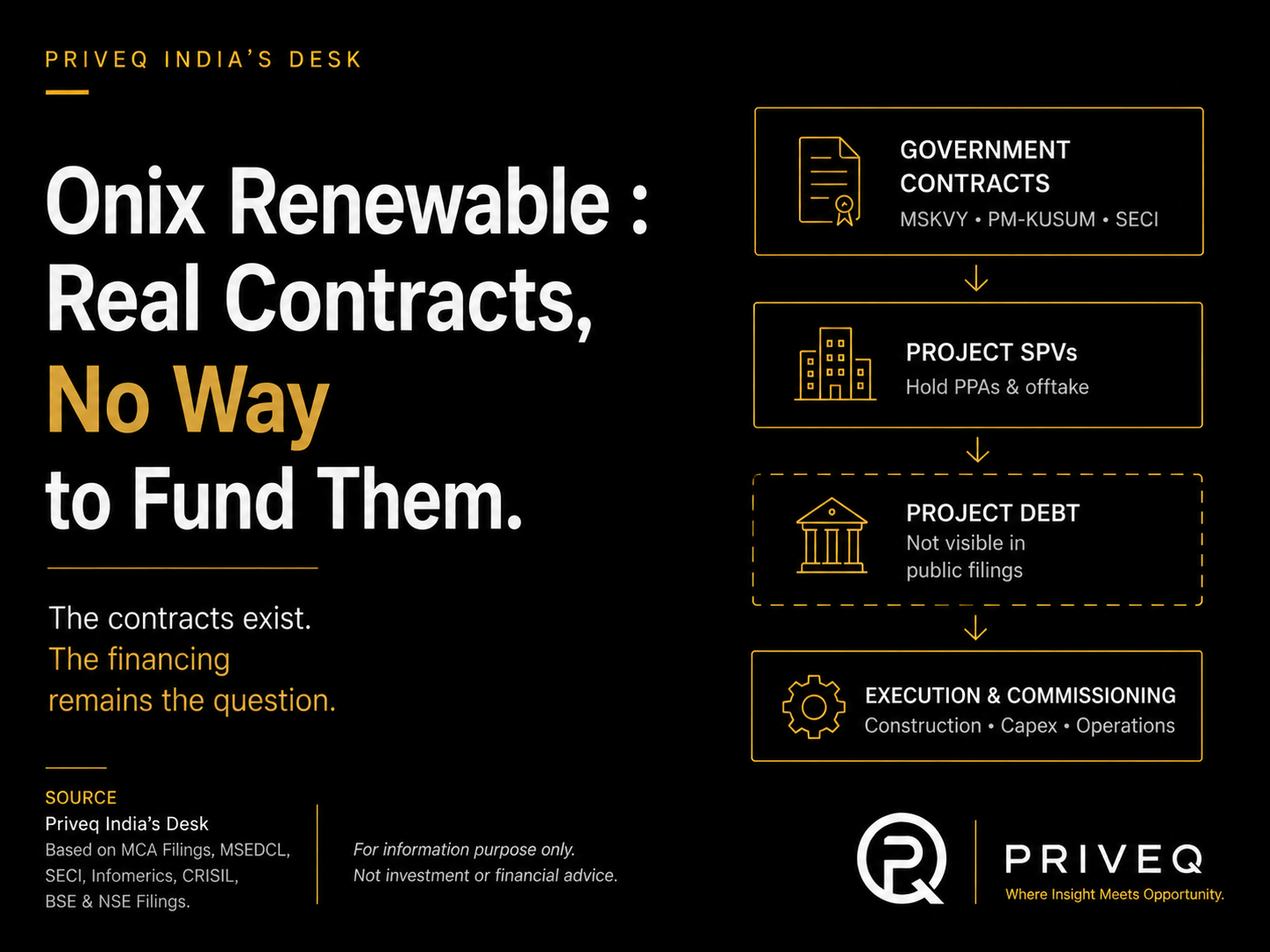
The short version
Onix Renewable is a real business, and we want to say that first, because most of what is written about it is either promotion or dismissal and it is neither. It holds genuine government offtake: close to 1,959 MW of solar power purchase agreements with a state discom, 246.5 MW of feeder solarisation under PM-KUSUM, and a competitive green ammonia win against ACME, NTPC and Waaree in a national auction. Those contracts are on file and they are not in doubt.
The problem is underneath them. The entities that hold that offtake have almost no capital and no project debt registered against them. In one year the parent raised ₹492.78 crore of share premium and sent ₹326.57 crore back out to its own group as loans. About 62% of its revenue comes from companies its own directors sit on. Its registered valuer put fair value at ₹24,903 a share in October 2024; eighteen months later the company issued stock to insiders at ₹25. And the single largest slice of its order book, a 969 MW project, has already left the group to a listed competitor, a month before we marked the price.
We clear this paper on our desk at ₹50. This note explains what that ₹50 is buying, and the one thing that would have to change for it to be worth more.
Correction, 27 July 2026. An earlier version of this note stated a share count of 24.83 crore, based on a reading of the MCA allotment register and two PAS-3 filings that we took as evidence of a share subdivision from ₹10 to ₹5 face value. A reader challenged this on our social channels, citing their own CDSL holding statement at ₹10 face value. We checked NSDL's ISIN master directly and found two separate, active ISINs on Onix Renewable: the original line at ₹10 face value, and a distinct line at ₹5 face value carrying the April and May 2026 rights issue. There was no subdivision. These are two share classes coexisting, not one class that split. The correct total share count is approximately 13.9 crore, not 24.83 crore. Every figure below has been corrected accordingly, and we have left this note in place rather than delete the trail, because being wrong once in the open and fixing it is the whole point of clearing this paper under our own name.
The Desk Snapshot
Onix Renewable Limited, unlisted. Figures as read from primary filings.
Priveq desk price
₹50 per share, as of 24 July 2026
Registered valuer fair value
₹24,903.18 per share, 31 Oct 2024 (Atharva Valuation, DCF). Bonus adjusted: about ₹553
Company's own issue price
₹25 (Apr 2026) and ₹26 (May 2026), rights issue to existing holders
FY25 consolidated revenue
₹1,001.30 crore
FY25 consolidated PAT
₹114.79 crore
Implied equity value at ₹50
About ₹695 crore on 13.9 crore shares. 6.1x FY25 PAT
Biggest positive
Real government offtake: 1,959 MW MSKVY PPAs, 246.5 MW PM-KUSUM, a SECI green ammonia L1 win
Biggest risk
The SPVs holding that offtake carry no project debt, and the largest EPC slice has left to a listed rival
Key monitor
Whether the SPVs raise the ₹3,500 to ₹4,000 crore of project debt they need, and on whose balance sheet
Corrected 27 Jul 2026. An earlier version of this table showed 24.83 crore shares, based on a reading of MCA filings as evidence of a share subdivision. A reader challenge and a direct NSDL ISIN master check showed two separate active ISINs, at ₹10 and ₹5 face value, not one split class. Corrected total: 13.9 crore shares (10.93 crore at ₹10, 2.97 crore at ₹5 from the April-May 2026 rights issue), confirming to paid-up capital of ₹124.12 crore on the MCA master record.
A Real Business, and We Mean it
Start with what is true, because it is the part the sceptics get wrong.
Onix Renewable Limited is executing a large solar portfolio under Maharashtra's MSKVY 2.0 scheme, the state's flagship agricultural feeder solarisation programme. The power purchase agreement register published by MSEDCL, the state distribution utility, records at entries 112 and 113 two of Onix's special purpose vehicles holding 990 MW and 969 MW of signed PPAs, executed in October and December 2024, at tariffs in the ₹2.90 to ₹3.10 band. That is 1,959 MW of state offtake, and it is a public record, not a claim.
Separately, in Gujarat, an Onix group entity holds 73 feeder awards totalling 246.5 MW under the PM-KUSUM Component C programme, all at ₹3.00 per unit, recorded in a Gujarat Electricity Regulatory Commission petition relating to PGVCL, the state distribution utility. And in August 2025, Onix Renewable won a green ammonia auction run by SECI, the central government's Solar Energy Corporation of India, coming in as the lowest bidder at ₹52.50 a kilogram for a 50,000 tonne supply to the GNFC fertiliser plant at Bharuch, ahead of ACME, NTPC and Waaree. That is a genuine competitive win in a hard auction against serious names.
So the picture that gets painted, of a company with nothing real behind it, is false. There is real capacity, real government paper, and a real auction win. Any honest read has to start there. A firm that only sold conviction would stop there too, and tell you to buy. We are not going to, because the interesting part of Onix Renewable is not the contracts. It is the question of who pays to build them.
The Valuation Nobody Wants to Talk About
In December 2024, Onix Renewable's board commissioned a registered valuer, Atharva Valuation (OPC) Private Limited, an IBBI-registered valuer entity, to set a fair value for a fresh issue of shares under Section 62 of the Companies Act. The valuer used a discounted cash flow method and arrived at a number: ₹24,903.18 per share, as of 31 October 2024.
Hold that number for a second, because everything downstream bends around it.
The DCF that produced it is worth reading, because it tells you what you are being asked to believe. Of the ₹5,795 crore firm value, ₹3,779 crore, about 65%, is terminal value, which is to say cash flows beyond year seven. The near years are thin. The valuer's own projection for FY2026-27, the year the Maharashtra PPAs were meant to start generating, is free cash flow of just ₹62.6 crore, lower than the year before it. The model then has free cash flow rising more than tenfold by FY2030-31, discounted at a cost of capital of 17.4% to 17.9%, which is a gentle rate for a pre-commissioning, sub-investment-grade, single-promoter EPC company. The valuer hedges it honestly, calling the value "purely indicative" and adding that "the final value is something that the management will have to decide upon."
Now the part that matters. Adjust that ₹24,903 for the 44-for-1 bonus that followed, and it becomes about ₹553 per share in today's terms. In April and May 2026, the company issued fresh equity to its own existing shareholders, by rights issue, at ₹25 and ₹26 per share. That is roughly 95% below the fair value its own valuer had set eighteen months earlier.
A note on the share count, because we got it wrong once already and want to show the correction rather than bury it. We had originally read a change in face value between the MCA allotment register and the April 2026 rights issue as evidence of a share subdivision, ₹10 shares splitting into ₹5 shares, and published a total count of 24.83 crore on that basis. A reader challenged this, citing their own CDSL holding statement at ₹10 face value. We checked NSDL's ISIN master directly. There is no subdivision. Onix Renewable has two active ISINs: the original line at ₹10 face value, and a separate line at ₹5 face value covering only the April and May 2026 rights issue, a distinct class of shares rather than a stock split. The correct total is roughly 10.93 crore shares at ₹10 face value, plus about 2.97 crore shares at ₹5 face value from the rights issue, for approximately 13.9 crore shares in total, matching the company's own paid-up capital of ₹124.12 crore on the MCA master record almost exactly. We have corrected every figure below that depended on the earlier, wrong count.
There are only two ways to read that, and both belong in front of a buyer. Either the ₹24,903 valuation was never real, in which case every number built on that DCF is suspect. Or it was real, in which case a rights issue at ₹25 to a closed group of insiders transferred value away from anyone not in the room. We are not going to tell you which. We are going to tell you that our desk sits at ₹50, above the ₹25 insiders paid and well below the ₹553 the valuer signed off, and that the gap between those two numbers is the single largest unexplained fact about this company.
The Valuation Ladder
What each reference point implies per share, bonus adjusted to the corrected 13.9 crore share count. Corrected 27 Jul 2026, see note below.
Reference point
Per share
vs desk ₹50
Basis
Registered valuer fair value
~₹553
+1,007%
Atharva DCF, Oct 2024. 65% of it terminal value
FY25 placement, high
~₹556
+1,011%
₹25,000 pre-bonus, to FY25 investors
Priveq desk price
₹50.00
—
Where we clear the paper, 24 Jul 2026
Company's own rights issue
₹25 to ₹26
-48% to -50%
To existing holders, Apr and May 2026
Consolidated book value
~₹50.7
+1.5%
FY25 equity of ₹705.62 cr over shares
The valuer's fair value and the company's own issue price sit on opposite sides of the desk, eighteen months apart, on the same underlying shares. The piece states the fork rather than resolving it. Note the desk price now sits close to book value rather than well below it, a correction from an earlier version of this table that used a wrong share count.
The Money That Goes Round in a Circle
Here is where the real business and the financial engineering meet.
In FY25, Onix Renewable Limited reported revenue of ₹1,001.30 crore and profit after tax of ₹114.79 crore. Read on its own, that is a company that tripled revenue and made money doing it. Read against the related-party disclosure, it is something more complicated.
The gross value of related-party transactions in FY25 was ₹1,562.88 crore, more than the entire revenue line, and up from ₹0.36 crore two years earlier. The named related-party revenue counterparties add to ₹617.13 crore, or 61.6% of consolidated revenue. The top four buyers alone are ₹579.23 crore, 57.8% of revenue, and their combined paid-up capital is about ₹3 lakh. Two of them were incorporated during the very year they started buying. The company's own directors sit on all of them.
Money went the other way too. Long-term loans and advances rose from zero to ₹326.57 crore in a single year, out to the group. Trade receivables stood at ₹263.35 crore, of which ₹56.48 crore was more than six months old. And despite ₹163 crore of cumulative reported profit over three years, the group consumed about ₹336 crore of cash from operations across the same period. In FY25 alone, operating cash flow was negative ₹410.78 crore.
What moved between Onix and its own entities in FY25
Standalone and consolidated, ₹ crore. Sources: MCA AOC-4 XBRL and the AS-18 related-party disclosure.
Line | FY25 | Read |
|---|---|---|
Gross related-party transaction value (AS-18) | 1,562.88 | Against ₹1,001.30 cr of revenue. Was ₹0.36 cr in FY23 |
Revenue from named related parties | 617.13 | 61.6% of consolidated revenue |
of which, top four buyers | 579.23 | 57.8% of revenue. Combined paid-up capital about ₹3 lakh |
Long-term loans and advances | 326.57 | Up from zero in FY24 (consolidated). Out to group entities |
Securities premium added in the year | 492.78 | Raised against 7,15,258 shares allotted in FY25 |
Trade receivables | 263.35 | Receivables over six months old rose to ₹56.48 cr |
Operating cash flow (consolidated) | -410.78 | On reported PAT of ₹114.79 cr |
Reported gross margin was 49.8% against a peer median of 21.7% in the same segment. Roughly two thirds of revenue came from entities under common directorship. Those two facts are read together, not apart.
The reported gross margin, 49.8%, is more than double the 21.7% median of its segment peers. A margin that far above the field, earned mostly from buyers your own directors control, is not a margin you take at face value. It is a margin you ask questions about. The honest question is this: if a parent is advancing money to the developer SPVs that then pay it for construction, the profit is only as real as the SPVs' ability to fund themselves from somewhere other than the parent. Which brings us to the order book.
The Order Book that Walked Out
The order book is the number the promotion leans on: ₹13,000 crore at 31 March 2025, per the rating agency's own note, more than thirteen times FY25 revenue. It is real in the sense that the underlying PPAs exist. It is not real in the sense the headline implies, and one slice proves it.
The order book of ₹13,000 crore is the figure carried in the June 2025 rating rationale from Infomerics. That same rationale disclosed that 59% of the book sat with two companies : NOPL Pace Green Energy at 30%, and NOPL Solar Projects at 29%. These are the same SPVs that hold the Maharashtra PPAs. And on 27 June 2026, Vikran Engineering Limited, a listed engineering company, filed an intimation with both the BSE and the NSE that changes the picture entirely.
Vikran disclosed it had acquired 100% of NOPL Solar Projects, and had accepted a fresh ₹3,517.98 crore turnkey EPC contract for the 969 MW project directly from its new subsidiary. In the same filing, it recorded that the earlier work order for the project, awarded by Onix Renewable on 23 December 2025 for ₹2,035.26 crore, had been mutually cancelled, with only about ₹388.67 crore executed and ₹1,893.26 crore released. The cancellation letter, the filing notes, came from Onix Renewable itself, dated 23 June 2026. We cross-checked Vikran's disclosure against NOPL Solar's own directors on the MCA record, and they match: the SPV is now run by Vikran's promoter family.
The ₹13,000 crore order book, slice by slice
Order book of ₹13,000 crore at 31 Mar 2025, per the June 2025 rating rationale (13.3x FY25 revenue). Status as read from primary filings on 24 July 2026.
Slice | Share of book | Implied value | What the filings show |
|---|---|---|---|
NOPL Pace Green Energy | 30% | ~₹3,900 cr | 990 MW MSKVY PPA is real. SPV carries zero registered charges. Paid-up capital ₹1 lakh |
NOPL Solar Projects | 29% | ~₹3,770 cr | Gone. Acquired 100% by a listed EPC rival. The ₹3,517.98 cr contract is now the rival's, not Onix's |
NHPC allocation | 10% | ~₹1,300 cr | Misframed. A 100 MW 25-year power-purchase allocation (IPP), not a construction order |
Balance, incl. Onix Trans Stellar | ~31% | ~₹4,030 cr | 246.5 MW PM-KUSUM real. Trans Stellar carries zero charges, ₹10,000 paid-up capital |
The two NOPL entities were disclosed as 59% of the order book. One has left the group entirely. The other, and Onix Trans Stellar, hold state PPAs with no institutional project debt registered against them.
Read that slowly. Roughly 29% of the order book, the 969 MW project, is no longer Onix's to claim. The SPV that holds it now belongs to a listed rival. The EPC contract to build it now runs between that rival and its own subsidiary. Onix signed the release. And this happened on 27 June 2026, a full month before our desk marked the stock at ₹50 on 24 July. When we say a buyer at ₹50 should know what they are underwriting, this is the kind of thing we mean.
What is left of the order book sits with SPVs that have a different problem. We checked the charge registers held at the MCA. NOPL Pace Green Energy, holding a 990 MW PPA, has no registered charges. Onix Trans Stellar, holding 246.5 MW and ₹10,000 of paid-up capital, has no registered charges. No registered charge means no institutional project debt. Infomerics itself noted the SPVs need to raise ₹3,500 to ₹4,000 crore of project debt over FY26 and FY27, guaranteed by the parent. And that parent's credit standing has been moving the wrong way: Infomerics downgraded it to sub-investment grade in June 2026 and flagged it as non-cooperating, and separately, when CRISIL assigned it a rating in December 2025, the company declined to accept it. The capacity is real. The funding for it is not visible anywhere in the filings.
What You are Actually Buying to Get Listed
One more thing a buyer needs to understand, because it is not an IPO, whatever the earlier promotion suggested.
Onix Renewable Limited is not filing a draft prospectus and going through the normal listing scrutiny. It is reverse-listing into a small company already on the exchange, one that had initiated a pre-packaged insolvency process, by merging into it as part of that company's resolution plan. The shell keeps its listing ; Onix's shareholders receive shares on a one-for-one basis; the shell's own public holders keep one share in fifteen and have the rest converted into a token preference share redeemable after ten years.
There is no book building here, no price band, no anchor investors, no lock-in, and no merchant banker putting their name to a price. The shares will simply land on the exchange and find their own level against a tiny existing float. And here is the detail that should give any buyer pause: when the shell's public shareholders were sent the notice to vote on this reorganisation, the notice did not name Onix Renewable at all. It asked them to approve a "capital reduction" and a "share exchange ratio" without telling them, in the document they voted on, what they were merging with or on what terms. The company was named only in the outcome filing, after the vote.
That is the vehicle. A buyer of Onix's unlisted shares today is buying into a company that will reach the market through a route that, by design, told the receiving shareholders as little as the rules allowed.
Priveq India's Desk View
We clear Onix Renewable at ₹50, and we are comfortable telling you exactly what that number is and is not.
It is not a bet on the ₹13,000 crore order book, because roughly a third of that book has either left the group or been reclassified as an IPP allocation rather than a construction contract, and the rest sits in SPVs with no visible funding. It is not a bet on the reported earnings, because 62% of the revenue comes from related parties and the cash flow runs the other way. And it is emphatically not a bet on the ₹24,903 valuation, which the company's own subsequent ₹25 rights issue contradicts by a factor of eleven.
At ₹50, the implied equity value is about ₹1,241 crore, roughly 10.8 times FY25 reported profit and about 1.76 times book. On a company with real government contracts, that is not an obviously stretched multiple. On a company whose largest contract just walked out, whose SPVs cannot yet fund what they have won, whose auditor relationships and rating both deteriorated in the run-up to listing, and whose earnings are mostly internal, it is a multiple that requires you to believe the execution will arrive before the funding runs out.
The one variable that would change our view, in either direction, is project debt. If the SPVs raise the ₹3,500 to ₹4,000 crore they need from banks, on their own balance sheets, against these PPAs, then the capacity is real, the order book funds itself, and ₹50 is cheap. If that debt instead gets guaranteed onto the parent, or does not arrive, then the related-party revenue is circular, the margin is an accounting artifact, and ₹50 is expensive. We are watching the charge registers of the SPVs, not the order book headline, because that is where the answer will show up first. Until it does, we clear the paper at ₹50 for those who want it, and we tell them plainly that this is the risk they are taking.
Frequently Asked Questions
What is the Onix Renewable unlisted share price today?
Priveq India's Desk clears Onix Renewable Limited at ₹50 per share as of 24 July 2026. This is a live counterparty level and it moves. For today's clearing price, message Priveq India's Desk on WhatsApp at +91 82874 66698.
Is Onix Renewable doing an IPO?
Not in the conventional sense. It is reverse-listing by merging into an already-listed company that had entered a pre-packaged insolvency process, as part of that company's resolution plan. There is no draft prospectus, price band, anchor book or lock-in. Onix shareholders receive shares on a one-for-one basis when the merger takes effect, subject to tribunal, regulator and exchange approvals.
Are Onix Renewable's government contracts real?
Yes. The Maharashtra MSKVY solar PPAs (about 1,959 MW across two SPVs), the Gujarat PM-KUSUM feeder awards (246.5 MW), and the national green ammonia auction win (50,000 tonnes) are all recorded in primary government and regulatory filings. The open question is funding, not existence.
Why is the desk price so far below the reported valuation?
The company's registered valuer set fair value at ₹24,903 per share in October 2024, which is about ₹553 after adjusting for the 44-for-1 bonus that followed. The company then issued shares to its own existing holders at ₹25 to ₹26 in April and May 2026. Our ₹50 sits above the insider issue price and well below the valuer's figure, close to book value, reflecting real contracts on one side and unfunded SPVs, related-party earnings and a departed order slice on the other.
What is the single biggest risk?
That the developer SPVs cannot raise project debt on their own balance sheets and the funding falls back onto the parent's guarantee. The parent is rated sub-investment grade and stopped cooperating with its rating agency ahead of listing. If the SPV debt does not materialise, the capacity does not get built and the related-party revenue looks circular.
Why does the share count show approximately 13.9 crore rather than 24.83 crore, which an earlier version of this note stated?
We corrected this. The earlier figure assumed a share subdivision from ₹10 to ₹5 face value, based on a reading of MCA filings. A reader challenged it, citing their own CDSL statement at ₹10, and a direct check of NSDL's ISIN master showed two separate active ISINs on Onix Renewable rather than one split class: the original line at ₹10 face value, and a distinct line at ₹5 face value covering only the April and May 2026 rights issue. About 10.93 crore shares sit on the ₹10 line, and about 2.97 crore on the ₹5 line, for a corrected total of roughly 13.9 crore shares, which ties closely to the ₹124.12 crore paid-up capital on the MCA record. Every figure in this note that depended on the share count has been updated accordingly.
What we can and cannot stand behind
We separate what we have read from a primary source, what we have estimated, and what we have not been able to confirm. This is the house discipline and it matters most on a name we deal in.
Primary-sourced and verified. The 13.9 crore current share count, confirmed directly against NSDL's ISIN master, which shows two separate active ISINs for Onix Renewable at ₹10 and ₹5 face value rather than one subdivided class, ties to paid-up capital of ₹124.12 crore on the MCA master record. The FY25 financials, share capital movements, related-party figures and loans (Onix Renewable's MCA AOC-4 and XBRL filings). The ₹24,903 fair value and DCF workings (the Atharva Valuation report filed with the MCA). The Maharashtra MSKVY PPAs (the MSEDCL PPA register) and the Gujarat PM-KUSUM awards (a Gujarat Electricity Regulatory Commission petition relating to PGVCL). The green ammonia auction win (the SECI result document). The acquisition of NOPL Solar Projects by Vikran Engineering, the ₹3,517.98 crore new contract, and the ₹2,035.26 crore Onix contract cancellation with ₹1,893.26 crore released (Vikran Engineering's BSE and NSE intimation of 27 June 2026, cross-confirmed against NOPL Solar's own directors on the MCA record). The absence of registered charges on NOPL Pace Green Energy and Onix Trans Stellar (their MCA charge registers). The rating downgrade and non-cooperation status (Infomerics releases), and the declined CRISIL rating (CRISIL's own release). The listing route and the shareholder notice that did not name Onix (the listed transferee company's BSE filings).
Our estimate, labelled as such. The split and bonus adjustment of the valuer's figure to about ₹276.70, and of the FY25 placement high to about ₹277.78, are our calculations from the allotment register. The implied equity value of about ₹1,241 crore at ₹50 is derived from our share count. The book value per share of about ₹28.40 is derived.
Reported, not yet independently verified by us. The 100 MW NHPC solar-plus-storage allocation at a tariff around ₹3.09 per unit is consistent across trade coverage and a stated letter-of-award reference, and the structure (a 25-year power purchase allocation, not a construction order) is not in doubt. We have not yet read the central regulator's proceedings or the connectivity registry entry ourselves, so we hold the exact megawatt and tariff figures as reported rather than desk-verified. The specific board or shareholder resolution subdividing the company's ₹10 shares into ₹5 shares has not been read by us directly; we infer it from three independent filings that agree with each other, as set out above, and will cite the resolution itself if we obtain it. The scheme document, valuation report and fairness opinion behind the one-for-one merger swap are not yet in our hands; when we obtain them, we will update this note.
If any of the above firms up or turns out wrong, we will say so here and correct it in the open.
To ask where Onix Renewable is clearing on our desk today, or to work an order, reach us on WhatsApp at +91 82874 66698 or write to support@priveq.in.
Disclaimer
This note is prepared by Priveq India (Priveq Investech Private Limited) for information only. It is not an offer, a solicitation, or investment advice, and it is not a recommendation to buy or sell any security. Nothing here should be read as a price target or a guarantee of value.
You should know, and we state it plainly, that Priveq transacts as a counterparty in the shares discussed in this note. We may buy or sell Onix Renewable shares on our own account, and the ₹50 desk level referenced here is the price at which we may deal, not an independent valuation. Our commercial interest and the views in this note therefore sit in the same place, and you should weigh the analysis with that in mind. We have tried to earn your trust by disclosing every finding against our own book, including the ones that argue against dealing at all.
This note draws on primary records : Onix Renewable's own filings with the Ministry of Corporate Affairs, the Atharva Valuation report, the MSEDCL power purchase register, a Gujarat Electricity Regulatory Commission petition, the SECI auction result, rating releases from Infomerics and CRISIL, and stock-exchange intimations filed by Vikran Engineering Limited with the BSE and NSE. Where a figure rests on one of those sources, we have named it in the text so you can check our working. Financial figures are drawn from statutory filings and other sources believed reliable but not independently audited by us; some secondary figures are relayed through secondary sources and are flagged as such above.
Unlisted and pre-IPO shares are illiquid, carry a high risk of loss, and may be difficult to value or sell. Prices move sharply and without notice. Regulatory approvals for the transactions described, including tribunal, securities regulator and exchange clearances, remain pending and may not complete, or may complete on different terms.
Do your own diligence, and consult your own financial and legal advisers before dealing. Past performance and projected cash flows are not reliable indicators of future results. Priveq accepts no liability for any loss arising from reliance on this note.