

The Short Version
ORBIS FINANCIAL CORPORATION LIMITED is priced as a custodian trading at half the multiple of CAMS. Its own numbers say most of its revenue is not custody. It is treasury income earned on client money, which rises and falls with interest rates and trading volumes, and both fell this year. At ₹370 the stock is fair value, roughly 22.7 times FY25 earnings, sitting at the lower end of what we would call reasonable. That is a different thing from cheap. The discount to CAMS is mostly deserved, and the upside rests on one testable question: whether the fee side of the business keeps growing fast enough to change the mix.
The market prices Orbis Financial as a custodian trading at roughly half the multiple of CAMS. That one line contains the whole bull case for the unlisted stock, and it does not survive contact with the company's own numbers.
Read the rating rationale and the label starts to slip. In the first half of FY26, close to 62% of Orbis's gross revenue was treasury income and clearing fees, not custody fees. So a large part of what is being valued as a steady annuity is closer to interest earned on client money, and that income shrinks when interest rates fall or when trading volumes drop. Both happened this year. Standalone gross revenue fell 13%.
The discount to CAMS, in other words, is not a bargain waiting to close. It is the market pricing a different and more cyclical business, and mostly getting it right. This note works through why, and where the price of ₹370 sits once you have.
Metric | Value | Why it matters |
|---|---|---|
Current Price | ₹370/share | Indicative unlisted market level (21 Jul 2026) |
Fair Value | ₹360–440/share | Our estimated valuation range |
View | Fairly Valued | Not deeply undervalued |
FY25 P/E | 22.7x | Below listed peers |
Price/Book | 5.2x | Based on FY25 net worth |
Biggest Positive | Improving fee income mix | More annuity-like over time |
Biggest Risk | Treasury income dependence | Linked to rates & derivatives activity |
Key Monitor | Client cash collateral | Leading indicator for earnings |
The One-liner
Orbis is a good business trading at a fair price, not a great business trading at a cheap one. The discount to listed peers is largely earned. The part of the story worth owning is whether the fee-based half of the business keeps growing fast enough to change that.
The Number that Reframes Everything
Start with one figure that resets the narrative. After two decades in the business, Orbis holds about 0.55% of Indian custody assets.
The other 99% and more sits with bank custodians most investors never think about : SBI-SG, Deutsche, Standard Chartered, HSBC, Citi, HDFC, Kotak and a handful of others. Orbis is not the market leader in custody. It is a small, independent specialist operating at the edge of a market owned by banks.
That is not a criticism. A focused, founder-run, conflict-free custodian is a genuine niche, and Orbis has grown into it well. But it changes the frame. You are not buying the dominant player in a structural growth market. You are buying a small share of it, and the price has to reflect that.
Metric | Orbis Financial | CAMS |
|---|---|---|
Primary Business | Custody, Clearing & Treasury | Mutual Fund Registrar |
Largest Revenue Driver | Treasury & Clearing | Recurring Fee Income |
Revenue Quality | Cyclical | Highly Recurring |
Market Position | Niche Independent Player | Industry Duopoly |
Earnings Sensitivity | Rates & Trading Volumes | AUM Growth |
Typical Multiple | ~22x | ~40x |
What Orbis Actually Does For a Living
ORBIS FINANCIAL CORPORATION LIMITED was incorporated in 2005 and runs an integrated set of securities services. It is a SEBI-registered custodian, a professional clearing member across equity, commodity and currency derivatives, a depository participant on both depositories, a designated depository participant that registers foreign portfolio investors, a category one registrar and transfer agent, and, through a subsidiary, a debenture trustee. It has a young GIFT City subsidiary building the same services inside the international finance centre.
The pitch is coherent: a single, independent provider with no competing bank or broking arm, which appeals to foreign investors and alternative funds that want a custodian with no conflict of interest. The financials back the quality of execution. FY25 profit after tax was ₹204.6 crore, net worth was ₹899.6 crore, the balance sheet carried no debt, and return on net worth was 25.8%. ICRA upgraded the company to A plus with a stable outlook in February 2026. These are not the numbers of a weak business.
Where the Money Really Comes From
Here is the part the "custodian at a discount" framing skips, and it is the heart of the analysis.
A custody fee and a treasury income rupee are not the same rupee, and they do not deserve the same multiple.
Custody fees are annuity income. A client places assets, the custodian earns a recurring fee on them, and the revenue is sticky across cycles. That is the kind of income that earns a high multiple, and it is why CAMS and KFin trade where they do.
Treasury income is different. Orbis earns a large part of its money as interest on client cash collateral, mostly margin placed by foreign investors in the clearing business. That income rises and falls with two things Orbis does not control: the level of interest rates, and the volume of derivatives trading that determines how much collateral sits on the books. It is closer to a rate position than an annuity, and it deserves a lower multiple, not a higher one.
Now the split, from the rating rationale:
Treasury income and clearing fees together were about 62% of gross revenue in the first half of FY26.
That share was 63% in FY25 and 71% in FY24.
Custodial fees are the second stream, and the fee-based share is rising as custody scales.
Two things are true at once here, and the piece holds both. The mix is improving, which is a real positive: fee income is growing and the business is slowly becoming more annuity-like. But the majority of revenue is still float and volume linked, which is a real qualifier: this is a more cyclical business than the custody label implies.
The first half of FY26 showed exactly this. As interest rates eased and a regulatory clampdown on index derivatives cut trading, client cash collateral fell about 20% year on year, and gross revenue dropped 13%. Profit still rose 8%, but only because the company cut referral and staff costs hard. That cost lever works once. It does not work every year. Sustained profit growth from here needs collateral and fee income to recover, not costs to keep falling.
Question | Custody Fee Income | Treasury Income |
|---|---|---|
Nature of Revenue | Recurring | Linked to interest rates & trading activity |
Predictability | High | Moderate to Low |
Earnings Quality | Strong | More cyclical |
Valuation Multiple | Higher | Lower |
Closest Listed Example | CAMS / KFin | No direct listed comparable |
What Drives Growth? | Client assets & fee additions | Client cash collateral, interest rates & derivatives volumes |
The Peer the Market uses, and the Peers it ignores
The unlisted market compares Orbis to CAMS and KFin because they are the listed financial-infrastructure names everyone knows. The comparison sets the ceiling, so start there, then widen it, because the names the market ignores explain the discount better than the names it uses.
CAMS and KFin are the ceiling. They are mutual fund registrars, an effective duopoly serving the whole industry. They are asset light, they need almost no balance sheet, they have pricing power, and CAMS earns a return on equity around 40%. As of late July 2026 CAMS traded near 40 times earnings and KFin near 43 times. That is the multiple Orbis is measured against, and it is worth being clear about why those two earn it : Near-Monopoly Annuity Economics that Orbis does not have.
The bank custodians are the context. They own the custody market Orbis competes in. Their dominance is the reason Orbis sits at 0.55% share after twenty years, and it is a ceiling on how large the custody fee base can realistically become. You cannot judge Orbis's growth runway without them in view.
Nuvama Custodial and StockHolding are the honest mirror. Nuvama Custodial Services is the closest genuine comparable, a non-bank custodian with a similar model, backed by a global fund, but it is a private subsidiary with no traded price. StockHolding was the domestic pioneer and is now being absorbed into its parent. Neither gives you a clean listed multiple, but both tell you what an independent custody business is actually worth to a professional buyer, which matters more than a duopolist's multiple that Orbis was never going to earn.
Put the three together and the conclusion is not "Orbis is a cheap CAMS." It is "Orbis is a different business, and the CAMS multiple was never the right yardstick."
What the Discount is Actually Pricing
So why does ORBIS FINANCIAL CORPORATION LIMITED trade at roughly 22 times earnings when CAMS and KFin trade near 40? The gap is not the market missing value. It is the market pricing four real differences.
Earnings quality : A majority of revenue is treasury and clearing income that moves with rates and volumes, against the pure fee annuity CAMS and KFin earn.
Scale and share : Orbis holds about 0.55% of custody assets in a market owned by banks, against the duopoly position CAMS and KFin hold in fund registry.
Concentration : The top ten custody clients are about a third of assets, and the top five clearing clients are about a third of cash collateral. A duopolist has thousands of relationships and no such dependency.
Liquidity : Orbis is unlisted. Its shares change hands in an indicative dealer market, not a live exchange, and that illiquidity alone warrants a discount.
Each of these is a reason to pay less. Stack them and a large discount is not an anomaly. It is the correct answer.
The Valuation, at ₹370
On the desk today, ORBIS FINANCIAL CORPORATION LIMITED is clearing at ₹370 a share as at 21 July 2026. Against roughly 12.53 crore shares, that is an implied equity value of about ₹4,637 crore.
Run that against the FY25 numbers:
Price to earnings, on FY25 profit of ₹204.6 crore: about 22.7 times.
Price to book, on FY25 net worth of ₹899.6 crore: about 5.2 times.
Implied earnings per share: about ₹16.3. Book value per share: about ₹72.
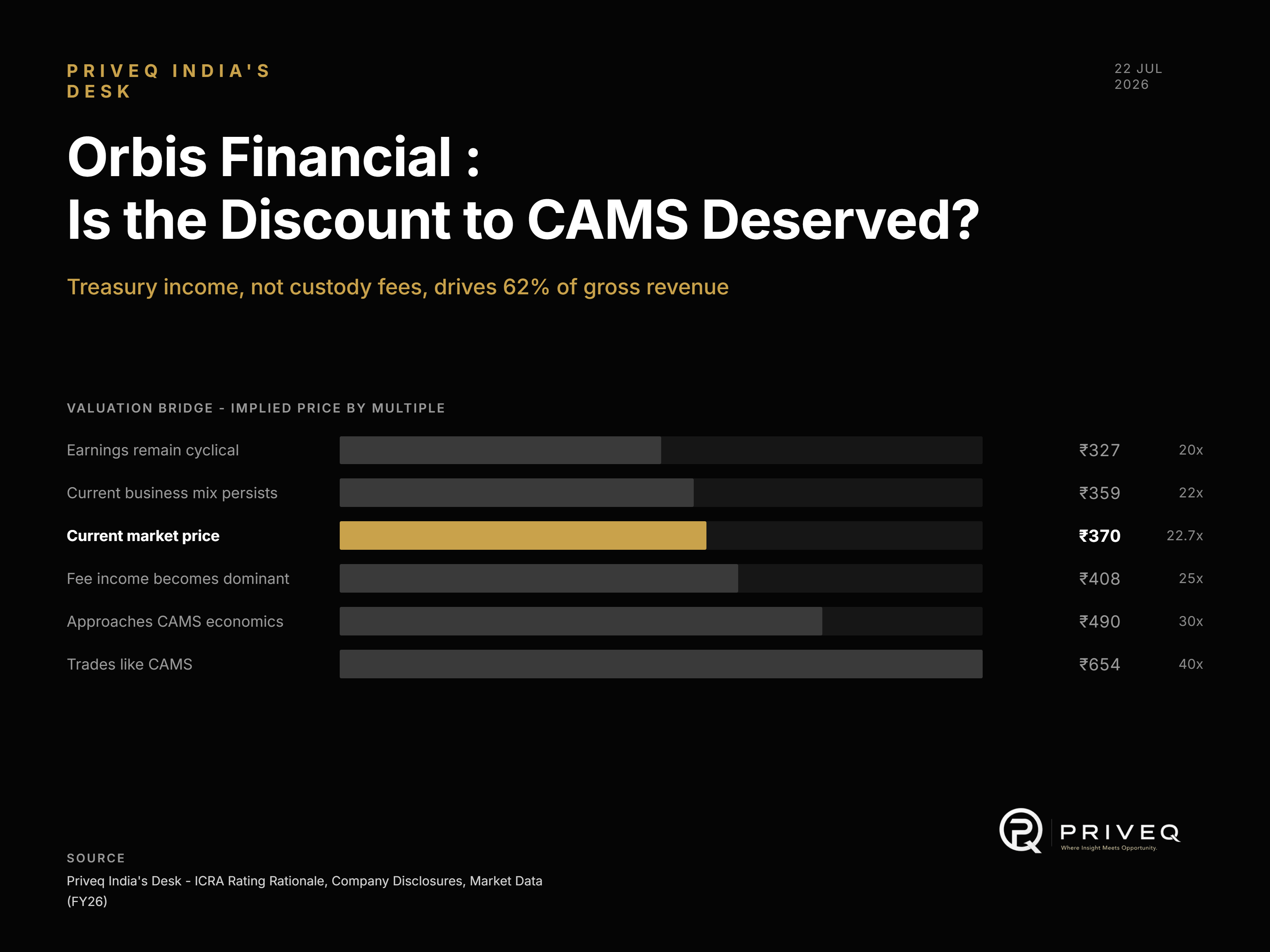
Now the comparison the whole note has been building toward. Here is what ORBIS FINANCIAL CORPORATION LIMITED would be worth at various multiples, so you can see where ₹370 sits.
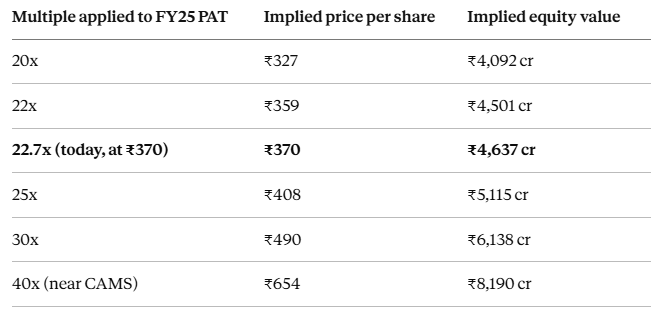
The bull case implicitly asks you to believe Orbis re-rates toward that bottom row. We do not think the FY25 numbers support it. A business where most revenue is rate and volume linked, whose profit fell at the revenue line this year and only rose because of cost cuts, does not earn a duopolist's multiple.
If the Market Believes... | Multiple | Implied Price |
|---|---|---|
Earnings remain cyclical | 20x | ₹327 |
Current business mix persists | 22x | ₹359 |
Current Market Price | 22.7x | ₹370 |
Fee income becomes dominant | 25x | ₹408 |
Business approaches CAMS economics | 30x | ₹490 |
Trades like CAMS | 40x | ₹654 |
Our Own Read : A fair private-market value for Orbis sits in the region of 22 to 27 times FY25 earnings, which is roughly ₹4,500 to ₹5,500 crore, or about ₹360 to ₹440 a share. At ₹370, the stock sits at the lower edge of that range. That makes it fair, and at the margin slightly cheap, rather than the deep bargain the discount to CAMS makes it look. And we will say plainly that ₹370 is close to where our own desk clears the stock, so this is not us talking our book up.
The single number that would move this view is not the multiple. It is next year's earnings, and specifically the direction of one line.
The Swing Factor : Client Cash Collateral
If you track one figure on Orbis, track client cash collateral. It is the balance of client margin the treasury income is earned on, and it is the closest thing to a leading indicator this business has.
It fell about 20% year on year into September 2025 as rates eased and derivatives volumes dropped, then began recovering from a low around August 2025. Where it settles decides whether treasury income stabilises and profit growth resumes, or whether FY26 stays soft.
The read for a holder is simple. If collateral recovers durably and fee income keeps climbing so that the treasury and clearing share falls below about 55% of revenue, the business becomes more annuity-like and a higher multiple starts to look fair. If collateral keeps sliding, ₹370 is not as cheap as 22 times earnings suggests, because those earnings are on their way down.
The Risks Worth Naming
Beyond the collateral swing factor, three risks deserve to be on the page.
Regulatory capital. A draft rule would raise the cash margin that professional clearing members must post against bank guarantees, from the current level, in the next financial year. Orbis has the net worth to absorb it, but it raises the capital intensity of the clearing business and is worth watching.
Concentration. The dependence on a small number of large custody and clearing clients means the loss of one or two relationships would show up in the numbers quickly.
Regulatory dependency. A meaningful part of the business rides on foreign investor flows and derivatives activity, both of which move with SEBI policy. This year's index-derivatives measures are a live example of how quickly that can cut revenue.
Putting the Pieces Together
Factor | Assessment | Why |
|---|---|---|
Business Quality | Good | Debt-free, founder-led, niche positioning |
Earnings Quality | Moderate | Treasury income still dominates |
Balance Sheet | Strong | No debt, healthy RoNW |
Competitive Position | Moderate | Small share in a bank-dominated market |
Valuation | Fair | Around lower end of estimated range |
Margin of Safety | Limited | Already close to intrinsic value |
Overall View | Fairly Valued | Better business than many believe, but not materially mispriced |
The Desk View
Orbis is a well-run, debt-free, founder-led custodian with a genuine niche and improving earnings quality. It is also a smaller, more concentrated, and more cyclical business than the "custodian at a discount to CAMS" story implies, and its discount to listed peers is mostly earned rather than a mispricing.
At ₹370 the stock is fair value, sitting at the lower end of the range we would call reasonable. That is a different statement from cheap. A buyer here is not getting a duopolist at half price. They are getting a decent specialist at a decent price, with the upside resting on one testable thing: whether fee income and client collateral grow enough to make the business more annuity-like than it is today.
We would take the other side of the deeply undervalued thesis, and we would happily own the compounding-niche thesis at the right entry. The two are not the same trade, and knowing which one you are making is the whole point.
FAQs
What is the ORBIS FINANCIAL CORPORATION LIMITED unlisted share price today?
ORBIS FINANCIAL CORPORATION LIMITED is clearing at ₹370 a share on the Priveq desk as at 21 July 2026, which is about 22.7 times FY25 earnings and 5.2 times book. Indicative levels are for information, move with the market, and are not an offer to deal.
Why does Orbis trade at a discount to CAMS and KFin?
Because it is a different business. CAMS and KFin are near-monopoly mutual fund registrars with pure annuity income and very high returns on equity. Orbis is a smaller custody, clearing and treasury business where most revenue is linked to interest rates and trading volumes, with higher client concentration and no listing. Those differences justify most of the gap.
Is Orbis actually a custodian?
It is a custodian, but custody fees are not where most of the money comes from. In the first half of FY26 about 62% of gross revenue was treasury income and clearing fees rather than custody fees. The fee-based share is rising, but the majority of revenue is still cyclical.
Did Orbis's earnings fall this year?
Standalone gross revenue fell about 13% in the first half of FY26 as client cash collateral dropped around 20%. Profit still rose about 8%, but that was driven by cost cuts rather than revenue growth.
Is Orbis planning an IPO?
No draft prospectus has been filed with SEBI as of mid 2026, and there is no confirmed timeline. Any listing talk is speculative until a filing appears.
Is Orbis financially sound?
On the available figures, yes. It is debt-free, earns a return on net worth in the mid twenties, and was upgraded by ICRA to A plus with a stable outlook in February 2026. The questions in this note are about valuation and earnings quality, not solvency.
What We Can and Cannot Stand Behind
We think it matters to tell you where each number in this note comes from.
What we stand behind, from primary sources. The financials, ratios, revenue mix, client counts, concentration, market share, collateral movements and the regulatory margin proposal are drawn from ICRA's rating rationales. The credit rating and its February 2026 upgrade are from the same. The listed multiples for CAMS and KFin are from market data and the companies' own FY26 results. The SEBI settlement is from the public order.
What we treat as indicative only. The unlisted share price, including our own ₹370 desk level, is a dealer mark in an illiquid market, not an audited or exchange-traded price, and it moves. Absolute assets under custody, the per-share earnings and book value, and the detailed shareholding split come from company disclosures relayed through secondary sources, and we would verify them against the audited annual report before treating any single figure as final.
What we could not confirm, and so have left out. A precise basic versus diluted earnings figure, a full audited segment revenue split, and the detail of one older regulatory settlement were not available from a primary source at the time of writing. We would rather flag those gaps than fill them with numbers we cannot support.
If any of these firm up or change, we will update the note.
To ask where ORBIS FINANCIAL CORPORATION LIMITED is clearing on our desk today, or to work an order, reach us on WhatsApp at +91 82874 66698 or write to support@priveq.in.
Disclaimer: This note is prepared by Priveq Investech Private Limited for information and educational purposes only. It is not investment, financial, legal or tax advice, nor a recommendation or an offer to buy or sell any security. Figures are drawn from ICRA rating rationales for Orbis Financial Corporation Limited, a public SEBI settlement order, market data and company disclosures relayed through secondary sources. Valuation multiples, ranges and the fair-value view expressed in this note are estimates and judgements of the Priveq research desk. They are not disclosures by the company, its advisers or any regulator, and other analysts working from the same information may reasonably reach different conclusions. Indicative unlisted prices, including any Priveq desk level, are not a quote or an offer, are dealer marks in an illiquid market, and may differ materially from any level at which a transaction is concluded or at which the shares may eventually list. Priveq Investech Private Limited transacts as a counterparty in the unlisted shares referenced in this note and therefore holds a commercial interest in them. Certain figures in this note are unaudited or sourced from secondary references and should be independently verified before any investment decision. Investing in unlisted and pre-IPO shares carries substantial risk, including illiquidity, valuation uncertainty, regulatory risk, client concentration risk, and the possibility that a listing is delayed or does not occur. Past performance does not indicate future results. Conduct your own due diligence and consult a SEBI-registered adviser before investing.