

The Short Version
PRISM, the Gurugram-based parent of OYO and legally Oravel Stays Limited, halved its fresh issue to up to Rs 3,350 crore in an addendum dated 21 October 2026, and as of 29 October 2026 it has not announced a price band. PRISM's audited FY26 profit of Rs 994 crore rests on a Rs 595 crore tax credit, so earnings multiples mislead, while a desk price of Rs 20.50 (29 October 2026) equals about 14x EV/EBITDA on audited FY26 EBITDA and 15.05 billion shares. That values the equity near Rs 30,860 crore on the filing's own share base.
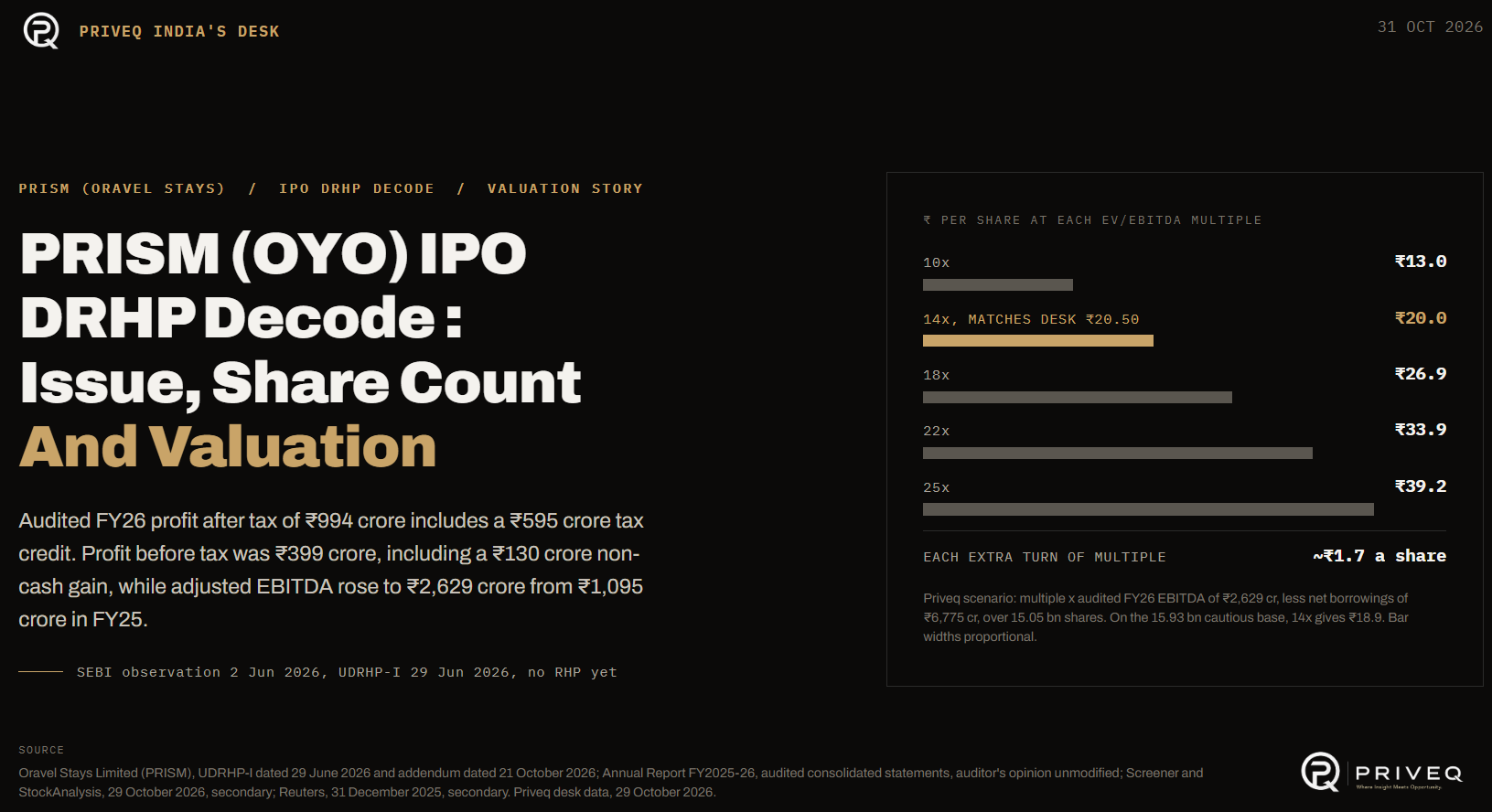
Our stated position, a Priveq scenario and not a price call: the filings support roughly Rs 20 to Rs 34 a share if the market applies 14x to 22x to audited FY26 EBITDA of Rs 2,629 crore, which puts Rs 20.50 at the low end of that range. The reported US$7 to 8 billion headline would need about 1.5x to 1.8x that EBITDA even at 18x. The variable still open is whether the restated FY26 numbers in the red herring prospectus (RHP) match the audited ones.
PRISM (Oravel Stays Limited): company data
Company: Oravel Stays Limited (legal name); PRISM (corporate brand); OYO (consumer brand); formerly Oravel Stays Private Limited
Sector: Travel and hospitality platform: hotels, homes and listings, in more than 35 countries
Filing status: Updated Draft Red Herring Prospectus-I (UDRHP-I) dated 29 June 2026; addendum dated 21 October 2026, listed on the SEBI site 26 October 2026; no RHP or price band yet
Issue: Fresh issue of up to Rs 3,350 crore (Rs 33,500 million); no offer for sale; pre-IPO placement dropped (addendum)
Latest financials: Audited FY26 (consolidated, annual report): revenue from operations Rs 9,358 crore, adjusted EBITDA Rs 2,629 crore, profit before tax Rs 399 crore (includes a Rs 130 crore non-cash gain on loss of control of a subsidiary), profit after tax Rs 994 crore. Restated nine months to 31 December 2025: revenue Rs 6,941 crore, profit before tax Rs 245 crore, profit after tax Rs 748 crore (UDRHP-I). FY25 revenue Rs 6,253 crore, profit after tax Rs 245 crore
Desk price: Rs 20.50 per Re 1 equity share, as of 29 October 2026, indicative; minimum lot: see the Marketplace page
Share basis: Re 1 face value, after the 1:1 bonus (allotted 9 October 2025) and the 1-for-19 bonus (allotted 22 December 2025); 15,053,791,264 shares after conversion of all preference shares, before options
Valuation lens (Priveq-derived): EV/EBITDA and EV/gross booking value; price-to-earnings not used because profit after tax is tax-driven
Identifiers: CIN U63090GJ2012PLC107088 (UDRHP-I cover); ISIN PENDING-ISIN-VERIFY (not yet pulled)
Primary sources: UDRHP-I, addendum to UDRHP-I, SEBI Public Issues listing; full list below
Last verified: 29 October 2026
For the live desk snapshot, see PRISM (OYO) on Priveq Marketplace.
Where does the PRISM (OYO) IPO stand today?
PRISM's IPO has SEBI clearance, a filed UDRHP-I dated 29 June 2026 and a 26 October 2026 addendum, but as of 29 October 2026 no price band, so the next catalyst is the RHP and not approval. The UDRHP-I lists SEBI's final observation letter to the lead managers dated 2 June 2026; the letter itself is not on SEBI's public listings and was not read.
IPO status tracker for PRISM (Oravel Stays Limited), as of 29 October 2026
Each row is tagged disclosed (in a filing), reported (press, not confirmed by a filing) or expected. Dates are IST publication dates where relevant.
Stage | Date | Status | Source |
|---|---|---|---|
Board resolution authorising the IPO | 19 Sep 2025 | Disclosed | UDRHP-I, The Issue, note 3 |
Shareholders approve the IPO (EGM) | 20 Dec 2025 | Disclosed | UDRHP-I, The Issue, note 3 |
Confidential DRHP filed | 31 Dec 2025 | Reported | Press; SEBI pre-filing route |
SEBI final observation letter to the lead managers | 2 Jun 2026 | Disclosed | UDRHP-I, material documents for inspection, item 69 (printed p.1133); letter itself not read |
In-principle listing approvals from BSE and NSE | 17 Feb 2026 | Disclosed | UDRHP-I, material documents for inspection, item 68 |
UDRHP-I dated | 29 Jun 2026 | Disclosed | UDRHP-I cover |
SEBI email allowing a fresh-issue change of up to 50% without re-filing | 12 Oct 2026 | Disclosed | Addendum, first paragraph |
Board resolution to cut the fresh issue; IPO Committee resolution | 19 Oct 2026; 21 Oct 2026 | Disclosed | Addendum, first paragraph |
Addendum signed; listed on SEBI site | 21 Oct 2026; 26 Oct 2026 | Disclosed | Addendum; SEBI Public Issues listing |
FY26 audited consolidated results in the annual report (auditor opinion unmodified) | FY2025-26 annual report | Disclosed | Annual Report FY2025-26, p.149 and p.163-166 |
Red herring prospectus (RHP), price band, anchor book | Not announced | Expected | Addendum says investors should rely on the RHP |
Bid open and close, allotment, listing | Not announced | Expected | Reported target of November 2026 is unconfirmed |
The SEBI email applies to IPOs opening on or before 31 March 2027. No UDRHP-II or RHP appeared on the SEBI draft-documents listing as of 29 October 2026.
Net read: the premise that approval is still awaited is out of date. The live questions are the final issue size, the price band and whether the RHP's restated FY26 numbers match the audited ones in the annual report; the first two are not in any filing yet.
What do the filings say about the PRISM IPO size and objects?
PRISM's addendum of 21 October 2026 cuts the fresh issue from up to Rs 6,650 crore to up to Rs 3,350 crore and drops the pre-IPO placement, with no offer for sale (Addendum, "The Issue" and "Objects of the Issue"). The company relied on a SEBI email of 12 October 2026 that lets issuers change fresh-issue size by up to 50% without re-filing.
What the filings say about the PRISM IPO size and objects
UDRHP-I (29 June 2026) against the addendum (21 October 2026). Rs million unless stated; US$ at Rs 94.76 as used in the filings.
Item | UDRHP-I | Addendum | Change |
|---|---|---|---|
Fresh issue (gross proceeds) | Up to 66,500 (Rs 6,650 cr) | Up to 33,500 (Rs 3,350 cr) | Halved |
Offer for sale | None | None | No change |
Pre-IPO placement | Up to 13,300, capped at 20% of fresh issue | Not to be undertaken | Deleted |
Object 1: investment in Oravel Stays Singapore Pte. Ltd. to repay or prepay its borrowings | 49,875 (US$526.33 mn) | 25,125 (US$265.14 mn) | Cut by 24,750 |
Object 1 as a share of gross proceeds | 75.0% | 75.0% | Unchanged |
Object 2: general corporate purposes | Not above 25% of gross proceeds | Not above 25% of gross proceeds | Unchanged |
Term Loan B outstanding at 31 May 2026 | 77,569.59 (US$818.59 mn) | Same | n/a |
Share of Term Loan B prepaid from proceeds | 64.3% | 32.4% (derived) | Halved |
Gross proceeds against net worth of 61,466.16 (31 Dec 2025) | 108% (risk factor 42) | 55% (derived) | Risk factor now moot |
Share of Term Loan B prepaid for the addendum column is Priveq arithmetic (25,125 / 77,569.59). Price band, share count and employee reservation remain blank in both documents.
The money has one named use: investing in Oravel Stays Singapore Pte. Ltd. to prepay its borrowings, Rs 2,512.5 crore (US$265.14 million at Rs 94.76), which is 75% of gross proceeds. General corporate purposes are capped at 25%. The company confirms the objects are met from net proceeds and internal accruals, so the firm-financing rule does not apply.
Net read: the halved issue funds about half of the debt paydown the UDRHP-I planned, so more of the Term Loan B stays on the balance sheet. The smaller issue is also below net worth (about 55% against 108% before), which makes risk factor 42 in the UDRHP-I obsolete as drafted.
How did the 2025 bonus issues change PRISM's per-share numbers?
PRISM issued a 1:1 bonus (allotted 9 October 2025) and a 1-for-19 bonus (allotted 22 December 2025), so any earlier per-share price is divided by 2.105 to compare with today's Re 1 share (UDRHP-I, share capital history). Together they multiply share counts by the same factor. The footnotes to the filing label the second one "19:1", but the allotment table says one bonus share for every 19 held.
Corporate actions that change PRISM per-share numbers
Dates are from the UDRHP-I share-capital history; approval dates from the footnotes to the same table. Adjustment factors are Priveq arithmetic.
Date of allotment | Action | Ratio or amount | Effect on a pre-action per-share price |
|---|---|---|---|
10 Sep 2021 | Sub-division of equity shares from Rs 10 to Re 1 face value | 10 for 1 | Divide by 10 |
11 Sep 2021 | Bonus issue | 3,999 shares for each share held | Divide by 4,000 |
9 Oct 2025 (approved 26 Sep 2025) | Bonus issue | 1 for 1; 1,736,711,919 shares | Divide by 2 |
22 Dec 2025 (approved 20 Dec 2025) | Bonus issue | 1 for every 19 held; 184,513,724 shares | Divide by 1.0526 |
7 Feb 2026 | Series G CCCPS partly converted | 15,487,073 Series G shares | None; a small tranche |
20 May 2026 | Series G CCCPS issued to K&J Consulting sellers, non-cash | 131,496,556 at Rs 29 | Converts 1:2.11 |
Worked example: a pre-October 2025 price is divided by 2.105 (2 x 20/19). The Series G issue price of Rs 29 becomes Rs 13.78 on today's Re 1 share, so a desk price of Rs 20.50 is 49% above it. The footnotes to the filing call the second bonus "19:1"; the allotment table, and the Ritesh Agarwal holding, are consistent only with one bonus share for every 19 held.
Three things follow for anyone comparing prices:
Old prices must be divided. Any price quoted before October 2025 is divided by 2.105 to compare with a Re 1 share today.
The filing's per-share data is already adjusted. Earnings per share of Rs 0.18 for FY25 is retrospectively adjusted for both bonuses (UDRHP-I, ratio notes).
No bonus preference shares exist. A bonus preference-share election was reported in the press in October and November 2025 and then withdrawn; the UDRHP-I capital structure lists no such security.
On the Series G preference shares, 15,487,073 Series G shares converted into equity on 7 February 2026, but 661,432,387 Series G shares remain outstanding and convert 1:2.11 into 1,395,622,313 equity shares. Net read: Rs 20.50 sits on today's Re 1 share, and the Series G issue price of Rs 29 becomes Rs 13.78 on that basis, so the desk price is 49% above it.
Which PRISM share count should you use?
PRISM has 3,745,994,357 equity shares today, but 15,053,791,264 after all preference shares convert, and the second number is the right base for a valuation (UDRHP-I, Capital Structure, printed p.151). Using the smaller count would overstate the price implied by any equity value by about four times.
Share base for PRISM per-share maths: what each count includes
UDRHP-I, Capital Structure and shareholding table (pre-issue, as of the document date). Share counts are Re 1 equity shares.
Measure | Shares | Use |
|---|---|---|
Equity shares issued today | 3,745,994,357 | Not a valuation base; ignores preference shares |
Preference shares outstanding | 662,589,611 | Convert into up to 11,307,796,907 equity shares |
Equity shares after conversion of all preference shares | 15,053,791,264 | Priveq headline base, stated by the filing |
Options in force (resulting shares) | 878,244,396 | Cautious case: adds to the count if all are exercised |
Headline base plus all options in force | 15,932,035,660 | Upper bound; options carry exercise prices |
Weighted diluted shares, nine months to 31 Dec 2025 | 15,819,883,279 | Used only for per-share earnings |
The promoter figure of 66.76% on a fully diluted basis implies a denominator near 15.83 billion, which Priveq could not reconcile to either count above. Treated as unreconciled.
Priveq uses 15.05 billion as the headline and shows 15.93 billion, which adds every option in force, as a cautious case; the options carry exercise prices, so the true dilution sits between the two. At Rs 20.50 the equity is worth about Rs 30,860 crore on the headline base and Rs 32,661 crore on the cautious base.
Net read: the choice of base moves the valuation by about six per cent, much less than the choice of multiple, but it must be stated every time a per-share price is converted into a company value.
How does PRISM make money?
PRISM earned Rs 6,941 crore of revenue from operations in the nine months to 31 December 2025, of which sale of accommodation services was 54.9% and commission and royalty income 31.9% (UDRHP-I, Basis for Issue Price). The group partners with owners of independent hotels and homes under its brands, and it also holds leases, with lease liabilities of Rs 2,784 crore at 31 December 2025.
It runs three storefront types across more than 35 countries as at 31 December 2025:
Hotels: 24,303 hotel storefronts, from economy brands (OYO, Hotel O, Motel 6, Studio 6) to premium brands (Sunday, Palette, Clubhouse, Townhouse)
Homes: 124,668 home storefronts, mainly in Europe through Belvilla, DanCenter and Traum, plus urban homes through Checkmyguest and MadeComfy
Listings: 144,583 listings storefronts that pay a fixed subscription fee
PRISM revenue by type, nine months to 31 December 2025
UDRHP-I, Basis for Issue Price, revenue composition. Rs crore; share of revenue from operations is Priveq arithmetic.
Revenue type | Rs crore | Share |
|---|---|---|
Sale of accommodation services | 3,811.1 | 54.9% |
Commission from bookings and royalty income | 2,214.9 | 31.9% |
Cancellation income | 69.4 | 1.0% |
Value added services | 71.5 | 1.0% |
Tours, packages and events | 70.1 | 1.0% |
Rental income | 151.5 | 2.2% |
Food and beverages | 27.0 | 0.4% |
Subscription income | 5.7 | 0.1% |
Other operational revenue | 519.8 | 7.5% |
Revenue from operations | 6,941.0 | 100.0% |
Commission and royalty income includes fees charged to hotel owners for the Motel 6 and Studio 6 brands. Rental income relates to the co-working business. Prior years are in the filing; the 9M mix is shown because the G6 acquisition (17 Dec 2024) changes comparability.
How the money moves differs by model. Under the Motel 6 and Studio 6 franchise brands the group earns fees from hotel owners, on homes it earns commission and listing fees, and sale of accommodation services is revenue charged to customers for room nights (UDRHP-I, KPI definitions). India is the largest market by hotel storefronts but the smallest of the four regions by GBV, with nine-month GBV annualised only about 4% above FY25 (derived), and 76.12% of the group's employees (2,614 people) sit in India.
Net read: revenue per rupee of booking value has fallen to 30.25% of GBV in the nine months (30.50% across audited FY26) from 38.41% in FY25 and the filing does not explain the fall. A shift in mix towards US franchise bookings is one plausible driver (Priveq hypothesis), and it means growth in GBV and growth in revenue are not the same thing.
How much of PRISM's profit is real?
PRISM's audited FY26 profit after tax of Rs 994 crore includes a Rs 595 crore income tax credit, about 60% of the profit, and profit before tax was only Rs 399 crore. That pre-tax figure itself includes a Rs 130 crore non-cash gain on loss of control of a subsidiary (annual report, statement of profit and loss and cash flow statement). The restated nine months show the same pattern: Rs 748 crore profit after tax on a Rs 503 crore credit (UDRHP-I). The company says so itself in risk factor 7, and a deferred tax credit of Rs 678 crore in FY26 is the main part of the credit.
PRISM consolidated financials: audited FY26 and restated earlier periods, Rs crore
The FY26 column is audited consolidated, from the annual report (n/r means the line was not read). The other columns are UDRHP-I restated; 9M FY26 is April to December 2025, not annualised.
Rs crore | FY26 audited | 9M FY26 | FY25 | FY24 | FY23 |
|---|---|---|---|---|---|
Revenue from operations | 9,358.0 | 6,941.0 | 6,252.8 | 5,388.8 | 5,463.9 |
Revenue less operating expenses (gross profit) | n/r | 4,231.0 | 3,123.3 | 2,503.3 | 2,326.7 |
EBITDA, reported | n/r | 2,127.2 | 953.4 | 1,280.0 | (324.4) |
EBITDA excl. exceptional items, share-based pay and other income | 2,629.3 | 1,968.1 | 1,094.9 | 898.0 | 273.6 |
Finance costs | 1,414.2 | 1,089.3 | 959.2 | 843.8 | 681.6 |
Depreciation and amortisation | n/r | 792.7 | 483.6 | 200.3 | 280.3 |
Profit/(loss) before tax | 398.9 | 245.2 | (489.3) | 235.8 | (1,286.3) |
Income tax expense/(credit) | (595.3) | (503.1) | (734.1) | 6.2 | 0.2 |
of which deferred tax | (677.6) | (559.3) | (767.6) | (51.3) | (38.1) |
Profit/(loss) after tax | 994.2 | 748.3 | 244.8 | 229.6 | (1,286.5) |
Net cash from operating activities | 2,511.2 | 1,593.8 | 321.3 | 598.2 | 141.8 |
Gross booking value (GBV) | 30,683.2 | 22,946.2 | 16,278.8 | 10,587.2 | 10,175.7 |
Gross profit is revenue less operating expenses, as the filing defines it. FY24 profit before tax includes a fair-value gain on joint ventures, which the filing names as the main driver of that year's profit. FY26 profit before tax includes a Rs 130 crore non-cash gain on loss of control of a subsidiary, and FY26 EBITDA is the adjusted figure in the annual report.
Profit quality: how much of PRISM's profit after tax came from a tax credit
Rs crore, FY26 from the audited annual report and the rest from the restated statements. Tax credit means the income tax line is negative. Derived rows are Priveq arithmetic.
Rs crore | FY26 audited | 9M FY26 | FY25 |
|---|---|---|---|
Profit/(loss) before tax | 398.9 | 245.2 | (489.3) |
of which non-cash gain on loss of control | 129.9 | n/r | n/r |
Income tax credit | 595.3 | 503.1 | 734.1 |
of which deferred tax credit | 677.6 | 559.3 | 767.6 |
Profit after tax | 994.2 | 748.3 | 244.8 |
Tax credit as a share of profit after tax (derived) | 60% | 67% | Loss before tax became a profit |
The company says, in risk factor 7, that the FY25 profit was primarily attributable to a deferred tax credit while it recorded a loss before tax, and that the nine-month profit was primarily due to the same credit plus profit before tax.
What does hold up:
Operating profit is real and growing. Adjusted EBITDA rose to Rs 2,629 crore in audited FY26 from Rs 1,095 crore in FY25 and Rs 898 crore in FY24.
Cash from operations is large. Net cash from operating activities was Rs 2,511 crore in FY26 against Rs 321 crore in FY25.
But cash after obligations is thin. After capex of Rs 177 crore, interest paid of Rs 982 crore, lease interest of Rs 373 crore and lease principal of Rs 570 crore, FY26 left about Rs 408 crore (Priveq arithmetic on the audited cash flow statement).
And interest takes over half of EBITDA. Finance costs of Rs 1,414 crore were 54% of adjusted EBITDA of Rs 2,629 crore, an interest cover of 1.9x.
The deferred tax asset is an accounting entry that recognises future tax savings: net deferred tax assets were Rs 1,096 crore at 31 December 2025 against Rs 663 crore at 31 March 2025. Its value arrives only if PRISM earns taxable profit to use it.
Net read: PRISM is an operating-profit story with a thin cash margin and a tax-credit profit line, which is why the earnings-multiple lens is set aside in this piece.
How much debt does PRISM carry, and what does the IPO repay?
PRISM had total borrowings of Rs 7,810 crore and lease liabilities of Rs 2,712 crore at 31 March 2026 (audited annual report), against Rs 7,485 crore and Rs 2,784 crore at 31 December 2025. Its Term Loan B principal was US$818.59 million at 31 May 2026 (UDRHP-I, balance sheet and Objects of the Issue). The company's own net leverage ratio was 2.60x on annualised nine-month EBITDA.
PRISM Term Loan B: the debt the IPO proceeds are meant to reduce
UDRHP-I, Objects of the Issue and definitions; addendum. Amounts as disclosed at 31 May 2026.
Term | Disclosure |
|---|---|
Facility | Five-year secured Term Loan B, US$830 mn originally, effective 17 Dec 2024 |
Borrowers | Oravel Stays Singapore, OYO Hotels Inc. (Delaware) and OYO Hospitality Netherlands |
Principal outstanding at 31 May 2026 | Rs 77,569.59 mn (US$818.59 mn) |
Interest rate | SOFR (floor 1%) plus 8.00% a year, per the financial statement note |
Scheduled amortisation | 1% a year for four quarters, then 2.5% a year; bullet at maturity in December 2029 |
Prepayment from the IPO: UDRHP-I | Rs 49,875 mn, up to 64.30% of principal |
Prepayment from the IPO: addendum | Rs 25,125 mn (US$265.14 mn), about 32% of principal (derived) |
Other triggers | Excess cash flow sweep; offer to prepay at 101% on a change of control |
Maturity is stated in the filing as five years from the 17 December 2024 effective date. The filing says early repayment carries a make-whole style premium during the first two years.
The loan costs SOFR plus 8.00% a year with a 1% floor, according to the financial statement note, which is expensive debt; finance costs of Rs 1,089 crore took 55% of the nine-month adjusted EBITDA. The filing says the prepayment would cut interest by up to 61.53% over the loan's life, using the larger original paydown. With the addendum, about 68% of the principal stays (Rs 5,244 crore, derived), so the interest burden falls by less.
The UDRHP-I also carries triggers that matter to an equity holder: an excess-cash-flow sweep, a 101% offer to prepay on a change of control, and security over substantially all assets of the borrowers, including intellectual property.
Net read: the IPO is mostly a deleveraging event, not a growth-capital raise, and the remaining Term Loan B is the largest single claim ahead of the equity.
How would the PRISM IPO be valued, and what does the price need?
PRISM's IPO will be priced off operating metrics and peers, because at Rs 20.50 (29 October 2026) the price is about 114 times FY25 earnings per share but only 14.3x EV/EBITDA on audited FY26 EBITDA. The UDRHP-I's own Basis for Issue Price leaves the price band blank and lists listed peers, a net-worth return and the company's KPIs.
Priveq's lens is EV/EBITDA, cross-checked with EV to gross booking value, because the profit line is tax-driven and EBITDA is the steadier measure. Inputs: audited FY26 adjusted EBITDA Rs 2,629 crore, net borrowings of Rs 6,775 crore at 31 March 2026 and 15.05 billion shares. Our earlier annualised nine-month EBITDA landed within 0.2% of the audited figure.
PRISM at a desk price of Rs 20.50: the valuation lenses side by side
All Priveq arithmetic as of 29 October 2026, on the 15.05 bn-share base unless stated. The reported profit lens is shown only to explain why it is not used.
Lens | Value at Rs 20.50 | Comment |
|---|---|---|
Market value | Rs 30,860 cr (US$3.26 bn) | Rs 32,661 cr on the 15.93 bn cautious base |
Enterprise value | Rs 37,636 cr | Adds net borrowings of Rs 6,775 cr (31 March 2026); leases excluded |
EV / FY26 EBITDA | 14.3x | 15.3x with lease liabilities; 19.5x on EBITDA after lease costs; 15.0x on the cautious base |
EV / FY26 GBV | 1.23x | Booking value, not revenue |
EV / FY26 revenue | 4.02x | Revenue includes franchise fees and owned-model sales |
Price / net asset value per share | 4.8x | NAV Rs 4.26 at 31 Dec 2025; tangible net worth is negative |
Price / FY25 basic EPS | 114x | EPS Rs 0.18 includes the deferred tax credit |
Price / normalised EPS | 162x | FY26 profit before tax less the Rs 130 cr gain, x 75%, on the 15.93 bn base; scenario |
Tangible net worth is net worth of Rs 6,147 cr less goodwill of Rs 6,386 cr and other intangibles of Rs 5,342 cr, which is negative Rs 5,582 cr (derived from the 31 December 2025 balance sheet).
What each PRISM price per share implies on the 15.05 billion-share base
Priveq arithmetic, scenarios and not guidance. Net borrowings Rs 6,775 cr at 31 March 2026 (borrowings less cash and bank balances, leases excluded); audited FY26 adjusted EBITDA Rs 2,629 cr. US$ at Rs 94.76. Dilution is the Rs 3,350 cr fresh issue over the post-issue equity.
Price per share (Rs) | vs desk | Market value (Rs cr) | US$ bn | EV (Rs cr) | EV / FY26 EBITDA | EV / FY26 GBV | Dilution (Rs 3,350 cr) |
|---|---|---|---|---|---|---|---|
16 | -22% | 24,086 | 2.54 | 30,862 | 11.7x | 1.01x | 12.2% |
18 | -12% | 27,097 | 2.86 | 33,872 | 12.9x | 1.10x | 11.0% |
20.50 (desk) | +0% | 30,860 | 3.26 | 37,636 | 14.3x | 1.23x | 9.8% |
22 | +7% | 33,118 | 3.49 | 39,894 | 15.2x | 1.30x | 9.2% |
25 | +22% | 37,634 | 3.97 | 44,410 | 16.9x | 1.45x | 8.2% |
30 | +46% | 45,161 | 4.77 | 51,937 | 19.8x | 1.69x | 6.9% |
35 | +71% | 52,688 | 5.56 | 59,464 | 22.6x | 1.94x | 6.0% |
40 | +95% | 60,215 | 6.35 | 66,991 | 25.5x | 2.18x | 5.3% |
45 | +120% | 67,742 | 7.15 | 74,518 | 28.3x | 2.43x | 4.7% |
Desk price as of 29 October 2026 is indicative and moves. The lease liabilities of Rs 2,712 cr (31 March 2026) sit outside EV in this table; adding them lifts the multiple at the desk price from 14.3x to 15.3x, and expensing leases in EBITDA (Rs 1,928 cr) lifts it to 19.5x.
What an EV/EBITDA multiple on its own supports for PRISM equity
Priveq arithmetic, scenario. Equity = multiple x audited FY26 EBITDA (Rs 2,629 cr) less net borrowings (Rs 6,775 cr). Per-share values on the 15.05 bn base and on the 15.93 bn cautious base.
EV/EBITDA applied | Equity value (Rs cr) | Rs per share (15.05 bn) | Rs per share (15.93 bn) |
|---|---|---|---|
10x | 19,518 | 13.0 | 12.3 |
12x | 24,777 | 16.5 | 15.6 |
14x | 30,035 | 20.0 | 18.9 |
16x | 35,294 | 23.4 | 22.2 |
18x | 40,553 | 26.9 | 25.5 |
20x | 45,811 | 30.4 | 28.8 |
25x | 58,958 | 39.2 | 37.0 |
30x | 72,105 | 47.9 | 45.3 |
At about 14x the equity value matches the desk price of Rs 20.50. Each additional turn of multiple adds roughly Rs 1.7 a share on the headline base.
What the price would need to reach the reported headline:
What EBITDA the reported US$7 to 8 bn headline needs at different multiples
Priveq arithmetic, scenario. The headline is a Reuters report of 31 December 2025 in which one of three unnamed sources gave the range and the pre or post-money basis is not stated; it is treated here as pre-money on 15.05 bn shares at Rs 94.76 a dollar. Brackets show the multiple of audited FY26 EBITDA of Rs 2,629 cr.
Reported valuation | EBITDA needed at 14x | EBITDA needed at 18x | EBITDA needed at 22x |
|---|---|---|---|
US$7 bn (Rs 44.1 a share, pre-money) | Rs 5,222 cr (1.99x) | Rs 4,062 cr (1.54x) | Rs 3,323 cr (1.26x) |
US$8 bn (Rs 50.4 a share, pre-money) | Rs 5,899 cr (2.24x) | Rs 4,588 cr (1.74x) | Rs 3,754 cr (1.43x) |
The reading: the headline is not a price a 14x market pays on today's EBITDA; it needs either a peer-median multiple and about 1.5x to 1.8x the FY26 EBITDA, or both a higher multiple and a larger earnings base.
Net read: at 14x the market pays today's EBITDA for the desk price, and the distance from there to Rs 44 to 50 is a multiple argument at 22x and an earnings argument below it. We hold this as a scenario, not a forecast.
Why does PRISM's EV/EBITDA at the desk price sit about half of the reported target?
PRISM's multiple at the Rs 20.50 desk price is 14.3x against 27.8x to 31.5x for the reported US$7 to 8 billion headline, and the filing supports several reasons for the gap without proving any. The gap is about 49% to 55%, and the headline is a Reuters report of December 2025 citing one of three unnamed sources, with no stated pre or post-money basis.
Hypothesis :
At Rs 20.50 the multiple is 14.3x; the reported US$7 to 8 bn headline needs 27.8x to 31.5x on the same inputs, and the peer median is 25.9x. The reasons below are hypotheses tested against the filing, not confirmed causes.
Hypothesis | What the filing shows | Direction |
|---|---|---|
Interest absorbs the operating profit | Finance costs of Rs 1,414 cr were 54% of FY26 adjusted EBITDA of Rs 2,629 cr; Term Loan B costs SOFR plus 8.00% | Supports a lower equity multiple |
Cash after obligations is thin | FY26 operating cash of Rs 2,511 cr less capex Rs 177 cr, interest Rs 982 cr, lease interest Rs 373 cr and lease principal Rs 570 cr leaves about Rs 408 cr (derived) | Supports |
EBITDA is pre-lease and acquisition-heavy | Lease liabilities rose from Rs 241 cr (FY24) to Rs 2,712 cr at 31 March 2026 after the G6 deal; EBITDA after lease costs is Rs 1,928 cr | Supports |
Tax-driven profit hides weak earnings | FY26 profit before tax Rs 399 cr, including a Rs 130 cr non-cash gain; tax credit Rs 595 cr | Supports |
Litigation tail | CCI penalty of Rs 168.8 cr under appeal; Zostel matter could require issue or transfer of up to 7% of shareholding | Supports |
Unlisted discount and no price band yet | Desk prices carry illiquidity and no anchor; the reported target comes from one press report with no stated pre or post-money basis | Cannot be sized |
Annualising nine months overstates EBITDA | Tested and rejected: nine months x 12/9 came to Rs 2,624 cr against audited FY26 of Rs 2,629 cr | Does not narrow the gap |
The FY26 audited figures come from the annual report, not the restated basis the RHP will carry; the UDRHP-I itself stops at 31 December 2025.
Net read: the gap is mostly a statement about leverage and cash conversion, with the unlisted discount and the unknown basis of the headline making up the rest; none of these is a reason the headline cannot happen, only a list of what has to be true for it to.
How does PRISM compare with listed peers?
PRISM at Rs 20.50 is valued at 14.3x FY26 EBITDA, below every Indian listed peer, including Lemon Tree Hotels (15.2x), and below the peer median of 25.9x, on secondary data read on 29 October 2026. The UDRHP-I names The Indian Hotels Company, Lemon Tree, ITC Hotels and TBO Tek as its listed peers.
PRISM against listed hotel and travel peers
Filing columns are from UDRHP-I, Basis for Issue Price (prices of 10 June 2026, FY25 EPS). EV/EBITDA columns are Priveq-derived from secondary sources read on 29 October 2026 and are indicative.
Peer | P/E in UDRHP-I (10 Jun 2026) | RoNW FY25 (UDRHP-I) | EV / EBITDA (29 Oct 2026, derived) | Basis |
|---|---|---|---|---|
The Indian Hotels Company | 26.65 | 17.16% | 33.6x | Screener, consolidated, ex-leases |
Lemon Tree Hotels | 65.32 | 19.56% | 15.2x | Screener, consolidated, ex-leases |
ITC Hotels | 65.08 | 5.94% | 21.4x | Screener, consolidated, ex-leases |
TBO Tek | 79.16 | 19.24% | 40.0x | Screener, consolidated, ex-leases |
MakeMyTrip | Not in the filing set | Not read | 25.9x | StockAnalysis |
Airbnb | Not in the filing set | Not read | 32.0x | StockAnalysis |
Booking Holdings | Not in the filing set | Not read | 11.0x | StockAnalysis |
PRISM at Rs 20.50 | Not meaningful | 5.18% | 14.3x | Priveq-derived, audited FY26 |
Median of the seven peer EV/EBITDA readings is 25.9x; the four Indian names alone give 27.5x. The filing's own text gives an industry P/E range of 34.10 to 55.10 (average 44.99), which does not match its own peer table (26.65 to 79.16, average about 59); Priveq flags this discrepancy and relies on neither as a valuation anchor.
Peer EV/EBITDA here uses consolidated figures and excludes lease liabilities, the same convention as PRISM's net borrowings, so the comparison understates every company that carries leases. At the Indian peer median of 27.5x, PRISM would be worth about Rs 44 a share; at Lemon Tree's multiple, about Rs 22. Those are scenarios and not expectations.
Net read: Lemon Tree, the most levered Indian peer on our figures (borrowings of Rs 2,004 crore against EBITDA of Rs 699 crore), is the only one near the desk price, so Rs 20.50 sits where a levered hotel operator is valued and not where the platform peers are.
How big is PRISM's market, according to the 1Lattice industry report?
The industry report PRISM commissioned from 1Lattice sizes the Indian hospitality market at Rs 4.1 trillion (US$47.8 billion) in 2025, growing 12.4% a year to Rs 7.4 trillion by 2030. The same report puts 92% of Indian hotel storefronts in the unorganised segment, which is the pool PRISM aims to brand and distribute through.
The "Report on Hospitality Industry" is dated 16 June 2026 and was commissioned and paid for by the company under an engagement letter of 2 September 2025 (UDRHP-I, Industry Overview). Priveq read the full 51-page report (signed by a senior director at 1Lattice) on the company's website on 30 October 2026, and the market figures below match the UDRHP-I excerpts.
India market: Rs 2.9 trillion in 2022, Rs 4.1 trillion in 2025 (11.9% a year), Rs 7.4 trillion projected for 2030.
Organised share: 8.0% of Indian hotel storefronts in 2025, up from 6.3% in FY22; the report gives 77% unorganised for Europe and about 65% organised for the US.
Supply gap: 589.6 thousand room nights per million people in India against 3,774.4 thousand in the US and 980.1 thousand in Southeast Asia.
PRISM's share: about 1.8% of combined hotel storefronts in its benchmark markets and under 1% of homes in Europe.
India supply and revenue: about 227 thousand hotel storefronts in 2025, with room revenue of Rs 2.7 trillion (US$31.1 billion), 65% of the market. PRISM had 14,937 India storefronts at 31 December 2025, the largest organised footprint in the country according to the report.
Benchmark tables: the report's peer tables carry PRISM's restated 9M FY26 figures unchanged (revenue Rs 6,941 crore, gross profit Rs 4,231 crore, adjusted EBITDA Rs 1,968 crore, 8.58% of GBV), so the report and the filing tie. The report states that the peers are operational analogues, not direct comparables, and aligns Airbnb and Booking Holdings to calendar-year nine months.
Net read: treat these as the company's commissioned view of its own market. The report also calls PRISM the second-most profitable online asset-light hospitality platform in India for FY25, a claim Priveq has not tested. It also sets a 12% market growth rate against PRISM's India core hotel GBV, which grew 5% from FY24 to FY25 (UDRHP-I), so a bigger market does not by itself mean PRISM India is gaining share (Priveq hypothesis, periods differ).
What drives PRISM's growth, and what could cut it?
PRISM's gross booking value grew to Rs 22,946 crore in the nine months to 31 December 2025 from Rs 16,279 crore in the whole of FY25, led almost entirely by the US after the G6 acquisition (UDRHP-I, KPIs). Audited FY26 gross booking value was Rs 30,683 crore (annual report). India, where the business began, was flat to soft.
PRISM gross booking value by region, Rs crore
UDRHP-I KPIs. The annualised column is nine months x 12/9, Priveq arithmetic, and ignores seasonality.
Region | 9M FY26 | FY25 | FY24 | 9M annualised vs FY25 |
|---|---|---|---|---|
US | 12,023 | 4,713 | 972 | +240% |
Europe | 4,039 | 4,737 | 3,900 | +14% |
SEAME and International | 4,153 | 3,317 | 2,378 | +67% |
India | 2,732 | 3,512 | 3,338 | +4% |
Global | 22,946 | 16,279 | 10,587 | +88% |
The US line includes G6 Hospitality (Motel 6, Studio 6) only from 17 December 2024, so FY25 holds about three and a half months of it. India is the slowest-growing region: FY25 GBV was 5% above FY24, and the nine-month figure annualises to 4% above FY25.
PRISM growth and de-growth drivers: scorecard from the filing
Direction is Priveq judgement on the disclosed numbers. Sizes are from the UDRHP-I; scenario cells are labelled.
Driver | Disclosed evidence | Direction |
|---|---|---|
US franchise (Motel 6, Studio 6) | US GBV Rs 12,023 cr in 9M FY26 against Rs 4,713 cr in FY25; fees from G6 hotel owners sit within commission and royalty income of Rs 2,215 cr in 9M against Rs 1,562 cr in FY25 | Growth |
Premium and company-serviced hotels in India | India company-serviced storefronts 1,573 at 31 Dec 2025 against 1,053 at 31 Mar 2025; global GBV per hotel storefront per month Rs 8.86 lakh against Rs 4.40 lakh in FY25 | Growth |
Urban homes in Europe and Australia | Checkmyguest (2024) and MadeComfy (2025) acquisitions; homes storefronts 124,668 | Growth |
India core hotel GBV | Rs 2,732 cr in 9M FY26; Rs 3,512 cr in FY25; Rs 3,338 cr in FY24 | Flat to soft |
India market growth against PRISM India | 1Lattice puts India hospitality growth at 11.9% a year for 2022 to 2025 and 12.4% to 2030; PRISM India core hotel GBV grew about 5% from FY24 to FY25 | Possible share loss or mix shift (hypothesis) |
Debt service and refinancing | Term Loan B at SOFR plus 8.00%; about Rs 5,244 cr still outstanding after the proposed prepayment (derived) | De-growth if rates or terms bite |
Litigation | CCI penalty Rs 168.8 cr under appeal; Zostel matter could require issue or transfer of up to 7% of shareholding | De-growth tail |
Deferred tax assets | Net deferred tax assets of Rs 1,096 cr at 31 Dec 2025 against Rs 663 cr at 31 Mar 2025 | Accounting; no cash by itself |
Currency | About 88% of nine-month GBV is outside India (derived) and the Term Loan B is in US dollars; hedging not read | Not sized |
Market growth figures are from the 1Lattice report commissioned by the company (read in full, 30 October 2026); the India GBV comparison is Priveq arithmetic and the periods differ.
Sensitivity: PRISM Rs per share for a change in FY26 EBITDA and the multiple applied
Scenario, not guidance. Base audited FY26 EBITDA Rs 2,629 cr; net borrowings Rs 6,775 cr; 15.05 bn shares.
Change in EBITDA | 14x | 18x | 22x |
|---|---|---|---|
-20% | 15.1 | 20.7 | 26.2 |
-10% | 17.5 | 23.8 | 30.1 |
+0% | 20.0 | 26.9 | 33.9 |
+10% | 22.4 | 30.1 | 37.8 |
+20% | 24.8 | 33.2 | 41.6 |
Read across for the multiple, down for how far EBITDA lands from the audited FY26 base. Net borrowings are held fixed.
Net read: the sensitivity says a 20% miss on FY26 EBITDA at 18x takes the value to about Rs 21 a share, near the desk price; the desk price is therefore already close to a 20% haircut at a mid multiple.
What restructurings, litigation and ownership risks sit around PRISM?
PRISM has done no demerger or split at the issuer in 2025 or 2026; its only demerger was the 2019 transfer of the Indian hotel business to OYO Hotels and Homes (UDRHP-I, printed p.481). That transfer took effect on 1 November 2019. The 2025 corporate actions were the two bonus issues and preference-share conversions covered above.
Other structural events in the filing:
2024 Propco restructuring: a revised framework of dividend, buy-back and capital reduction under the Global Propco shareholders' agreement, replacing an earlier demerger structure (UDRHP-I, material agreements)
Sunday Proptech: shareholders' agreement of 31 October 2025; Oravel Stays held about 34.33% of Sunday Proptech Limited on 26 December 2025
InCred scheme: a merchant-banking demerger at one of the book-running managers, which changes that manager's name and registration but not PRISM's capital
Ownership as stated in the UDRHP-I shareholding table: promoters and promoter group hold 61.96% of today's issued equity and 74.21% of the 15.05 billion fully diluted base, the public 36.02% and 25.28%, and employee trusts 2.02% and 0.50%. The filing separately says the three promoters, Ritesh Agarwal, RA Hospitality Holdings (Cayman) and SVF India Holdings (Cayman) Limited, hold 66.76% fully diluted; Priveq could not reconcile that denominator.
Three risks the filing discloses:
Zostel dispute: an arbitration award held a term sheet binding; the Delhi High Court set it aside and Zostel's appeal is pending before the Division Bench; its fresh application was dismissed as withdrawn on 10 August 2026 and Priveq found no later hearing date. If Zostel wins a non-appealable order, the company may have to issue or transfer up to 7% of its shareholding or pay an equivalent value.
Competition Commission penalty: Rs 168.8 crore (Rs 1,688 million) under appeal before NCLAT, with 10% deposited.
Promoter pledge: 100% of the share capital of RA Co, a promoter, is pledged to a lender under a three-year financing by a promoter group entity; the filing says PRISM's own shares are not pledged by the individual promoter or RA Co.
Contingent liabilities were 8.28% of net worth, about Rs 509 crore, at 31 December 2025.
Net read: none of these is large against the equity value at the desk price, but the Zostel outcome is the only item that could change the share count, and the pledge is the only item that could change who the promoter is.
The Desk View
Our stated position is that PRISM at a desk price of Rs 20.50 (29 October 2026) sits at the low end of what the filings support, at 14.3x FY26 EBITDA against a peer median of 25.9x. The equity is a thin and levered slice of that EBITDA, so the range of outcomes is wide. Desk prices reflect unlisted market activity and are not an independent Priveq valuation call.
The operating story is real. Adjusted EBITDA has risen from Rs 898 crore (FY24) to Rs 1,095 crore (FY25) and Rs 2,629 crore (FY26, audited), and FY26 operating cash flow was Rs 2,511 crore.
The profit story is not. The Rs 595 crore FY26 tax credit, about 60% of profit after tax, explains why reported earnings multiples of 114x or more tell you nothing.
The debt decides the equity. Term Loan B at SOFR plus 8.00% takes 55% of EBITDA in interest, and the halved issue prepays only about a third of it.
The range is Rs 20 to Rs 34, with an error bar. That is 14x to 22x on audited FY26 EBITDA, and a 20% EBITDA miss moves each end by roughly Rs 5 to Rs 8 a share.
The one variable that would change this position is the RHP's restated FY26 EBITDA; a figure materially below the audited Rs 2,629 crore would weaken point four, and one above it would strengthen it.
What does this mean, by situation?
None of this is advice; it is what to watch in each position.
If you already hold this position: compare any price band with the 14x to 22x bracket and the Rs 29 Series G issue price of Rs 13.78 adjusted for the bonuses, and read the RHP's final use of proceeds against the Rs 2,512.5 crore in the addendum.
If you are evaluating a first position: convert any quoted price to today's Re 1 share first, because prices from before October 2025 differ by a factor of 2.105, and ask which share count the quote assumes.
If you are advising a client on this: point to the tax-credit disclosure in risk factor 7, the Term Loan B terms, and the Zostel and Competition Commission items, and note that the post-listing lock-in terms sit in the RHP.
What to watch, with dates:
RHP and price band: not announced as of 29 October 2026; the SEBI fresh-issue flexibility runs to IPOs opening on or before 31 March 2027
Restated FY26 results: the UDRHP-I stops at 31 December 2025; audited FY26 is in the annual report, and the RHP should carry the restated version
Final use of proceeds: the addendum states Rs 25,125 million to Term Loan B; any change would appear in the RHP
Zostel appeal: pending before the Delhi High Court Division Bench; the last reported step was a fresh application dismissed as withdrawn on 10 August 2026, and no next date was found
FAQs
How is the PRISM (OYO) IPO being valued when most of its profit is a tax credit?
PRISM is valued on EBITDA and booking value, not reported earnings, because its audited FY26 profit after tax includes a Rs 595 crore tax credit. At the desk price the equity is about 14x FY26 EBITDA, and the filing leaves the price band blank, so no final method is set.
What is the PRISM (OYO) unlisted share price today?
PRISM's desk price is Rs 20.50 per Re 1 equity share as of 29 October 2026. Desk prices are indicative, depend on unlisted market activity and move, so confirm with the desk before any transaction.
Is the PRISM IPO price band announced?
No, the price band is not announced as of 29 October 2026. The SEBI addendum dated 21 October 2026 leaves price, share count and employee reservation blank and tells investors to rely on the RHP.
What is still unconfirmed about the PRISM IPO?
--> Several items are not yet confirmed by a filing. The open items are:
The price band, opening date and listing date
The RHP's restated FY26 financials (audited FY26 is read from the annual report)
The basis of the reported US$7 to 8 billion valuation
The reconciliation of the 66.76% promoter holding to a share count
The status of Series G conversion between 29 June 2026 and the RHP
Why does PRISM have 15.05 billion shares when only 3.75 billion exist today?
PRISM has 3,745,994,357 equity shares today and 15,053,791,264 after its preference shares convert. The valuation base is the larger number because the preference shares convert before the RHP is filed. Options in force add up to 878 million more.
Was the PRISM share price adjusted for the 2025 bonus issues?
Yes, the filing's per-share data and the Rs 20.50 desk price are on today's Re 1 share, after both bonuses. Divide any pre-October 2025 price by 2.105 to compare it, as the Series G price of Rs 29 becomes Rs 13.78.
Should I be concerned that PRISM's profit is mostly one tax credit?
It matters for how you value PRISM: a deferred tax credit is an accounting entry, not cash, so earnings multiples overstate profit. Operating EBITDA, which grew to Rs 2,629 crore in audited FY26, is the steadier guide.
How does PRISM's valuation compare with Indian Hotels and Lemon Tree?
PRISM is valued near Lemon Tree and well below The Indian Hotels Company at the desk price, on secondary data read on 29 October 2026. That is about 14x EV/EBITDA on FY26 EBITDA against 15.2x and 33.6x, and differences in leases and leverage limit the comparison.
How can I buy PRISM unlisted shares?
You can express interest on the PRISM page on Priveq Marketplace or message the desk on WhatsApp at +91 82874 66698. Lot size and the buy-interest flow are as shown on the Marketplace page. Pre-IPO shares are illiquid, and lock-in rules after listing are set in the RHP.
How does PRISM make money?
PRISM earns most of its revenue from sale of accommodation services and commission and royalty income, which together were 86.8% of nine-month revenue. Franchise fees from Motel 6 and Studio 6 and fees from home owners sit within commission and royalty income.
What We Can And Cannot Stand Behind
Primary-sourced and verified
The addendum cut: fresh issue up to Rs 33,500 million, pre-IPO placement dropped, Rs 25,125 million to Term Loan B, board resolution 19 Oct 2026 and IPO Committee resolution 21 Oct 2026
Two bonus issues, allotted 9 October 2025 (1:1) and 22 December 2025 (1 for 19); 3,745,994,357 equity shares today; 15,053,791,264 after preference conversion; 878,244,396 option shares in force
Audited FY26 results from the annual report (auditor's opinion unmodified), the restated nine-month and annual figures, and the company's own statement in risk factor 7
Term Loan B terms and the Rs 77,569.59 million principal at 31 May 2026
The Zostel, Competition Commission and promoter pledge disclosures
Indicative or derived by Priveq
Enterprise value on audited FY26 EBITDA, EV multiples, the price ladder and sensitivity grid; all are scenarios
The desk price of Rs 20.50 and the Rs 20 to Rs 34 bracket
Peer EV/EBITDA, which comes from secondary data read on 29 October 2026 and excludes leases
Cash after obligations of about Rs 408 crore for FY26, tangible net worth, the share of Term Loan B prepaid, and the 15.93 billion cautious base
Could not be confirmed
Price band, RHP date and listing date; the restated FY26 figures; the text of SEBI's observation letter of 2 June 2026 (its date and reference number are disclosed in the UDRHP-I, but the letter is not on the SEBI listings and was not read)
The basis of the US$7 to 8 billion valuation headline: Reuters (31 December 2025) attributes it to one of three unnamed sources and does not say whether it is pre or post-money
The denominator behind the 66.76% promoter figure
The filing's industry P/E range (34.10 to 55.10), which does not match its own peer table
The 1Lattice report's own methodology and the basis for its "second-most profitable" ranking (the report was read in full but the ranking's workings are not shown), the annual report's contingent-liability and subsequent-event notes (image pages, not read), which subsidiary produced the Rs 130 crore gain, hedging policy, and the status of Series G conversion after 29 June 2026
Primary Sources
Company documents (SEBI-hosted)
Updated Draft Red Herring Prospectus-I, Oravel Stays Limited, 29 June 2026, SEBI listing; PDF: The Issue; Capital Structure (printed p.151 onward); Restated Consolidated Summary Statements (printed pp.129 to 134); Objects of the Issue (printed pp.293 to 306); Basis for Issue Price (printed pp.311 onward); Risk Factors 7, 29, 42; History and Certain Corporate Matters (printed pp.481 to 497); Outstanding Litigation (printed p.993 onward)
Regulator listing
SEBI Public Issues, Draft Offer Documents, read 29 October 2026 to confirm no newer filing
Company annual report and industry report
1Lattice, Report on Hospitality Industry, 16 June 2026 (commissioned by the company), full report
Annual Report FY2025-26, Oravel Stays Limited (PRISM), audited consolidated statements
Secondary sources (peers and press), labelled secondary
Asian Hospitality, 12 August 2026, on Zostel withdrawing its application and Bar & Bench, 29 July 2025, on the Supreme Court declining Zostel's plea
Screener, consolidated peer pages, read 29 October 2026 and StockAnalysis for MakeMyTrip, Airbnb and Booking Holdings, read 29 October 2026
Skift, 22 October 2026, on the halved issue and PTI via Hotel Management Network, 23 October 2026
Business Today, 3 November 2025, on the withdrawn bonus preference-share proposal
Reuters, 31 December 2025, on the confidential filing and the reported US$7 to 8 billion valuation, as republished by MarketScreener (read by Priveq on 30 October 2026; one source of three said the company is seeking the range; pre or post-money not stated)
Talk to the desk: WhatsApp +91 82874 66698 | support@priveq.in | View PRISM (OYO) on the Priveq Marketplace
Disclaimer: This piece reflects Priveq India's (Priveq Investech Private Limited, Priveq.in) own research, based on primary filings, regulatory disclosures, and the company's own Updated Draft Red Herring Prospectus-I and addendum as detailed above. It is not investment advice, and does not allege any wrongdoing, misstatement, or violation by Oravel Stays Limited; the findings noted in this piece, including the tax credit, debt terms and litigation items, are read directly from the company's own public disclosures. Priveq Investech Private Limited is not registered with the Securities and Exchange Board of India (SEBI) as a stock broker, investment adviser, or research analyst. This piece is independent desk research and commentary, not "research" as defined under the SEBI (Research Analysts) Regulations, 2014, and should not be construed as investment advice from a SEBI-registered entity. Priveq transacts as a named counterparty in the unlisted shares discussed here, including Oravel Stays Limited, and may hold or deal in these shares before, during, or after publication; our commercial interest and the views in this piece sit in the same place, and should be weighed accordingly. Desk prices are indicative, subject to change without notice, and should be confirmed directly with the desk before any transaction. Unlisted securities are illiquid, carry a high risk of loss, and may be difficult to value or sell; prices move sharply and without notice. Readers should independently verify all figures against the company's own filings and consult qualified financial and legal advisors before transacting. Past performance and price appreciation referenced here are not indicative of future results.