


The Short Version
Goodluck India Limited's board gave in-principle approval on October 12, 2026 to enlarge an ongoing corporate restructuring exercise, first announced July 11, 2026, to now also amalgamate Goodluck Defence and Aerospace Limited (GDAL), alongside Goodluck Green Energy Limited, into the listed parent company. This leaves every GDAL shareholder's eventual value entirely dependent on a swap ratio that has not been disclosed, fixed, or even previewed in either filing, while the listed parent's own stock has already moved: Goodluck India closed up 13.21% the same day, from Rs. 500.25 to Rs. 566.35, as of October 12, 2026.
Event: Board approval to enlarge restructuring scope (amalgamation) Date: October 12, 2026 Source: BSE/NSE Regulation 30 filing, Goodluck India Limited Primary Metric Affected: Swap/exchange ratio for GDAL shareholders (not yet disclosed)
For GDAL's standalone defence-contract trajectory and the unresolved Rs. 46 crore vs. Rs. 33 crore FY26 guidance gap, see Priveq's two prior Event Notes on GDAL's Rs. 283 crore preferential raise and the earnings-call guidance discrepancy. This note doesn't re-litigate either, it picks up from where they left off.
What The October 12 Filing Actually Says, And Doesn't Say
Goodluck India Limited's Regulation 30 disclosure states that its board has given in-principle approval to enlarge the scope of the corporate restructuring exercise already underway, to now include the amalgamation of Goodluck Defence and Aerospace Limited and Goodluck Green Energy Limited into Goodluck India Limited, "subject to requisite approvals." The filing is silent on everything that would actually tell a GDAL shareholder what this is worth:
No swap ratio
No appointed date
No named valuer
No indicative timeline, beyond stating that a scheme of arrangement will follow in due course
That absence matters as much as the announcement itself. A scheme of arrangement amalgamating an unlisted company into a listed one under Sections 230-232 of the Companies Act, 2013 still has to clear:
An independent valuer's fairness opinion
NCLT approval
Separate shareholder and creditor votes at both companies
Each of these can still move, narrow, or in principle stall the terms GDAL holders eventually receive. Nothing in the October 12 filing forecloses any of that, it is a board's in-principle intent to widen scope, not a locked transaction.
This Didn't Come Out Of Nowhere
The October 12 filing is the second step in a restructuring process Goodluck India Limited had already signalled months earlier :
Date | Disclosure | What it covered |
|---|---|---|
July 11, 2026 | Board approval, original restructuring plan | Amalgamation of Goodluck Green Energy Limited into the listed parent; a 2:1 bonus issue; a Rs. 275 crore corporate guarantee for a GDAL project loan |
August 21, 2026 | Record date, 2:1 bonus issue | 6.6 crore bonus shares allotted against ~3.3 crore pre-bonus shares, taking the parent's outstanding share count to roughly 9.9-10 crore |
October 12, 2026 | Board approval, enlarged restructuring scope | Amalgamation scope widened to also include GDAL, alongside the already-announced Goodluck Green Energy merger |
The Rs. 275 crore corporate guarantee from July is worth sitting with: a listed parent backstopping its unlisted defence subsidiary's project debt is the kind of balance-sheet entanglement that typically precedes, not follows, a decision to formally consolidate the two entities. October 12's filing reads less like a new idea and more like the next disclosed step in a plan that was already in motion.
The Market Already Moved. GDAL's Price Hasn't
Goodluck India Limited's own stock reacted sharply to the October 12 news: up 13.21% intraday to close at Rs. 566.35 from a Rs. 500.25 open, against a 52-week range that puts the move near the top of its recent band, taking the listed parent's market capitalisation to approximately Rs. 5,694 crore as of October 12, 2026.
That Rs. 500.25 pre-rally reference price itself only makes sense once a separate, earlier numeric conflict is resolved. One secondary source reported the parent trading near Rs. 1,521 in early August 2026, while prices gathered around the October rally sit near Rs. 500, an apparent 3x drop that isn't a data error: the parent's 2:1 bonus issue (approved July 11, record date August 21, 6.6 crore bonus shares allotted) mechanically triples the share count and divides the per-share price by roughly three. Rs. 1,521 divided by 3 is Rs. 507, which lines up closely with the Rs. 500.25 pre-rally price. The two figures describe the same company before and after a disclosed corporate action, not a contradiction.
GDAL's own price, by contrast, hasn't moved on this news at all. Priveq's desk price for GDAL stands at Rs. 435 as of October 13, 2026, against 5.66 crore shares outstanding (post the August 2026 preferential issue), implying a derived market capitalisation of approximately Rs. 2,462 crore as of October 13, 2026. The listed parent re-rated the day the amalgamation scope was announced. The unlisted subsidiary that's actually being absorbed hasn't re-rated at all, because its desk price isn't reacting to a ratio that doesn't exist yet.
What Swap Ratio Would Be Fair To GDAL Holders Today
This is a Priveq desk scenario, not a disclosed or predicted ratio. No swap ratio has been set, named, or even hinted at in either filing. Rather than anchor this on a single comparison, Priveq triangulated GDAL's own reference value from three separate angles, the way a sell-side analyst would sanity-check a number before trusting it, since a single market-price ratio alone can be misleading in either direction:
The most recent arm's-length transaction. GDAL itself raised Rs. 283.5 crore in a preferential issue priced at Rs. 375 per share, with the board approving it on August 6, 2026, implying a GDAL market capitalisation of approximately Rs. 2,123 crore at that transaction. This is the single strongest reference point available for GDAL's own value, it's actual new capital changing hands at an agreed price, not a quote.
Today's desk price. Priveq's desk price for GDAL stands at Rs. 435 as of October 13, 2026, implying a derived market capitalisation of approximately Rs. 2,462 crore as of October 13, 2026. This sits about 16% above the August primary round, consistent with a company that's kept adding positive news (the parent guarantee, the MIL qualification) since that round priced.
GDAL's own forward-revenue-guidance-implied value. Dividing each of the two Mcap figures above by GDAL's own FY27 defence revenue guidance of Rs. 300-350 crore (raised by management on its Q1 FY27 call) gives GDAL's own self-referential forward Price/Sales multiple: roughly 6.1x to 7.1x at the August primary round, and roughly 7.0x to 8.2x at today's desk price. Applying that same 6.1x-8.2x band back onto the Rs. 300-350 crore guidance range produces an implied Mcap of roughly Rs. 1,830 crore to Rs. 2,870 crore, or Rs. 323 to Rs. 507 per share.
Anchor | Basis | Price per GDAL share | Implied GDAL Mcap (5.66 cr shares) |
|---|---|---|---|
1. Most recent arm's-length transaction | Aug 6, 2026 preferential issue, Rs. 283.5 cr raised | Rs. 375.00 | ~Rs. 2,123 crore |
2. Today's desk price | Priveq desk quote, Oct 13, 2026 | Rs. 435.00 | ~Rs. 2,462 crore |
3. Forward-revenue-guidance-implied (range) | FY27 defence revenue guidance Rs. 300-350 cr × GDAL's own 6.1x-8.2x self-referential forward P/S | Rs. 323 - Rs. 507 | ~Rs. 1,830 - 2,870 crore |
That the three anchors land in the same broad neighbourhood, rather than contradicting each other, is itself useful: it suggests today's desk price isn't pricing in some unguided revenue beat, it's roughly in line with what GDAL has already told the market to expect.
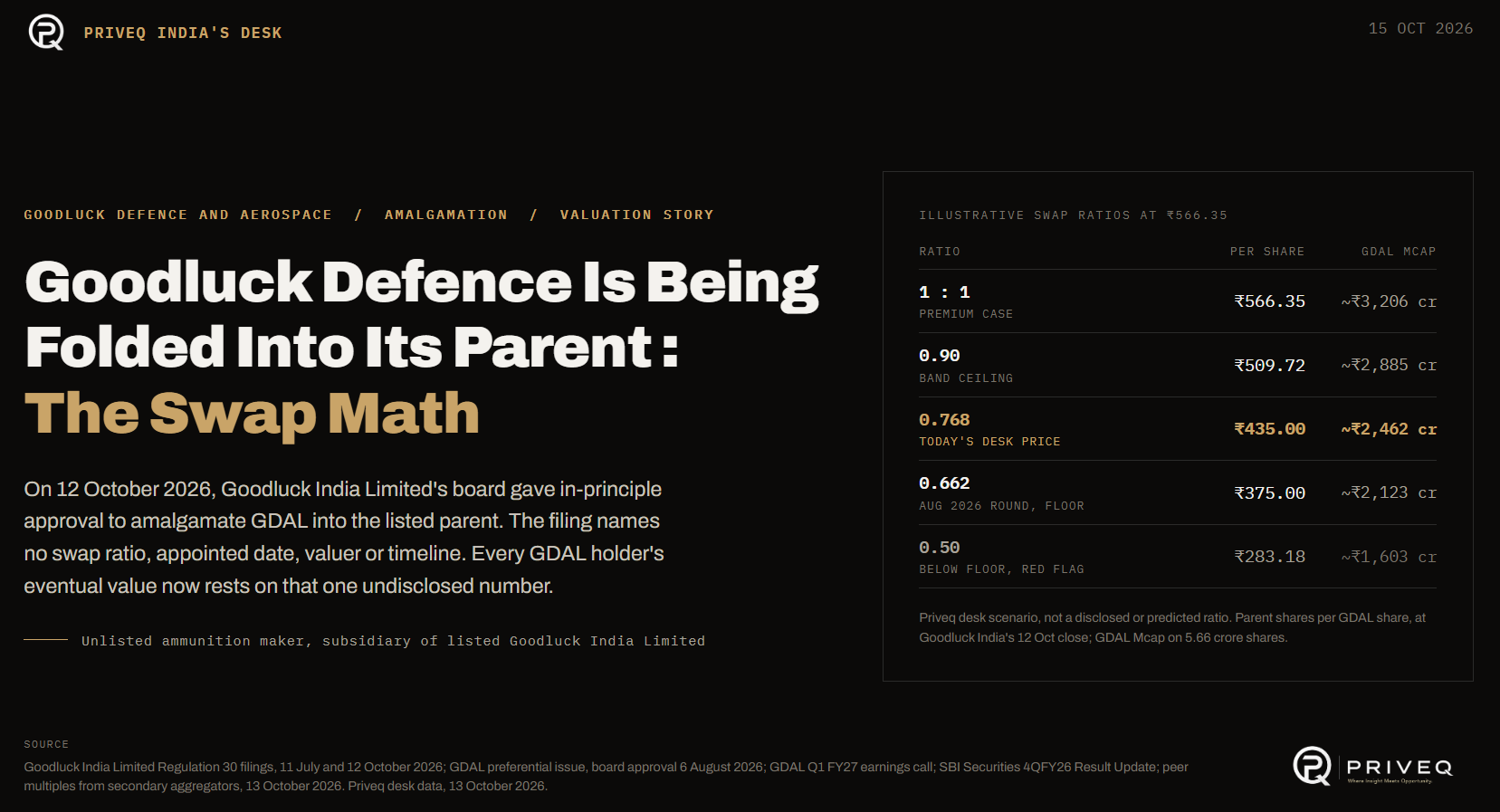
Putting the three anchors together, Priveq's defensible fair-value band for GDAL's side of the ratio runs from Rs. 375 (the recent primary round, acting as a practical floor absent any disclosed negative news since) to approximately Rs. 500-510 (the top of the forward-guidance-implied range), translating to a swap ratio of roughly 0.66 to 0.90 parent shares for every 1 GDAL share, with today's desk price (0.768) sitting close to the middle of that band.
Illustrative swap ratio (parent shares per GDAL share) | Implied value per GDAL share | Implied GDAL Mcap (5.66 cr shares) | How it reads against the three anchors |
|---|---|---|---|
1 : 1 | Rs. 566.35 | ~Rs. 3,206 crore | Above all three anchors, a clear premium case |
0.90 | Rs. 509.72 | ~Rs. 2,885 crore | Top of the defensible band (forward-guidance ceiling) |
0.768 (today's desk price) | Rs. 435.00 | ~Rs. 2,462 crore | Middle of the defensible band |
0.662 (Aug 2026 primary round) | Rs. 375.00 | ~Rs. 2,123 crore | Floor of the defensible band |
0.50 (1 : 2) | Rs. 283.18 | ~Rs. 1,603 crore | Below the Aug 2026 primary round, flagged below |
In the Rs. 283 figure specifically: a ratio that implies anything close to Rs. 283 per GDAL share is difficult to square with the facts in hand. GDAL itself priced new shares at Rs. 375 just over two months before this amalgamation news, and every piece of company-specific news disclosed since that round has been positive, not negative:
The Rs. 275 crore parent guarantee
The MIL sole-bidder qualification
The parent's own 13%+ rally on the amalgamation announcement itself
Absent some specific adverse information a valuer has seen and the market hasn't, there's no disclosed basis for marking GDAL down below what sophisticated investors paid for new shares in August. Priveq would treat a final ratio implying meaningfully less than Rs. 375 per share as a genuine red flag worth scrutinising, not simply a more conservative outcome.
Why The Real Ratio Could Land Somewhere Else Entirely
A scheme of arrangement's actual swap ratio is set by an independent valuer's fairness opinion, not by Priveq's three-anchor comparison above, and that opinion typically weighs several methods together:
Net asset value
Discounted cash flow or earnings capitalisation
Comparable company multiples
Where a market price exists, the market price method
GDAL's own share price is a desk-observed, unlisted-market figure, not an exchange-quoted price, so the "market price method" a valuer would actually apply likely carries less weight for GDAL's side of the ratio than it would for a listed-to-listed merger.
Priveq doesn't have GDAL's standalone net worth or full-year net profit figures, only its defence-segment FY26 EBITDA of approximately Rs. 29 crore (on Rs. 46 crore of defence revenue, per management's own May 28, 2026 call) and the Rs. 275 crore guarantee disclosing the scale of GDAL's project debt. Without a disclosed net asset value or audited standalone profit figure for GDAL, Priveq cannot build the earnings-capitalisation or NAV-based cross-check a real valuer would run alongside the market-price method, that gap stays open until GDAL or the scheme documents disclose those figures.
A listed-peer sanity check, with a deliberate mismatch flagged : Two listed ordnance-and-defence manufacturers trade at multiples nearly double GDAL's own self-referential 6.1x-8.2x forward-sales range above, and neither is a clean comp:
Solar Industries India: trailing P/S ~15.7x, Mcap approximately Rs. 1,78,673 crore, trailing P/E approximately 89.7x (as of October 13, 2026). A much larger, diversified explosives-and-defence major where defence is one segment among several.
Bharat Dynamics Limited: trailing P/S ~14.9x, Mcap approximately Rs. 41,238 crore, trailing P/E approximately 79.2x (as of October 13, 2026). A state-owned missile and torpedo prime carrying the kind of policy-driven premium a small private ammunition manufacturer wouldn't command.
Both multiples look distorted by scale and ownership structure rather than by anything transferable to GDAL.
A Closer Listed Peer Set, And What Each Implies For GDAL's Mcap
Solar Industries and Bharat Dynamics aren't the closest listed reference points available, they're just the largest and most liquid. Three smaller, more scale-comparable names sit closer to GDAL's actual business:
Premier Explosives Limited: a defence-and-space-focused explosives and propellant maker, with Defence & Space revenue at 84% of its mix as of 9M FY25.
Tirupati Forge Limited: secured an Arms Act license for 155mm artillery shell manufacturing, with pilot production targeted for December 2026.
Balu Forge Industries Limited: a diversified forging company that won an initial 30,000-unit 152mm artillery shell order in June 2026, scalable above 100,000 units.
These figures are sourced from secondary financial-data platforms (screener-type aggregators), not primary exchange filings, and are labeled as such.
Applying each peer's own trailing Price/Sales multiple to GDAL's Rs. 300-350 crore FY27 revenue guidance, a genuine limitation worth stating plainly since it mixes a forward guidance figure against each peer's trailing multiple rather than a clean like-for-like, gives a materially different read than the Solar Industries/Bharat Dynamics comparison :
Peer | Trailing P/S | Implied GDAL Mcap at Rs. 300-350 cr FY27 guidance | Implied value per GDAL share |
|---|---|---|---|
Solar Industries India | ~15.7x | ~Rs. 4,710-5,495 crore | Rs. 832-971 |
Bharat Dynamics | ~14.9x | ~Rs. 4,470-5,215 crore | Rs. 790-921 |
Premier Explosives (closest match) | ~6.67x | ~Rs. 2,001-2,335 crore | Rs. 354-413 |
Tirupati Forge | ~5.51x | ~Rs. 1,653-1,929 crore | Rs. 292-341 |
Balu Forge Industries | ~4.9x (consolidated basis) | ~Rs. 1,470-1,715 crore | Rs. 260-303 |
Why Premier Explosives stands out: similar scale to GDAL (Mcap ~Rs. 2,488 cr, TTM revenue ~Rs. 373 cr) and a comparably defence-dominated revenue mix (84% Defence & Space, 9M FY25). Its trailing P/S lands almost exactly inside GDAL's own 6.1x-8.2x self-referential range, an independent confirmation rather than an internal calculation. Tirupati Forge and Balu Forge Industries are literal 155mm/152mm shell entrants but earlier-stage in that specific business than GDAL, their lower implied values reflect how early their own shell revenue is, not a market discount on shells generally.
Premier Explosives is the closest match on fundamentals, not just product category. It's a similarly-sized company, Mcap approximately Rs. 2,488 crore against TTM revenue of approximately Rs. 373 crore, with a comparably defence-dominated revenue mix, as of its most recent reported data. Its own trailing multiple lands almost exactly inside GDAL's self-referential 6.1x-8.2x band, and the Rs. 354-413 per-share figure it implies sits close to, if slightly below, the Rs. 375-510 range built earlier from GDAL's own primary round and desk price. An independent listed company with genuinely similar scale and business mix landing in roughly the same place is a stronger validation of GDAL's own pricing than either the oversized Solar Industries/Bharat Dynamics comparison or Priveq's own internal triangulation would be alone.
Tirupati Forge and Balu Forge Industries are literal shell-makers but weaker comps for a different reason: both are earlier-stage in the shell business specifically than GDAL is. Tirupati Forge has secured its 155mm license but hasn't booked any shell revenue yet, pilot production isn't scheduled until December 2026, so its current multiple reflects its existing non-shell forging business re-rated on optionality, not an actual shell-revenue valuation. Balu Forge's 30,000-unit artillery shell order is a new, small addition to a much larger existing forging business spanning automotive and aerospace components, not yet a defence-dominated revenue mix the way GDAL's or Premier Explosives' is; separately, its own screener figures show a conflict between a TTM table revenue of Rs. 647 crore and a company announcement citing audited FY26 revenue of Rs. 1,107 crore, most plausibly a standalone-versus-consolidated reporting difference rather than a genuine contradiction, though Priveq hasn't independently confirmed which basis each figure uses. Both peers' lower implied Mcap figures above say more about how early their own shell businesses are than about what the market would pay for GDAL's already-guided, already-ramping Rs. 300-350 crore defence revenue base.
What Happens Next: The Process, Step By Step
Nothing in the October 12 filing happens automatically or quickly. A scheme of arrangement amalgamating an unlisted company into a listed one under Sections 230-232 of the Companies Act, 2013 has to clear a fixed sequence of steps, each one a point where the eventual terms can still move:
Independent valuer's fairness opinion. A registered valuer, typically working alongside a merchant banker, determines the actual swap ratio using the NAV, earnings-capitalisation, DCF, and market-price methods discussed above. This hasn't happened yet, or at least hasn't been disclosed.
Board-approved scheme document. The ratio, appointed date, and full transaction structure get formalised into an actual scheme, distinct from the in-principle approval disclosed on October 12.
Stock exchange no-objection. Because Goodluck India Limited is listed, BSE and NSE review the scheme under SEBI's circular on schemes of arrangement before it can proceed to NCLT.
NCLT filing and separate shareholder and creditor meetings. GDAL's own shareholders vote on the scheme separately from the parent's, each at the thresholds the Companies Act requires, and objections from either side can genuinely delay or reshape terms.
NCLT final order. The tribunal's approval is what actually sanctions the scheme.
Appointed date and share credit. GDAL shareholders receive parent shares at the ratio fixed in step 1, backdated to the scheme's appointed date.
Priveq has found no disclosed timeline for any of these steps as of October 14, 2026, and would caution against assuming a specific completion date until the scheme document itself is filed.
One distinction worth drawing from a comparable recent case: Cipla's NCLT-approved amalgamation of its wholly-owned subsidiary Inzpera Healthsciences, finalised in August 2026, needed no swap ratio at all because Inzpera had no outside shareholders, the filing explicitly notes "no new equity shares to be issued." GDAL's situation is structurally different precisely because it has outside shareholders (including the investors who bought in at Rs. 375 in August), which is exactly why a ratio has to exist here in a way it didn't for Inzpera, and why that ratio is the single number this entire story turns on.
Why FY27, Not Just Q1 FY27, Is The Right Lens
Priveq's triangulation above uses GDAL's own full FY27 revenue guidance of Rs. 300-350 crore, not a crude annualisation of the Rs. 80 crore Q1 FY27 figure alone, and that distinction gets sharper once a second, genuinely independent estimate is weighed in. SBI Securities' own 4QFY26 Result Update puts FY27 defence revenue at Rs. 270 crore, below the company's own raised Rs. 300-350 crore guidance, and FY28 defence revenue at Rs. 900 crore once the capacity expansion is commissioned, which the same report expects around 1QFY28, not within FY27 itself. That gap between the independent analyst's FY27 estimate and the company's own guidance is worth sitting with given management's own documented credibility gap: a February 2026 FY26 guide of roughly Rs. 100 crore came in at Rs. 45-46 crore actual, a miss the company attributed to export-shipment delays rather than a seasonal pattern.
Running the same self-referential 6.1x-8.2x forward Price/Sales band against SBI's more conservative Rs. 270 crore FY27 estimate gives an implied GDAL value of roughly Rs. 291 to Rs. 391 per share, modestly below the Rs. 323-507 range built off the company's own guidance, but still comfortably above the Rs. 283 figure already flagged as inconsistent with the August primary round.
Revenue basis | Source | FY27 revenue (Rs. crore) | Implied GDAL value per share |
|---|---|---|---|
FY27, company guidance | GDAL management, Q1 FY27 call | 300-350 | Rs. 323-507 |
FY27, independent analyst estimate | SBI Securities, 4QFY26 Result Update | 270 | Rs. 291-391 |
FY28, independent analyst estimate (post capacity expansion, direction only) | SBI Securities, 4QFY26 Result Update | 900 | Rs. 970-1,305 |
Why the relevant year could shift: no scheme timeline has been disclosed. A scheme of this kind routinely runs months past the original board approval (valuer's report, NCLT filing, separate shareholder/creditor meetings). If the valuation date lands later in FY27 or slips into FY28, the relevant revenue base could shift toward actuals-to-date or even toward the FY28 estimate, which carries materially more execution risk given the company's own history of guidance slippage on this exact capacity expansion.
There's a separate, structural reason FY27 alone may not even end up being the year that matters most. Neither filing discloses a swap-ratio timeline (see "What Happens Next" above), and a scheme of this kind routinely runs months past the original board approval once a valuer's report, NCLT filing, and separate shareholder and creditor meetings at both companies are accounted for. If the actual scheme and valuation date land well into FY27 or slip into FY28, the revenue base a valuer references could reasonably shift toward FY27 actuals-to-date, or even toward SBI's Rs. 900 crore FY28 estimate once the expanded capacity is running. That FY28 figure carries materially more execution risk than anything else in this piece, given how far out it sits and the company's own history of guidance slippage on this exact capacity expansion, but it's worth naming because it shows which direction the risk runs if the swap is set later rather than sooner: the longer this takes, the more the relevant revenue base likely grows, not shrinks, assuming the order book and capacity ramp stay on anything like their current trajectory.
The MIL Shell Qualification, As Supporting Context
The same week, GDAL separately disclosed qualifying as the Sole Eligible and Technically Qualified Bidder for a tender to supply 155mm HE M1A4 artillery shells to Munitions India Limited (MIL), a Ministry of Defence public sector undertaking. Sole-bidder status on a tender is a meaningful commercial signal, it typically means GDAL cleared MIL's technical qualification criteria while competing bidders did not, but it is not itself an order, and the filing discloses no contract value or quantity.
This matters to the amalgamation story mainly as context: it's a live, near-term reason GDAL's own defence order book could grow independent of anything the restructuring does, which is relevant to how any eventual valuer might read GDAL's forward earnings potential when setting a ratio.
The Desk View
Two things are true at once here. The amalgamation intent is real, dated, and consistent with a pattern Goodluck India Limited has been building since July (the guarantee, the bonus issue, now the enlarged scope), not a one-off announcement. And the single number that actually determines what this is worth to existing GDAL shareholders, the swap ratio, doesn't exist yet in any filing.
Priveq's own triangulation above narrows the defensible range meaningfully: anchored by GDAL's own August 2026 primary round (Rs. 375) at the floor and its forward-guidance-implied ceiling (roughly Rs. 500-510), the fair band sits well above the kind of deep-discount outcome a crude single-price comparison might otherwise suggest. Given the desk's own prior documented concern about GDAL management's guidance reconciliation (the unresolved Rs. 46 crore vs. Rs. 33 crore gap from the May 2026 call), Priveq would still want to see the actual scheme documents and the valuer's named methodology before treating any announced ratio as straightforwardly fair, but a ratio landing meaningfully below the Rs. 375 primary-round floor would be the bigger warning sign to watch for, not a ratio near today's desk price. The right posture for GDAL holders right now is to watch for the scheme filing and benchmark whatever ratio emerges against the Rs. 375 floor first, not to re-price GDAL off the parent's rally alone.
The Numbers At A Glance
Parent (Goodluck India Limited, listed): Rs. 566.35 close, +13.21%, Oct 12, 2026; Mcap ~Rs. 5,694 crore; ~9.9-10 crore shares post 2:1 bonus (record date Aug 21, 2026) GDAL (unlisted, this note's subject): Rs. 435 desk price, Oct 13, 2026; Mcap ~Rs. 2,462 crore; 5.66 crore shares GDAL's last primary round: Rs. 375/share, Aug 6, 2026, Rs. 283.5 crore raised; Mcap ~Rs. 2,123 crore GDAL's forward-guidance-implied range: Rs. 323-507/share, from FY27 defence revenue guidance of Rs. 300-350 crore Independent analyst FY27 estimate (SBI Securities): Rs. 270 crore, implying Rs. 291-391/share, more conservative than company guidance FY28 estimate (SBI Securities, post capacity expansion, distant and execution-dependent): Rs. 900 crore, implying Rs. 970-1,305/share Closest listed peer's validating multiple: Premier Explosives, ~6.67x trailing P/S, implying Rs. 354-413/share for GDAL Priveq's defensible swap-ratio band: 0.66 to 0.90 parent shares per 1 GDAL share (desk scenario, not disclosed) Swap ratio actually disclosed as of Oct 14, 2026: None
FAQs
Is Goodluck Defence and Aerospace (GDAL) being listed on the stock exchange?
Not directly. GDAL is being proposed for amalgamation into its already-listed parent, Goodluck India Limited, which would give existing GDAL shareholders listed shares in the parent once a swap ratio and scheme are finalised, rather than GDAL itself conducting an IPO.
Has a swap ratio been announced for GDAL shareholders?
No. The October 12, 2026 filing approves the intent to amalgamate GDAL into the parent but names no exchange ratio, appointed date, or valuer, leaving that as the single open variable for existing shareholders to watch.
Should GDAL shareholders expect the same swap ratio Priveq calculated in this piece?
No, the 0.66-0.90 band is an illustrative Priveq desk scenario, not a prediction. It triangulates GDAL's own recent primary round price, today's desk price, and its forward-revenue guidance, but doesn't account for the net asset value or earnings-capitalisation methods an actual independent valuer would also weigh.
Does a swap ratio implying Rs. 283 per GDAL share make sense?
Not on the facts Priveq has in hand. GDAL itself priced new shares at Rs. 375 in an August 2026 primary round, and every disclosed development since then has been positive, so a ratio implying a value below that round has no disclosed basis and would be a genuine red flag worth scrutinising.
What is a swap ratio in a company amalgamation, and why does it matter here?
A swap ratio sets how many shares of the surviving (here, listed) company each shareholder of the merging (here, unlisted) company receives for their existing holding. Because GDAL has no exchange-quoted price, this ratio is the only mechanism that converts a GDAL shareholder's stake into a tradable, listed asset, which is why its absence from the October 12 filing is the central open question of this story.
Does the parent's 13.21% stock jump mean GDAL is now worth more?
Not directly, and GDAL's own desk price hasn't moved. The parent's rally reflects the listed market's reaction to its own stock, which only translates into value for GDAL holders once a swap ratio converts GDAL shares into parent shares, a conversion that hasn't happened yet.
Could the eventual swap ratio be based on FY28 numbers instead of FY27?
It's possible, since no scheme timeline has been disclosed and this process typically takes months. If the valuation date lands later in FY27 or slips into FY28, the relevant revenue base a valuer references could shift toward the higher, more speculative FY28 estimate rather than today's FY27 guidance.
Reach Out
Have a position in GDAL and want to talk through what the swap ratio range above means for your specific holding? Reach out to the Priveq desk : +91 8287466698 on WhatsApp
Disclaimer
Priveq transacts as a named counterparty in these shares and may hold them, consistent with the disclosure carried in Priveq's two prior Event Notes on GDAL. This note is for informational purposes only and does not constitute investment advice. Unlisted shares carry liquidity, pricing, and regulatory risks distinct from listed securities. Readers should conduct independent due diligence and consult a licensed financial advisor before transacting.