


The Short Version
JSR Dynamics won the IAF's ADITI 1.0 challenge for a booster-assisted range extension kit, per the Defence Innovation Organisation's result dated 7 October 2024, and its desk price is Rs 12,100 as of 21 October 2026. India buys weapons through a staged route of grants, trials, sanction thresholds and production partners, and JSR Dynamics has publicly cleared the grant, design-win and first-trial stages, but the only quantity any primary document gives is five prototype kits, not a production run. Priveq reads the capability evidence as genuinely strong: an IAF-confirmed trial, two iDEX wins and BEL holding the IAF order. The price already assumes the next step, and the one variable that moves the call is whether the Khagantak-243 trial becomes a disclosed production quantity.
Company : JSR Dynamics Private Limited (converted to a public limited company on April 30, 2026), Nagpur, Maharashtra
Sector : Precision guided munitions and unmanned strike systems (Priveq category : Defense & Aerospace)
Founder: Air Marshal SB Deo (Retd), former Vice Chief of the Air Staff, IAF (founder's own account)
Latest audited year: FY2025-26; nil operating revenue in FY24, FY25 and FY26 (as reported in our earlier note on the company)
Desk price: Rs 12,100 per share as of October 21, 2026 (indicative, not an independent Priveq valuation); minimum lot 100 shares (check the live Marketplace page)
Market cap at desk price (derived by Priveq): Rs 2,725.98 crore on 22,52,877 equity shares (20,00,400 at March 31, 2026 plus 2,52,477 from the May 13, 2026 conversion of preference shares), excluding 40,00,000 redeemable preference shares and 4,258 unconverted convertible preference shares
Valuation lens: price to sales is not computable because operating revenue is nil; the piece uses peer price to sales and order-size reference points instead
Primary sources: iDEX/DIO ADITI 1.0 result (07.10.2024); ADITI scheme text and Edition 1.0 problem statements; iDEX Navy Open Challenge 8.0 notice (23-08-2023); PIB release on draft DAP 2026 (February 13, 2026)
Identifiers: CIN U29113MH2018PLC318834, as printed on the company's FY26 Form PAS-3 annexure (allotment of May 13, 2026) and shown on ZaubaCorp from MCA filings; the earlier private-company CIN was U29113MH2018PTC318834. equity ISIN INE0JFD01014, confirmed on the NSDL securities search (description "JSR DYNAMICS LIMITED EQ", status active, face value Rs 10, former name JSR Dynamics Private Limited); registrar and transfer agent Purva Sharegistry (India) Private Limited per the same record
Last verified: October 20, 2026
For the live desk snapshot, see JSR Dynamics on the Priveq Marketplace. For the earlier company read, see JSR Dynamics: Ten Products, One Trial and a 53% Rally.
Why is India Is Building Its Own Weapons?
India's defence production reached about Rs 1,54,000 crore (Rs 1.54 lakh crore) in FY2024-25, against Rs 46,429 crore in 2014-15, according to Press Information Bureau (PIB) releases. The same releases put defence exports at Rs 23,622 crore in FY2024-25, up from Rs 686 crore in FY2013-14, and say 177 of the 193 capital contracts signed in FY2024-25, worth Rs 1,68,922 crore of Rs 2,09,050 crore, went to domestic industry (about 80.8%, derived by Priveq). The direction is deliberate. The government has published five Positive Indigenisation Lists covering over 5,500 items, of which about 3,000 had been indigenised by February 2025, and earmarked 75% of the FY2025-26 modernisation budget, Rs 1,11,544 crore, for domestic industry.
One reason is supply. ThePrint reported on April 26, 2023, citing unnamed officials, that the Russia-Ukraine war and payment problems had disrupted military supplies from Russia and Ukraine, that the Air Force was the worst hit, that remaining S-400 regiments and Su-30MKI spares were delayed, and that about USD 2 billion in payments was pending. Officials told the paper that preparedness was not affected. That is a secondary report and we treat it as a lead. SIPRI's data points the same way: Russia supplied 72% of India's arms imports in 2010-14, 55% in 2015-19 and 36% in 2020-24, while India stayed the world's second-largest importer. There is also reporting on the United States side in 2026, with caveats. ThePrint reported on April 1, 2026, citing unnamed defence establishment sources, that GE told Hindustan Aeronautics the delay in F404 engines for the Tejas Mk1A was due to the "ongoing US-Israel and Iran war"; six engines had arrived against 11 promised for the year ended March 31, 2026. GE's public statement did not mention the war, and The Week noted it could not confirm the link independently. The engine delays also predate that war: Tribune reported pending Tejas engines in September 2024 and July 2025 without naming a cause. Separately, Bloomberg, relayed by UNI on September 19, 2026, reported that depleted US stocks and production bottlenecks from the Iran war could delay US weapon deliveries to allies, naming Germany; India was not mentioned in the text we read. These are secondary reports, so we present them as reported, not as established. The honest reading is that India has been moving away from a single dominant foreign supplier for a decade, that the Russia-Ukraine war sharpened the case, and that the 2026 Iran war has been reported, not proven, to have added to it.
India's Defence Self-Reliance Scoreboard, Rs Crore Unless Stated
Measure | Earlier base | Latest | Source (tier) |
|---|---|---|---|
Defence production, Rs crore | 46,429 (2014-15) | 1,27,434 (2023-24); 1,54,000 (FY2024-25, reported as Rs 1.54 lakh crore) | PIB releases (Tier 1) |
Defence exports, Rs crore | 686 (FY2013-14) | 23,622 (FY2024-25); target 50,000 by 2029 | PIB (Tier 1) |
Private sector share of FY2024-25 production | not read | 23% | PIB (Tier 1) |
Private sector exports, Rs crore | not read | 15,233 (about 64.5% of exports, derived) | PIB (Tier 1); share derived by Priveq |
Capital contracts signed, FY2024-25 | not read | 193 worth 2,09,050; 177 worth 1,68,922 went to domestic industry (about 80.8%, derived) | PIB (Tier 1); share derived by Priveq |
iDEX contracts and firms, as of February 2025 | not read | 430 contracts; 619 startups and MSMEs; 43 items worth over 2,400 procured (about 55.8 per item, derived) | PIB (Tier 1); average derived by Priveq |
US-origin supply, 2026 (reported) | Tejas engine delays pending since 2024 (cause not stated) | 6 of 11 F404-IN20 engines delivered in the year to March 2026; GE reportedly cited the US-Israel-Iran war (unnamed sources); GE's public statement did not | ThePrint, April 1, 2026 (Tier 3) |
Russia's share of India's arms imports (SIPRI) | 72% (2010-14); 55% (2015-19) | 36% (2020-24) | SIPRI trends data (Tier 3, secondary dataset) |
India's arms imports, 2020-24 vs 2015-19 | base period | down 9.3%; India still the second-largest importer | SIPRI (Tier 3, secondary dataset) |
Source: Press Information Bureau (PIB) defence releases for FY2023-24 and FY2024-25 and the February 2025 iDEX figures; SIPRI Trends in International Arms Transfers 2024. Production and export figures are in Rs crore; 1,54,000 is the Rs 1.54 lakh crore reported by PIB. Derived shares are Priveq arithmetic on the reported figures. Not independently re-checked against the Ministry of Defence annual report.
The scoreboard does not say a private firm like JSR Dynamics is part of the story. It says the buyer is spending a rising share of its budget at home, and a precision-munitions maker is the kind of supplier that policy is built to favour. It does not remove the dependence.
Net read: the policy tailwind is documented in primary releases; the supplier-war link rests on one secondary report and one dataset.
Where Does JSR Dynamics Sits In The Defence Stack?
JSR Dynamics sits at the weapon-systems layer of the Indian defence chain, the layer that integrates a body, a flight controller, a seeker and a warhead into something a pilot can release, and no listed company is a pure comparison for it. We use five listed names as references, read from Screener on October 20, 2026: Bharat Electronics (BEL) trades at about 9.6 times trailing sales, Solar Industries India at 15.8, and the three smaller growth names, Data Patterns, Paras Defence and Zen Technologies, between 20.0 and 24.1. BEL matters most here because it is the production partner the Indian Air Force (IAF) order for the Khagantak-243 glide bomb has been reported against; the layer map is Priveq's framing.
Where JSR Dynamics Sits In The Defence Stack, With Listed References, Rs Crore
Layer (Priveq framing) | What the layer does | Reference company | Market cap | TTM sales | Price to sales | TTM net margin |
|---|---|---|---|---|---|---|
Energetics and ammunition | Explosives, propellants, warheads | Solar Industries India | 179,197 | 11,351 | 15.8x | 18.1% |
Components, optics and materials | Optical sub-systems, thermal imaging, composites | Paras Defence and Space Technologies | 10,195 | 511 | 20.0x | 18.8% |
Training, simulation and counter-drone | Simulators and counter-drone systems | Zen Technologies | 14,694 | 671 | 21.9x | 29.4% |
Defence electronics and EW (private) | Radar, EW, avionics | Data Patterns | 22,684 | 941 | 24.1x | 28.5% |
Defence electronics and EW (public sector, production partner) | Systems integration and electronics | Bharat Electronics (BEL) | 275,725 | 28,717 | 9.6x | 21.4% |
Weapon systems and integration | Precision glide kits, glide bombs, decoy and loitering systems | JSR Dynamics (unlisted, desk price Rs 12,100) | 2,726 (common equity, derived) | nil operating revenue FY24 to FY26 | not computable | not computable |
Source: Screener.in consolidated pages for each listed company, read on October 20, 2026; market cap and trailing-twelve-month sales and net profit as displayed. Price to sales and net margin are derived by Priveq. JSR Dynamics market cap is the desk price of Rs 12,100 (as of October 21, 2026) times 22,52,877 common equity shares; compulsorily convertible preference shares are not included. The layer map is Priveq's framing, not an industry standard. Listed multiples move daily; refresh before relying on them.
The spread in the table is the point. A scaled public-sector integrator is valued at under 10 times sales; small, high-margin component and electronics firms at 20 or more. The market pays for margin and scarcity, and a weapon integrator that depends on partners for electronics may land closer to the first group than the second once it has revenue. That is a reading, not a forecast, and JSR Dynamics has no sales yet to test it on.
Net read: the stack gives the price a comparison, not a justification.
What Do JSR Dynamics' Products Do For The Services?
JSR Dynamics' products do one job for the armed forces: they make an existing weapon reach further and land closer, at a lower cost than buying an imported precision weapon. A booster-assisted kit lets an aircraft release an existing 250 kg bomb from outside the range of air defence. A glide bomb gives the same stand-off with a purpose-built airframe. A decoy drone makes the enemy radar switch on and reveal itself. A guided rocket puts precision into ammunition the Army already fires. The founder's cost claim is specific but unpriced: in the October 12, 2026 Bharat Shakti interview he said guided rockets cost one-twelfth of an imported equivalent, and the trade site idrw repeated it on October 13, 2026. No unit price was given by either, so we do not carry the number forward.
The tier tags in the table show how far each claim can be trusted. Tier 1 is a primary government or regulatory document, Tier 2 is a statement by the company or its founder, and Tier 3 is secondary reporting we treat as a lead.
JSR Dynamics Products, What They Do For The Services, And How Well The Claim Is Sourced
Product | What it does for the user | Service and status | Best source for the claim | Tier |
|---|---|---|---|---|
Booster-assisted range extension kit (BA-REK, listed on the site as JPB) | Bolts onto an existing 250 kg bomb to add a rocket booster and an electro-optical/infrared (EO-IR) seeker, so the aircraft can release from further away | IAF; ADITI 1.0 Challenge 09 won; result dated 07.10.2024 | iDEX/DIO ADITI 1.0 result | Tier 1 |
Khagantak-243 glide bomb | A Mk 81-class glide bomb for stand-off strikes, built to release from altitude and glide to target | IAF drop trial met objectives (IAF post, 2 September 2026); BEL notified an IAF order of unspecified quantity (Janes, February 2025; BEL statement of 11 February) | IAF statement; Janes | Tier 1 (trial) / Tier 3 (BEL order) |
Long Range Powered Precision Guidance Munition (LRPGM) | A powered, guided munition for the Navy | Listed for Navy Open Challenge 8.0, Challenge 2 | iDEX notice dated 23-08-2023 | Tier 1 |
MGLD jet-powered decoy and loitering drone (site spec: over 300 km, 1.2 h endurance) | A jet-powered drone that can act as a decoy or carry a warhead | Founder says an IAF contract exists and firing is due in months; the IAF's ADITI decoy-swarm challenge went to Anadrone Systems, not JSR | Bharat Shakti interview, 12 October 2026; ADITI 1.0 result | Tier 2 (contract claim) / Tier 1 (ADITI result) |
MGLD-N (Navy variant) | Naval decoy and strike variant | Reported Navy iDEX contract; no value, date or result disclosed | idrw, 13 October 2026 | Tier 3 |
Guided rockets (180 mm Army, 300 mm aircraft variant) | Adds guidance to rockets; founder says 12 guided rockets cost about the same as one imported equivalent | Technical collaboration agreement with Munitions India Limited (founder); no unit price | Bharat Shakti interview | Tier 2 |
Guidance kits and mortars (210-260 mm kit, 120 mm guided mortar, 122 mm rocket) | Turns unguided ammunition into precision ammunition | Listed on the company site; no customer or order named | Tier 2 | |
Jet-powered cruise missile (27-50 kg warhead, about 1,000 km) | A low-cost long-range strike weapon | Founder describes it; no trial or order read | Bharat Shakti interview | Tier 2 |
Source: iDEX/Defence Innovation Organisation ADITI 1.0 result dated 07.10.2024; iDEX Navy Open Challenge 8.0 notice dated 23-08-2023; Janes, February 2025 (BEL statement of February 11); IAF post of September 2, 2026; Bharat Shakti interview with Air Marshal SB Deo (Retd), October 12, 2026; jsrdynamics.in; idrw.org, October 13, 2026. Tier 1 is a primary government or regulatory document, Tier 2 is company or founder stated, Tier 3 is secondary reporting treated as a lead. The expansion of the acronym MGLD was not found in a document we read, so we use the abbreviation.
Two things stand out in the table. First, the Tier 1 rows are the ones with a government document behind them: the ADITI result, the Navy notice and the IAF trial statement. Second, the largest-sounding rows, the decoy contract and the cruise missile, are founder statements. One detail corrects an easy assumption: the IAF's own ADITI decoy-swarm challenge was won by Anadrone Systems of Gurugram, not JSR Dynamics, so the decoy contract the founder describes is a different route that we could not trace to a document.
Net read: three product claims are documented, the rest should be read as ambition until a document appears.
How JSR Dynamics Contributes To Atmanirbhar Bharat
JSR Dynamics' contribution to self-reliance is that the airframes, aerodynamics and control logic of its weapons are designed and built in Nagpur, the parts of a weapon that a foreign supplier would otherwise keep. The founder said in the October 12, 2026 interview that the firm follows an indigenous design, development and manufacture philosophy and will not field a product that performs 20% worse and costs 30% more than the import. He described an in-house 141-teraflop computer used for flow simulation that, he said, lands within 1% to 3% of flight results, a coordinate measuring machine, a five-axis machining centre from an Indian maker, carbon-fibre moulds, and a carbon-fibre supplier that has moved from the United States and the Netherlands to an Indian firm, Takasa. These are founder statements (Tier 2). The IAF's ADITI result and the iDEX Navy notice, both Tier 1, confirm that the design was good enough to win government challenges.
The dependence is real too, and the piece should say so. The founder said components such as silicon are still imported, though off the shelf and not export-controlled. The Khagantak-243 electronics and guidance, per Janes in February 2025 (BEL's statement of February 11), are BEL's, with JSR Dynamics building the body and control. The company site lists a 1,500 N turbojet for its drone, but where the engine comes from was not in anything we read. Draft DAP 2026 would raise the indigenous-content threshold for the top buy category from 50% to 60%, with at least 30% at trials, so imported content is a live issue for every firm in this layer, not only JSR Dynamics.
Net read: JSR Dynamics adds Indian design and airframe capability where India was dependent; it does not yet make the whole weapon from Indian parts, and nobody in this layer does.
How India Buys A Weapon : The Staged Route
India buys a weapon in stages, and each stage has a document that says whether a company has passed it. At the first stage, the iDEX/ADITI scheme sets a challenge and gives winners a grant of up to 50% of the development budget, capped at Rs 25 crore per winner and paid against milestones (ADITI scheme, Paras 2.2(b), 4(a), 6(b)). The scheme outlay is Rs 750 crore for FY2023-24 to FY2025-26, up to two winners are picked per challenge, and the scheme expects 20% of the technologies to reach productionisation (Para 9(ii)). It makes no procurement commitment, and whether it continues after March 2026 is not stated in the text we read. A winner then builds the prototype, the service tests it, and only after that does a sanction (Acceptance of Necessity) and a contract follow. JSR Dynamics has publicly cleared the first rungs.
The Indian Defence Procurement Ladder And Where JSR Dynamics Has Reached
Stage | What happens | Document or authority | JSR Dynamics status | Tier |
|---|---|---|---|---|
1. Challenge and grant | iDEX/ADITI sets a problem statement; winners get a grant of up to 50% of development cost, capped at Rs 25 crore per winner, paid in milestones | ADITI scheme text, Paras 2.2(b), 4(a), 6(b) | Won IAF Challenge 09 (07.10.2024); founder says Rs 10 crore plus received | Tier 1 / Tier 2 |
2. Prototype delivery | Winner builds and certifies the deliverable; for Challenge 09 that is five kits with integration and certification kit | ADITI 1.0 problem statements, PS-9 | Delivery of the five kits not read | Tier 1 (spec) |
3. User trials | The service tests the system against its stated parameters | Service trial reports | IAF said the Khagantak-243 drop trial met its objectives (2 September 2026) | Tier 1 |
4. Acceptance of Necessity (AoN) | The competent authority approves the need and the route to buy it | Draft DAP 2026, Chapter II Para 9: SPB up to Rs 300 crore; DPB Rs 300-500 crore; DAC above Rs 500 crore | No AoN for a JSR product read | Tier 1 (draft) |
5. Production partner | A public-sector or large-industry partner builds in volume | BEL notified of an IAF order (Janes); BEL-JSR MoU reported 2019-2020 | Order is BEL's, from the IAF; quantity and value undisclosed; JSR's share unknown | Tier 3 |
6. Contract and delivery | Signed contract with quantity, price and schedule | MoD contract announcement | None read for a JSR product; FY25 board report (10 July 2025) says sales had not begun and the IAF follow-on is contingent on validating the current agreement | Tier 1 (company statutory report) |
Source: ADITI scheme text (Paras 2.2(b), 4(a), 6(b)); ADITI 1.0 problem statements; draft Defence Acquisition Procedure (DAP) 2026 as released by the Press Information Bureau on February 13, 2026 and the partial draft text read through Chapter II Para 13; Janes, February 2025 (BEL statement of February 11); IAF post of September 2, 2026. SPB, DPB and DAC are the Service, Defence and Defence Acquisition councils' procurement boards. The ladder is Priveq's simplification of a process with variants by route.
The most useful reading of the table is where the documents stop. Stages 1 and 3 have Tier 1 evidence for JSR Dynamics. Stage 5 has secondary reporting that BEL notified an order. Stage 6, a signed contract with quantity and price, has none, and JSR Dynamics' own FY25 board report, signed on 10 July 2025, says why: revenue came "mainly from interest income," sales were "to begin soon," and the IAF's follow-on contract for long-range glide bombs is "contingent upon successful validation of the current agreement." That is not unusual for a company at this point in the route; it is the gap a reader should carry into any valuation.
Net read : JSR Dynamics is documented through trials and not yet documented at the contract.
What Does Draft DAP 2026 Changes?
Draft Defence Acquisition Procedure (DAP) 2026, announced by PIB on February 13, 2026, cuts the buy categories from five to four and raises the indigenous-content requirement for the top Indian category from 50% to 60%. We read the published partial draft only through Chapter II Para 13. The Make and iDEX and trial provisions in Chapters III to XII we could not obtain as text; we cite them from the Ministry of Defence statement of February 13, 2026 (carried by All India Radio), a JSA law-firm summary of March 2026, and an ORF commentary, all of which agree on five years of assured orders and none of which gives a quantity. We found no final version, so everything below is a draft. The provisions below are the ones that touch JSR Dynamics.
Draft DAP 2026: The Provisions That Matter For A Small Weapons Maker, Rs Crore Unless Stated
Provision | What the draft says | Locator | Read from | Why it matters here |
|---|---|---|---|---|
Buy categories | Five categories cut to four: Indian-IDDM; Indian and Manufacture in India; Global and Manufacture in India; Global | PIB release; draft text | PIB and draft PDF | Indian-IDDM (indigenously designed, developed and manufactured) is the route JSR's own designs would use |
Indigenous content | Indian-IDDM content raised from 50% to 60%: at least 30% at trials and at least 60% overall by final contract | Draft Para 27.4 | Draft PDF (partial) | Priveq reading: imported silicon may weigh on the percentage; how the draft counts it was not read |
Technology readiness level (TRL) | Indian-IDDM: TRL 5-9 (Para 22.1.2); single-vendor IDDM: TRL 6-9 (Para 21.2.1); Make-I/II: TRL 1-5 | Draft Paras 21.2.1, 22.1.2 | Draft PDF (partial) | The draft states two different ranges for Indian-IDDM; which applies to a given system was not read |
Request for information response | 8 weeks | Chapter I Para 8 | Draft PDF (partial) | Sets the clock on the first formal step |
AoN validity | 24 weeks | Chapter II Para 12 | Draft PDF (partial) | A sanction lapses if no contract follows |
AoN authority | SPB up to Rs 300 crore; DPB Rs 300-500 crore; DAC above Rs 500 crore | Chapter II Para 9 | Draft PDF (partial) | A first order for a small system sits at the lowest authority |
Life cycle cost analysis (LCCA) | Applies up to Rs 75 crore per project, with an annual cap of Rs 2,000 crore | Draft Para 19.3 | Draft PDF (partial) | Cost of ownership, not only unit price, enters the comparison |
Development scheme | Make-I/II/III, iDEX and the Technology Development Fund; iDEX/Make winners expected to get spiral development and five years of assured orders | MoD statement, Feb 13, 2026 (Tier 1); JSA Prism, Mar 2026, item 6(g) (Tier 3) | Statement and summary; draft text not read | Five years of assured orders is announced; no source gives a quantity |
Trials | Two-stage trials; vendors who succeed in trials get compensation; services can choose a quality-assurance trial mode | MoD statement (Tier 1); JSA Prism item 6(e) (Tier 3) | Statement and summary; draft text not read | Compensation for vendors who succeed in trial evaluations eases trial cost for a small firm; the amount is not stated |
Minimum pilot order | After an iDEX or TDF prototype passes trials, the sponsoring service must place a minimum pilot order quantity described as meaningful in scale | ORF commentary (Tier 3) | Commentary only; draft text not read | The nearest thing to a stated order commitment; the quantity is not given |
Global-category content | Global vendors must ensure 30% indigenous content | JSA Prism item 3 (Tier 3) | Summary only | Raises the bar for imported weapons competing with JSR Dynamics' products |
Design-cum-production partner (DcPP) | Term appears in the draft; PIB says it will be reviewed for a level playing field | Draft Para 23 | Draft PDF (partial) | No source applies the term to Khagantak-243 |
Source: PIB release dated February 13, 2026 on draft DAP 2026; partial draft DAP 2026 text (through Chapter II Para 13) as published on defencecapital.in. Draft DAP 2026 is a draft; no final version was found. Chapters III to XII could not be obtained as text, so the Make/iDEX and trial provisions are cited from the Ministry of Defence statement of February 13, 2026 (carried by All India Radio), the JSA Prism summary of March 2026 and ORF commentary. Amounts are in Rs crore.
Three of these bear on a first order. The AoN authority table means a small system can be sanctioned at the lowest board, below Rs 300 crore, without going to the top council. The 24-week sanction validity means a sanction can lapse if the contract does not follow. And PIB's description of five years of assured orders for iDEX and Make winners, if it survives into the final text, would be the first stated route from a grant to a volume commitment; we could not read its quantity or conditions.
Net read : The draft is friendlier to domestic designers, but the assured-order clause is the one to watch and the one we cannot yet quote.
What The IAF Actually Asked For
The IAF's problem statement for Challenge 09 asked for five kits, not a production run, and that is the only quantity any primary document gives for JSR Dynamics' IAF weapon. Statement PS-9 in the ADITI Edition 1.0 problem statements asks for a rocket- or engine-assisted range extension kit with an electro-optical/infrared seeker for the IAF's existing 250 kg bombs, with range above 150 km from a 5 km release at 0.8 Mach, scene-matching terminal guidance that works when satellite navigation is denied, fit to current bomb racks, and a circular error probable (CEP) under 5 m. The expected deliverable is five kits with integration, certification, maintenance equipment and storage. The result dated 07.10.2024 names JSR Dynamics Private Limited, Nagpur, for Challenge 09, subject to eligibility criteria. The other four IAF challenges went to Anadrone Systems, Diaspro Intech, Rchobbytech Solutions and AerX Labs India.
What The IAF Asked For In Challenge 09, And What Is Publicly Known About JSR Dynamics' Kit
Requirement | IAF problem statement PS-9 (Tier 1) | Public evidence on JSR Dynamics' kit | Tier |
|---|---|---|---|
Purpose | Rocket- or engine-assisted range extension kit with EO-IR head for existing 250 kg HSLD bombs | ADITI result confirms JSR for Challenge 09, 'booster assisted REK with EOIR terminal guidance' | Tier 1 |
Range | More than 150 km at 5 km launch altitude and 0.8 Mach | Site lists the kit's range as limited to 290 km; launch conditions not stated; no measured result read | Tier 2 |
Terminal guidance | EO-IR seeker with scene matching and GNSS-denied capability | GNSS-denied performance not read | not read |
Accuracy | Circular error probable (CEP) under 5 m; under 3 m desirable | Not read for this kit (a 5 m CEP appears for LRPGM, a different product, in company-released specs via idrw) | not read |
Integration | Fits existing IAF bomb racks | Not read | not read |
Deliverable | Five kits with integration, certification, maintenance equipment and storage facility | Delivery of the five kits not read | Tier 1 (spec) |
Future use | Higher weight-class kits | No order for higher classes read | not read |
Source: ADITI Edition 1.0 problem statements (17 statements: Army 3, Navy 5, IAF 5, Defence Space Agency 4), PS-9; iDEX/DIO ADITI 1.0 result dated 07.10.2024 (valid subject to eligibility criteria); jsrdynamics.in. 'Not read' means the item was not found in any document we read, not that it does not exist.
This table is the corrective to headline thinking. A win is a development contract for a defined prototype. Whether the kit hit 150 km, 5 m and GNSS-denied performance is the thing the public record does not yet say; the company site gives a range figure without launch conditions. Net read: the five-kit deliverable is a primary-sourced anchor, and the performance against it is unproven in public.
Civil And Defence Aerospace : Same Sky, Different Rules
Global civil aerospace is short of capacity, with a backlog of over 17,000 aircraft and lead times near seven years per IATA and Oliver Wyman figures cited in a Markets by Zerodha video of October 17, 2026, while defence runs on a different clock. The video does not mention JSR Dynamics. We use it as a lead, check the figures against named sources where we could find them, and put JSR Dynamics next to the civil suppliers because both sit in the same Indian precision-manufacturing base. Airbus's India sourcing rose from USD 500 million in 2019 to USD 1.4 billion in 2024, with a USD 2 billion target by the end of the decade, per its India head quoted in April 2025, and Indian aerospace exports are reported at USD 7 billion in FY25 against USD 1.4 billion in FY20. Civil figures are in US dollars as stated and are not converted.
Civil And Defence Aerospace: Same Sky, Different Rules
Dimension | Civil aerospace supply chain | Defence weapons route (India) | Source (tier) |
|---|---|---|---|
Demand signal | Backlog of over 17,000 aircraft; lead times near 7 years | Needs approved case by case through AoN; no standing backlog is published | IATA/Oliver Wyman (Tier 3, via video); draft DAP 2026 (Tier 1) |
Who buys | Two airframers (Boeing and Airbus, about 86% of deliveries per the video) sit above tiers of suppliers | One buyer, the state, through the services | Video claim (Tier 3); DAP (Tier 1) |
Qualification time | Certification said to take 3 to 7 years; one engine part took 4 years to first zero-defect blade (video) | Grant, trials and sanction in stages; draft sanction validity is 24 weeks | Video (Tier 3); draft DAP 2026 Ch II Para 12 (Tier 1) |
Capacity signal | Engine overhauls rose from 30-60 days to up to 120 days | Not published | AVweb (Tier 3) |
India's share and pull | Airbus India sourcing: USD 500 million (2019), USD 1.4 billion (2024), USD 2 billion target by decade end; Indian aerospace exports USD 1.4 billion (FY20) to USD 7 billion (FY25) | Defence exports Rs 686 crore (FY2013-14) to Rs 23,622 crore (FY2024-25) | Airbus India MD via The Machine Maker; idrw/USI; PIB (Tier 1) |
Margin shape | MRO gross margin 20-35% against 5-10% for manufacturing (video, citing IATA); working capital cycles over 70 days | Not disclosed for JSR Dynamics; no revenue yet | Video (Tier 3) |
Cost of labour | Lower in India than in the US and Europe | Same advantage, but quality oversight (DGQA, CEMILAC) adds cost | Video (Tier 3); founder (Tier 2) |
Import dependence | Titanium, superalloys, aluminium grades and carbon fibre imported | Silicon components imported but 'off the shelf' and not controlled (founder); carbon fibre now from Indian supplier Takasa | Video (Tier 3); founder (Tier 2) |
Source: Markets by Zerodha (Hindi) video of October 17, 2026, used as a lead and verified where a primary or named source was found; IATA/Oliver Wyman; AVweb; The Machine Maker (Airbus India MD Remi Maillard, April 2025); idrw/USI; PIB. Civil figures are in US dollars as stated and are not converted. The video does not mention JSR Dynamics; the comparison is Priveq's. The video's labour-cost figures were garbled in the auto-transcript and are not used.
The contrast is in who sets the pace. In civil, two airframers and a backlog set a multi-year, visible demand curve, and a supplier is paid for qualifying. In defence there is one buyer, no published backlog, and a staged sanction. The same factory skills, tight tolerances and certified processes, serve both, which is why Indian firms in precision machining talk about both. For JSR Dynamics, the civil story is relevant as a talent and supplier-base signal and as a possible way to smooth demand, but the company has not said it will do civil work, and we do not suggest it.
Net read : the civil boom validates the Indian manufacturing base; it does not create defence orders.
What A First Order Could Look Like
A first order is more likely to be sized by a sanction threshold and by what similar small suppliers have won than by what the company hopes for. We do not give a unit price or a unit-count forecast, because no primary document gives either. We can give the reference points a reader can check: the ADITI grant cap, what the scheme and PIB say about iDEX-linked procurement so far, and the sanction thresholds in draft DAP 2026. A reference point is not an order.
Order-Size Reference Points By Route, Rs Crore (Ceilings, Not A Forecast)
Route | Reference point | Rs crore | Source (tier) |
|---|---|---|---|
ADITI grant | Maximum grant per winner (a development grant, not an order) | 25 | ADITI scheme (Tier 1) |
ADITI-linked procurement, observed | 13 procurement contracts worth over 280, about 21.5 each (derived, a floor) | 21.5 | ADITI scheme Para 1(c) (Tier 1); average derived |
iDEX-supported items, observed | 43 items worth over 2,400, about 55.8 per item (derived, a floor) | 55.8 | PIB, February 2025 (Tier 1); average derived |
BEL's IAF order for Khagantak-243 | Held by BEL; quantity and value undisclosed; JSR's share unknown, so not counted as JSR order book | n/d | Janes, February 2025 (Tier 3) |
Lowest sanction authority | SPB can sanction up to | 300 | Draft DAP 2026 Ch II Para 9 (Tier 1, draft) |
Mid sanction authority | DPB sanctions | 300 to 500 | Draft DAP 2026 Ch II Para 9 (Tier 1, draft) |
Top sanction authority | DAC above | 500 | Draft DAP 2026 Ch II Para 9 (Tier 1, draft) |
Life cycle cost analysis | Applies up to, per project | 75 | Draft DAP 2026 Para 19.3 (Tier 1, draft) |
Viewer expectation (not evidence) | A comment on the interview video wished for yearly orders of 500 | 500 | Viewer comment (Tier 3); not used as evidence |
Source: ADITI scheme text; PIB (iDEX figures, February 2025); draft DAP 2026 (PIB release of February 13, 2026 and partial draft text). Averages are Priveq arithmetic on 'over' figures and are therefore floors. These are reference points for sizing a conversation, not a forecast of what JSR Dynamics will be ordered. JSR Dynamics has no disclosed order book, so backlog coverage cannot be computed.
Read as ceilings, the table says three things. ADITI-linked procurement observed so far averages about Rs 21.5 crore a contract, and iDEX-supported items about Rs 55.8 crore each (both derived from "over" figures, so floors, and both blended across very different products). A first order for a small weapons kit would sit at the lowest sanction authority, which handles up to Rs 300 crore. And the one number the public discussion reaches for, Rs 500 crore a year, is a viewer's wish in a comment, not evidence. The IAF order that BEL was notified of in February 2025 has no disclosed quantity or value, and JSR Dynamics has no disclosed order book, so backlog coverage, the metric we would use for a defence manufacturer, cannot be computed. One figure circulates that this table does not support. An undated ORIM Advisors note (its file path suggests January 2025) describes a "confirmed order book" of Rs 1,000 crore, split Rs 300 crore IAF, Rs 300 crore Navy, Rs 260 crore BEL and Rs 140 crore exports, with over Rs 5,000 crore in negotiation. We do not count it. It names no contracts or source, it projects FY25 revenue of Rs 360 crore and FY26 of Rs 690 crore against nil operating revenue in both years, it prices an issue at Rs 7,551 a share while the company's allotment filing shows Rs 6,514, and the company's own FY25 board report says sales had not begun.
Net read: orders in the tens of crores are consistent with how the route has worked; orders in the hundreds are not yet supported by a document.
What Does The Price Assume?
The desk price of Rs 12,100 (October 21, 2026) values JSR Dynamics' common equity at about Rs 2,725.98 crore against nil operating revenue in FY24, FY25 and FY26. From our earlier note: FY26 net profit was Rs 2.31 crore, driven by grant income, foreign exchange gains and interest rather than sales; total assets were Rs 268.98 crore; shareholders' funds were Rs 131.34 crore. The figures come from that note and were not re-pulled for this piece.
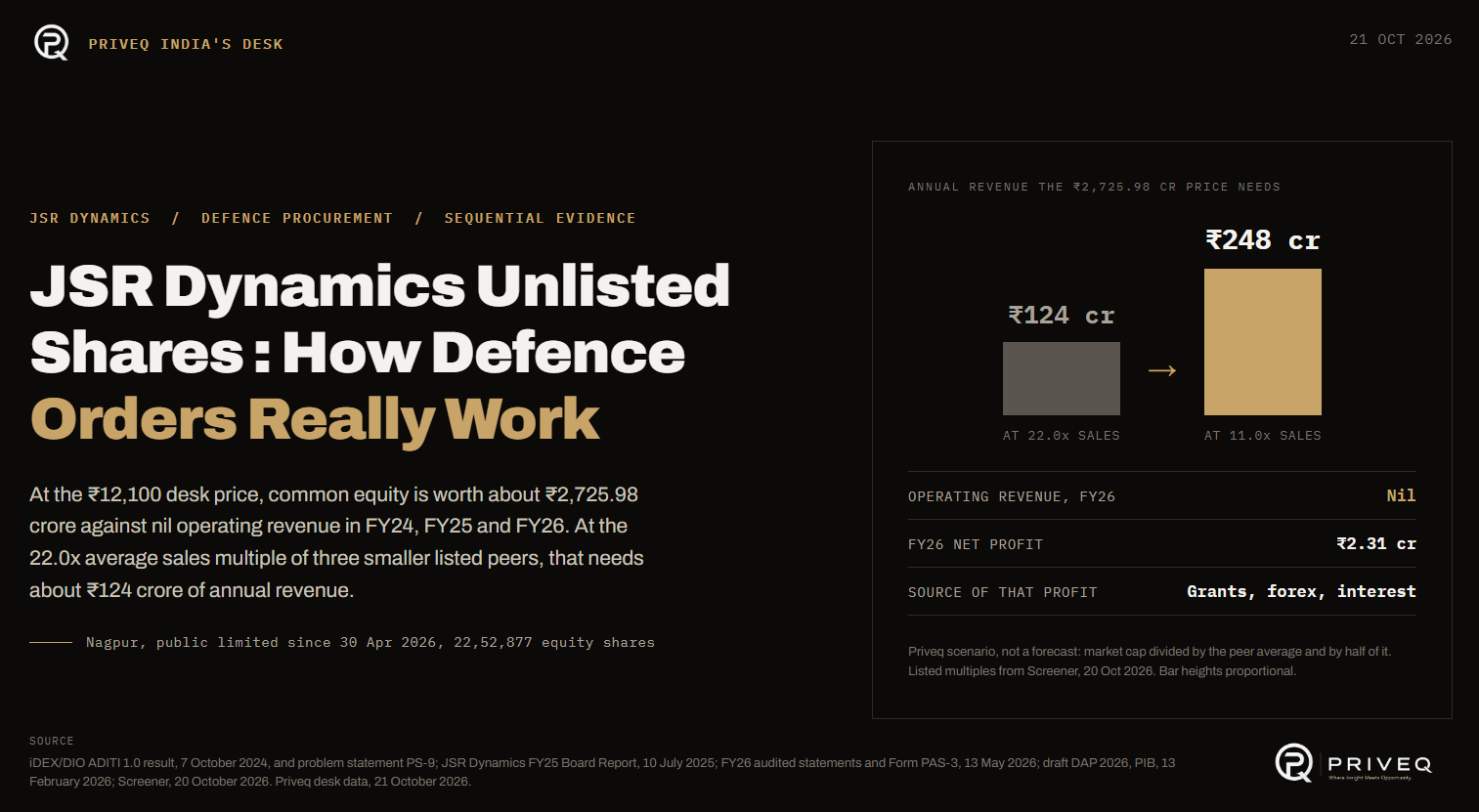
To see what the price needs, we ran one scenario. The three smaller listed peers average about 22.0 times trailing sales. At that multiple, the market cap above would need annual revenue of about Rs 124 crore; at half that multiple, about Rs 248 crore. The valuer's November 2024 DCF value for the preference shares, Rs 6,513.70, puts the desk price at about 1.86 times that figure; the DCF's FY26 projection of Rs 311.29 crore, from the same earlier note, compares with nil operating revenue. The scenario is arithmetic, not a forecast.
What The Desk Price Assumes: A Scenario Using Listed Peer Multiples, Rs Crore
Step | Figure | Basis |
|---|---|---|
Desk price per share (as of October 21, 2026) | Rs 12,100 | Priveq desk; indicative |
Equity shares outstanding | 22,52,877 | FY26 audited statements (20,00,400 at March 31, 2026) plus 2,52,477 shares allotted May 13, 2026 on conversion of preference shares (Form PAS-3); summed by Priveq |
Market cap at desk price | 2,725.98 | Derived: price times shares; common equity only |
Average price to sales of Data Patterns, Paras and Zen | 22.0x | Screener, October 20, 2026; derived |
Revenue that multiple would need | 124 | Derived: market cap divided by average multiple |
Revenue needed at half that multiple | 248 | Derived: market cap divided by half the multiple |
JSR Dynamics operating revenue, FY24 to FY26 | nil | Company filings, as reported in our earlier note |
Desk price against DCF value per CCPS (Rs 6,513.70) | 1.86x | Derived; DCF is the November 2024 IBBI-registered valuer's figure for the preference shares |
Source: Priveq desk; Screener.in (October 20, 2026); company filings and valuer's report as summarised in Priveq India's earlier JSR Dynamics note. Priveq scenario, not company guidance or a forecast. The key assumption is that a pre-revenue weapons maker would one day earn what listed growth peers earn per rupee of sales; the three smaller peers carry price to sales of roughly 20x to 24x.
The honest conclusion is narrow. The price is not paying for current business. It is paying for a first order, and probably a follow-on, arriving over the next few years at a margin that justifies a peer-like multiple. The first order is plausible on the evidence in this piece. The peer-like multiple is the uncertain part, because a weapon integrator that relies on a partner for electronics may deserve the lower half of the table. Net read: the price assumes the next step and more; it does not need a miracle, but it leaves little room for a delay.
The Desk View
Priveq reads JSR Dynamics as the best-evidenced capability story among the small Indian precision-munitions makers we can see, and as a price that already carries its first order. Five points support that.
The capability evidence is primary. An IAF challenge win dated 07.10.2024, a Navy iDEX listing dated 23-08-2023 and an IAF statement that the Khagantak-243 drop trial met its objectives on 2 September 2026 are government documents, not company claims.
The route is long and JSR Dynamics is on it. Grant, design win and first trial are done in public. Sanction, production partner and contract are not.
The quantity is the gap. The only number in a primary document is five kits. BEL holds an IAF order whose size and value are not disclosed.
The price is ahead of the paper. At Rs 2,725.98 crore against nil sales, the price needs a disclosed order and a margin.
One variable moves the call. If the Khagantak-243 trial becomes a disclosed production quantity, the case strengthens materially. If the quantity stays small or undisclosed for a long time, the price is exposed to the delay.
What would make us more cautious: continued grant-driven profit with no sales, an ADITI scheme that lapses after March 2026 without a successor, or a final DAP 2026 that drops the five-year assured-order clause or leaves its quantity vague. What would make us more constructive: a Ministry of Defence or BEL disclosure of quantity and value, or a signed contract for any JSR Dynamics product.
What This Means, By Situation
If you already hold JSR Dynamics: the evidence supports the capability thesis; the price asks you to also believe in timing. Watch for a disclosed quantity, BEL disclosures, and the ADITI scheme's status.
If you are considering buying: the question is not whether JSR Dynamics can build the weapon, since the trial evidence says it can. It is what you are paying for a first order that may be tens of crores in value, and how long you can wait. Ask the desk for the live price and the lot size before deciding.
If you are watching: the cleanest triggers are a BEL announcement with a number, an IAF or MoD contract notice, a final DAP 2026, and the firing the founder says is due under the IAF decoy contract.
If you are comparing against listed defence names: use the stack table; the listed peers carry revenue, JSR Dynamics does not, and the comparison is on margin and scarcity more than on size.
FAQs
Does JSR Dynamics have any defence orders?
JSR Dynamics has a documented IAF ADITI win, not a documented production order. BEL was reported in February 2025 to have been notified of an IAF order for Khagantak-243, with quantity and value undisclosed. The founder also says an IAF decoy contract exists; we found no document for it.
What is the JSR Dynamics unlisted share price today?
The Priveq desk price is Rs 12,100 per share as of October 21, 2026.. It is indicative and subject to change, so confirm it with the desk. The minimum lot is 100 shares.
What did JSR Dynamics win in the ADITI 1.0 challenge?
JSR Dynamics won the IAF's Challenge 09, a booster-assisted range extension kit with an EO-IR seeker, per the Defence Innovation Organisation's result dated 07.10.2024. The problem statement asks for five kits, a range above 150 km from a 5 km release and an accuracy under 5 m.
Is the Khagantak-243 in service with the IAF?
There is no document saying the Khagantak-243 is in service. The IAF said its drop trial on 2 September 2026 met its objectives, and Janes reported in February 2025 that BEL was notified of an order. Trial success is not induction.
How does India buy weapons from a small company?
India buys in stages. A grant under iDEX/ADITI comes first, then prototype trials, a sanction at a board set by cost, and a contract, often through a production partner like BEL. Each stage has a document.
Is JSR Dynamics' order book Rs 1,000 crore?
No document supports a Rs 1,000 crore order book. The figure comes from an undated ORIM Advisors note that names no contracts, and JSR Dynamics' FY25 board report says sales had not begun. We do not count it.
Is JSR Dynamics profitable?
JSR Dynamics reported a small profit in FY26, Rs 2.31 crore, but not from sales. Operating revenue was nil in FY24, FY25 and FY26, and the profit came from grant income, forex and interest, per our earlier note.
Does JSR Dynamics help India reduce arms imports?
Yes in design and airframe capability, and partly in components. The founder says silicon parts are still imported, and Janes reports BEL supplies the Khagantak-243 electronics. Supply disruption is reported for Russia (ThePrint, 2023) and, in 2026, for US-origin Tejas engines, where GE reportedly cited the Iran war (ThePrint, April 2026, unnamed sources; GE's public statement did not mention the war); both are secondary reports.
Is draft DAP 2026 final?
No. It is a draft announced by the Ministry of Defence on February 13, 2026, and we found no final version. We read only the partial draft text through Chapter II Para 13. The Make and iDEX provisions are taken from the Ministry’s statement as reported by AIR, JSA Prism and ORF, so treat them as secondary until the full text is read.
How can I buy JSR Dynamics unlisted shares?
Through the Priveq Marketplace or the desk on WhatsApp at +91 82874 66698. Confirm the live price and the lot size first. Unlisted shares are illiquid and can be hard to sell.
What We Can And Cannot Stand Behind
We can stand behind (Tier 1, primary documents):
JSR Dynamics won IAF ADITI 1.0 Challenge 09; the result is dated 07.10.2024 and is subject to eligibility criteria.
The IAF asked for five kits, a range above 150 km, accuracy under 5 m, per PS-9.
JSR Dynamics was listed for Navy Open Challenge 8.0, Challenge 2, in the iDEX notice dated 23-08-2023.
The ADITI grant is up to 50% of development cost, capped at Rs 25 crore per winner.
Draft DAP 2026 exists as a draft, with the provisions and locators in Table 5. The Ministry of Defence announced on February 13, 2026 that it provides five years of assured orders for Make and iDEX projects, spiral development, two-stage trials and compensation to vendors who succeed in trial evaluations.
JSR Dynamics Limited's equity ISIN is INE0JFD01014: NSDL lists it as active, issuer JSR Dynamics Limited (formerly JSR Dynamics Private Limited), face value Rs 10, registrar Purva Sharegistry (India) Private Limited.
NSDL lists six ISINs under JSR Dynamics Limited: equity INE0JFD01014 (active); a 10% preference ISIN INE0JFD04018 maturing March 30, 2029 (active); three 0.01% preference ISINs, INE0JFD03010 and INE0JFD03036 (suspended) and INE0JFD03028 (deleted); and the debenture ISIN INE0JFD08019 (deleted). The three 0.01% preference ISINs carry dates of March 26, April 7 and April 16, 2026, which fit the 14-month conversion windows of the three January and February 2025 convertible preference tranches; that match is Priveq's inference.
JSR Dynamics Limited's CIN is U29113MH2018PLC318834, as printed on its own FY26 Form PAS-3 annexure for the May 13, 2026 allotment, and shown on ZaubaCorp from MCA filings (previous CIN U29113MH2018PTC318834).
The equity share count of 22,52,877: 20,00,400 at March 31, 2026 per the audited statements, plus 2,52,477 from the conversion of preference shares on May 13, 2026 per the PAS-3 allottee list (summed by Priveq). Another 40,00,000 redeemable preference shares and 4,258 unconverted compulsorily convertible preference shares are excluded from the market cap.
The IAF said the Khagantak-243 drop trial on 2 September 2026 met its objectives.
JSR Dynamics' FY25 board report (signed July 10, 2025): revenue mainly from interest income, sales "to begin soon," and the IAF follow-on contract contingent on validating the current agreement.
We report, but attribute (Tier 2, company or founder statements):
The IAF decoy contract and imminent firing (founder, October 12, 2026).
The Rs 30 crore Maharashtra Aerospace and Defence Venture Fund and about Rs 60 crore machinery capex (founder).
Guided-rocket cost advantage, calibres and the Munitions India Limited collaboration (founder).
Site product specifications, including the 290 km figure for the kit.
The cruise missile description.
We cannot stand behind, or did not verify (Tier 3 or not read):
BEL's IAF order for Khagantak-243: quantity, value and the "prototype and production" description are from Janes, relaying a BEL notification.
The Navy MGLD-N contract: reported by idrw only.
Any signed JSR Dynamics production contract, quantity or unit price.
The Rs 1,000 crore "confirmed order book" (including Rs 260 crore from BEL) and Rs 5,000 crore pipeline in an undated ORIM Advisors note; no contract, filing or named source backs it, and it conflicts with the company's FY25 board report.
How much of BEL's Khagantak-243 order, if any, passes to JSR Dynamics.
Performance of the kit against PS-9.
Whether the ADITI scheme continues after March 2026.
The paragraph text of draft DAP 2026 Chapters III to XII, the quantity behind "assured orders," and the amount of trial compensation (the clauses are announced but we could not read them).
That the Iran war caused GE's F404 delays: GE's public statement does not say so, and the delays predate the war.
Which preference-share ISIN belongs to which tranche: NSDL's labels carry dates, and we infer from them that three 0.01% preference ISINs are the three convertible tranches, but NSDL does not say so.
Talk to the desk: WhatsApp +91 82874 66698 | support@priveq.in | View JSR Dynamics on the Priveq Marketplace
Disclaimer: This piece reflects Priveq India's (Priveq Investech Private Limited, Priveq.in) own research, based on primary regulatory disclosures, government releases and the company's own public statements as detailed above. It is not investment advice, and does not allege any wrongdoing, misstatement, or violation by JSR Dynamics; the findings noted in this piece are read directly from public disclosures. Priveq Investech Private Limited is not registered with the Securities and Exchange Board of India (SEBI) as a stock broker, investment adviser, or research analyst. This piece is independent desk research and commentary, not "research" as defined under the SEBI (Research Analysts) Regulations, 2014, and should not be construed as investment advice from a SEBI-registered entity. Priveq transacts as a named counterparty in the unlisted shares discussed here, including JSR Dynamics, and may hold or deal in these shares before, during, or after publication; our commercial interest and the views in this piece sit in the same place, and should be weighed accordingly. Desk prices are indicative, subject to change without notice, and should be confirmed directly with the desk before any transaction. Unlisted securities are illiquid, carry a high risk of loss, and may be difficult to value or sell; prices move sharply and without notice. Readers should independently verify all figures against the company's own filings and consult qualified financial and legal advisors before transacting. Past performance and price appreciation referenced here are not indicative of future results.