

The Short Version
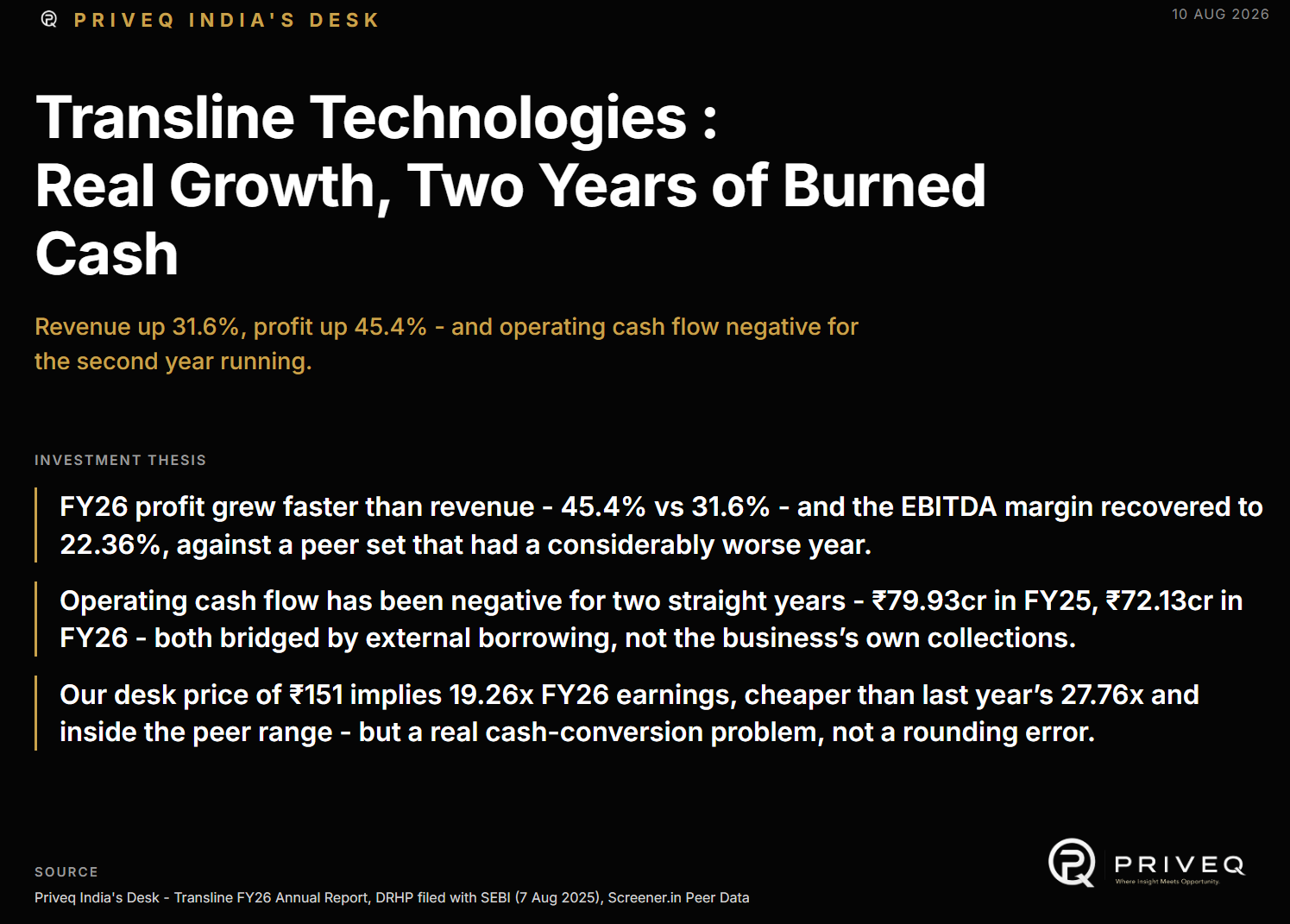
Transline Technologies Limited, a Delhi-headquartered systems integrator in video surveillance, biometrics, and IT infrastructure, had a genuinely strong FY26: revenue grew 31.6% to ₹488.46 crore, profit after tax grew faster at 45.4% to ₹70.28 crore, and EPS climbed to ₹7.84. At Priveq's desk price of ₹151 per share, that prices the stock at roughly 19.26 times FY26 earnings, cheaper than it looked on last year's numbers, and inside the range its listed peers trade at today, several of whom had a rough FY26 of their own. The desk isn't going to let that strong topline carry the whole story. Net cash used in operating activities was negative ₹79.93 crore in FY25 and negative ₹72.13 crore in FY26, two straight years in which real, audited profit did not convert into cash, bridged instead by fresh borrowing and, in FY25, a fresh equity raise. Layer onto that an unresolved Companies Act adjudication over board-composition compliance and a SEBI-approved IPO that has sat untouched for seven months, and the picture is a real business with a real cash-conversion problem, not a fabricated growth story.
The Desk Snapshot
Transline Technologies Limited, unlisted, DRHP filed with SEBI. Figures as read from primary filings.
Priveq desk price
₹151 per share, as of 10 August 2026
Implied valuation
~₹1,354 crore (derived: 8,96,75,000 shares × ₹151)
FY26 revenue
₹488.46 crore, up 31.6% YoY
FY26 PAT
₹70.28 crore, up 45.4% YoY. EPS ₹7.84
Implied P/E (FY26 basis)
19.26x. Cheaper than 27.76x implied on FY25 earnings at the same price
Price / FY26 book value
5.44x
Biggest positive
FY26 profit grew faster than revenue; EBITDA margin recovered to 22.36%; peer set fared considerably worse over the same period
Biggest risk
Negative operating cash flow two years running: -₹79.93 cr FY25, -₹72.13 cr FY26, funded by external borrowing
Key monitor
Whether the 165-day working capital cycle (FY25) starts coming back in, and whether a third consecutive cash-negative year follows
Share count and paid-up capital confirmed from the DRHP: 8,96,75,000 shares of ₹2 face value, following the Dec 2024 1:5 split. FY25 NAV per share independently computed from the FY26 Annual Report's balance sheet matches the DRHP's stated ₹19.91 exactly.
The Business : What Transline Actually Does
Transline Technologies Limited was incorporated on 2 February 2001 as Transline India Business Solution Private Limited, renamed Transline Technologies Private Limited in 2010, and converted to a public limited company on 3 January 2023. It is a systems integrator across video surveillance, biometric and identity solutions, IT infrastructure and cloud services, and software products, serving government agencies, public sector undertakings, and private enterprises including Indian Railways, oil and gas PSUs, banking, and state police departments.
The company's own disclosed project history in the DRHP gives a real sense of scale and client type over time: a 2008 biometric attendance system for a state municipal department covering 150,000 employees; a 2011 Aadhaar kit contract generating over 5.8 million Aadhaar IDs; a 2019 rollout of Aadhaar enrolment kits to major public and private sector banks, postal circles, and education departments; a 2023 installation of 20,000 CCTV cameras for a state public works department; and, in 2025, installation of 1,720 CCTV cameras across 11 police stations in Delhi. This is a genuinely long-running government and PSU contractor, not a recent entrant riding a surveillance trend.
Revenue is meaningfully concentrated: the top 10 customers accounted for 80.97% of FY25 revenue (down from 92.53% in FY23, a real diversification trend worth noting), and video surveillance, biometrics, and IT infrastructure combined made up 80.36% of FY25 revenue. As of 31 March 2025, approximately 93.92% of the order book was attributable to government customers specifically. This is a business whose fortunes are tied closely to government tender cycles and procurement timing, which the company's own risk factors acknowledge directly.
Corporate History and Capital Structure
The company's authorised share capital has moved several times in the years leading up to the DRHP, each via shareholder resolution: from ₹50,000,000 to ₹110,000,000 in December 2022, to ₹175,000,000 in May 2023, to ₹250,000,000 in March 2024, and finally restructured in December 2024 into a 1:5 stock split, converting face value from ₹10 to ₹2 per share while keeping authorised capital at ₹250,000,000. Paid-up capital following this history stands at ₹179.35 million across 8,96,75,000 equity shares of ₹2 face value.
Two share transfers are disclosed in the "History and Certain Corporate Matters" section, both moving assets from the company to founder and Managing Director Arun Gupta personally, not to unrelated third parties: on 29 November 2022, a 99.99% shareholding (1,99,998 shares) in what was then Transline IFMI Systems Private Limited, since renamed Amaran Real Estates Private Limited, was transferred to Arun Gupta; on 25 November 2024, a 90.00% shareholding (9,000 shares) in Computer Knowledge Corporation Private Limited was similarly transferred to him. Both transactions are small in absolute terms and disclosed plainly in the DRHP, but they are promoter-related transfers rather than arm's-length divestments, and the desk notes that distinction rather than treating them as ordinary asset sales.
Separately, Arun Gupta has personally guaranteed a ₹10 million term loan the company holds with Artline Finance Private Limited, carrying a 2% per month penal interest rate on any overdue amount, a 12-month facility period.
The company's capital-raise history through this period, per the DRHP's disclosed allotment register, shows a real, multi-round pricing progression, all pre-split, at ₹10 face value: 8,00,000 shares placed at ₹135 per share on 14 August 2023, then 2,74,860 shares at ₹270 per share on 29 March 2024, a doubling of the placement price within roughly seven and a half months, both within FY24. That ₹270 price held flat across three further rounds into FY25 : 2,41,000 shares on 15 April 2024, 5,95,800 shares on 26 April 2024, and 8,87,824 shares on 24 May 2024, together the ₹46.57 crore FY25 equity raise referenced in the cash flow statement. Allottees across these rounds include third-party unlisted-market participants such as Green Portfolio, Unlisted Tech Private Limited, and All Time Securities Private Limited, alongside individual investors, not solely promoter-group entities, which supports reading these as arm's-length market prices rather than related-party-set figures. No fresh equity was raised in FY26.
Adjusted for the December 2024 1:5 split, that pricing history works out to roughly ₹27 per share for the August 2023 round and ₹54 per share for the four rounds that settled at ₹270. At Priveq's desk price of ₹151, that is 5.59 times the earliest placement price and 2.80 times the price the last four rounds converged on, a real multi-round valuation ladder, not a single data point.
The Private Placement Ladder
Pre-split allotment prices from the DRHP's disclosed allotment register, adjusted for the December 2024 1:5 split (face value ₹10 → ₹2) to the current share count.
Round
Pre-split price
Post-split equivalent
vs desk ₹151
14 Aug 2023 (8,00,000 shares)
₹135
₹27.00
5.59x
29 Mar 2024 (2,74,860 shares)
₹270
₹54.00
2.80x
15 Apr 2024 (2,41,000 shares)
₹270
₹54.00
2.80x
26 Apr 2024 (5,95,800 shares)
₹270
₹54.00
2.80x
24 May 2024 (8,87,824 shares)
₹270
₹54.00
2.80x
Priveq desk price
₹151.00
—
Placement price doubled from ₹135 to ₹270 within roughly seven and a half months (Aug 2023 to Mar 2024), then held flat across four further rounds into May 2024. Allottees include third-party unlisted-market participants (Green Portfolio, Unlisted Tech Private Limited, All Time Securities Private Limited) alongside individual investors, not solely promoter-group entities.
FY26 Financial Performance
The audited Statement of Profit and Loss for the year ended 31 March 2026 shows real, broad-based improvement over FY25.
Revenue from Operations grew 31.6% to ₹488.46 crore, from ₹371.08 crore in FY25, a genuine deceleration from FY25's own 64.27% growth rate over FY24, worth naming plainly rather than glossing over, but still a strong absolute number. Profit after tax grew faster than revenue, 45.4%, to ₹70.28 crore from ₹48.33 crore, and EPS rose to ₹7.84 from ₹5.44. EBITDA margin, calculated as profit before tax plus depreciation and finance cost over revenue, actually recovered in FY26 to 22.36%, up from FY25's 21.39%, though still below FY24's 23.14% peak. Finance costs rose sharply, to ₹109.50 million from ₹70.51 million, consistent with the company's growing reliance on debt to fund its working capital gap, addressed in the next section.
At Priveq's desk price of ₹151, that puts Transline at approximately 19.26 times FY26 earnings and 5.44 times FY26 book value, a cheaper multiple than the roughly 27.76x implied on FY25 earnings at the same price, and one that now sits comfortably inside, rather than above, the range its listed peers trade at.
The Cash Flow Reality
This is the section the desk will not let a strong topline paper over. Despite genuine, audited profit growth in both years, Transline's Statement of Cash Flows shows net cash used in operating activities of ₹72.13 crore in FY26 and ₹79.93 crore in FY25, two consecutive fiscal years in which the business did not generate cash from its own operations.
The gap traces directly to working capital. Trade receivables, contract assets (largely unbilled revenue on long-cycle government projects), and inventory all grew faster than collections : Contract assets alone increased by ₹74.80 crore in FY26. This mirrors a trend already visible in the DRHP's own disclosed working capital cycle, which lengthened from 74 days in FY23 to 117 days in FY24 to 165 days in FY25, a pattern the desk was already flagging as a risk before the FY26 cash flow statement confirmed it in hard rupee terms.
Both years' shortfalls were bridged externally rather than internally : The FY26 gap was funded through ₹24.63 crore in net new borrowings, and the FY25 gap through a combination of borrowings and the ₹46.57 crore fresh equity issuance mentioned above. Total borrowings rose from ₹86.08 crore at the end of FY25 to ₹110.71 crore at the end of FY26. Debt to equity actually improved slightly, from 0.48 to 0.44, because equity grew faster still on the back of retained profit, but the underlying reliance on external financing to cover an operating cash shortfall persisted through both years covered by the most recent audited financials.
To be direct about what this does and does not mean: it does not mean the reported revenue or profit figures are fabricated. It means Transline is a working-capital-intensive, government-and-PSU-heavy contractor whose collection cycle is currently outrunning its billing cycle, and that gap has to be funded from somewhere. The desk's single most important number heading into FY27 is whether that 165-day working capital cycle starts coming back in, or keeps stretching.
Profit vs. cash, two years running
Figures in ₹ crore, from the FY26 Annual Report's audited Statement of Cash Flows and Profit & Loss.
Particulars
FY25
FY26
Revenue from Operations
371.08
488.46
Profit After Tax
48.33
70.28
Net Cash from/(used in) Operating Activities
(79.93)
(72.13)
Funded via net new borrowings
Part of ₹44.66 cr net financing inflow
24.63
Funded via fresh equity issuance
46.57
Nil
Working Capital Cycle (days, per DRHP)
165
Not yet disclosed
For context beyond the two years shown above: the working capital cycle has been lengthening since FY23, from 74 days (FY23) to 117 days (FY24) to 165 days (FY25), per the DRHP's own KPI table. Both years' operating cash shortfalls shown above were bridged externally rather than from the business's own collections.
The Order Book and Client Concentration
As of 31 March 2025, Transline's disclosed order book stood at ₹198.69 crore, down 22.18% from ₹255.31 crore a year earlier, itself up sharply from ₹62.31 crore in FY23. Of that FY25 order book, 59.33% comprised orders from a single major customer, and 93.92% came from government customers overall. The order book is split between contract-based orders (₹139.21 crore) and AMC-based orders (₹59.48 crore) as of FY25.
The desk does not have a disclosed FY26 order book figure and treats this as an open gap rather than assuming continuity with the FY25 trend.
Outstanding litigation, per the DRHP's summary table, includes five civil proceedings initiated by the company aggregating ₹15.20 crore (including a ₹4.5 crore arbitration claim against Broadcast Engineering Consultants India Limited over a failed 2021 tripartite agreement), two civil and tax proceedings against the company aggregating ₹1.69 crore, and modest, separately disclosed income tax demands of ₹1.62 crore (Assessment Year 2013-14, pending before ITAT Delhi) and ₹0.06 crore (Assessment Years 2008-09 to 2011-12, in rectification process). None of these figures are individually material against a ₹488 crore revenue base, but they are disclosed and worth naming plainly.
How the Listed Peers Fared in FY26
Transline's own DRHP, filed in August 2025, benchmarked its implied valuation against three listed peers: Nelco Limited, Orient Technologies Limited, and Allied Digital Services Limited. All three had materially rougher FY26s than they had at the time that comparison was drawn, which matters directly for how to read Transline's current multiple.
Orient Technologies' FY26 net profit collapsed to ₹5 crore (EPS ₹1.00), down from an EPS of ₹12.85 the DRHP had cited for FY25, with both Q3 and Q4 FY26 posting outright losses and negative operating cash flow of ₹19 crore for the full year. Nelco Limited's FY26 EPS fell to ₹1.45, down from ₹10.37 in FY24, on an operating margin that nearly halved. Allied Digital Services was the relative outperformer, growing full-year net profit to ₹36 crore, though even it posted a loss-making fourth quarter and a worsening debtor-days trend.
Set against that backdrop, Transline's FY26 profit growth of 45.4% and margin recovery reads considerably stronger in relative terms than it might in isolation. The desk treats this as useful context, not as license to ignore Transline's own cash-conversion problem; a company can be the healthiest name in a weak peer set and still carry a real, disclosed risk worth pricing.
How the DRHP's own peer set fared in FY26
Consolidated figures, sourced from each company's own published FY26 results via Screener.in. These are the same three peers Transline's DRHP used to benchmark its valuation in August 2025.
Company
FY26 Revenue
FY26 Net Profit
FY26 EPS
Read
₹488.46 cr
₹70.28 cr
₹7.84
Up 45.4% YoY
Orient Technologies
₹870 cr
₹5 cr
₹1.00
Down from EPS ₹12.85 (FY25). Loss-making Q3 and Q4
Allied Digital Services
₹968 cr
₹36 cr
₹6.29
Grew, but Q4 alone was loss-making
Nelco Limited
₹307 cr
₹3 cr
₹1.45
Down from EPS ₹10.37 (FY24). Trades at 367x P/E regardless
All three peers had materially rougher FY26s than when Transline's DRHP benchmarked against them in August 2025. Read alongside Transline's own cash-flow risk, not as a reason to set it aside.
The Governance Matter
Transline's Secretarial Auditor's report for FY26 discloses that the company filed a compounding application with the National Company Law Tribunal on 11 March 2025, for non-compliance with Sections 177, 178, and 149(4) of the Companies Act, 2013, provisions covering audit committee composition, the nomination and remuneration or stakeholders relationship committee, and the requirement for independent directors on the board. That application was withdrawn on 18 December 2025 after it was determined the matter fell outside the compounding mechanism and instead required formal adjudication before the Registrar of Companies. As of the FY26 Annual Report, dated August 2026, that adjudication proceeding remains open and unresolved in the public record the desk has reviewed.
Separately, Amita Gupta, one of the four IPO promoters and a selling shareholder in the proposed Offer for Sale, resigned from the company's board on 19 May 2025. Asha Anil Agarwal and Drishti Gupta were appointed as Independent Director and Non-Executive Non-Independent Director respectively on the same date.
The IPO That's Been Sitting
Transline Technologies filed its DRHP with SEBI on 7 August 2025, structured entirely as an Offer for Sale of up to 1,61,91,500 equity shares, with no fresh capital reaching the company. SEBI approved the IPO on 22 January 2026, an approval typically valid for 12 months. As of this piece's publish date, more than six months later, no price band, lot size, or opening date has been announced. The desk notes this plainly: a SEBI-cleared IPO sitting dormant this long is itself a fact worth pricing into any near-term liquidity expectations, separate from the business fundamentals covered above.
The Desk View
Priveq's live desk price for Transline Technologies is ₹151 per share, implying a valuation of approximately ₹1,354 crore, or 19.26 times FY26 earnings and 5.44 times FY26 book value. That multiple sits inside, not above, the range its DRHP-cited listed peers trade at today, and it is cheaper than the roughly 27.76x the same desk price would have implied on FY25 earnings alone.
The genuine strengths are real: a two-decade operating history with substantiated government and PSU project delivery, FY26 profit growth that outpaced revenue growth, a recovering EBITDA margin, and a peer set that has fared considerably worse over the same period. Set against that: two consecutive years of negative operating cash flow funded by external financing rather than the business's own collections, an open Companies Act adjudication over board governance, and a SEBI-approved IPO that has stalled for over six months with no fresh capital reaching the company even when it does eventually launch, since the offer is structured entirely as an Offer for Sale.
The desk's position is that Transline's current price reflects a real, profitable, growing business, priced reasonably against its own earnings and its peer set, but carrying a genuine and currently unresolved cash-conversion risk that the desk is not pricing away. The one variable that would most improve this view: a working capital cycle that stops lengthening and a disclosed FY26 order book that shows the pipeline behind next year's growth. The one variable that would most concern the desk: a third consecutive year of negative operating cash flow.
FAQs
What is the Transline Technologies Limited unlisted share price today?
Priveq's live desk price is ₹151 per share as of the date noted at the top of this piece. Desk prices move; talk to the desk for the current quote before any transaction.
Why did Transline Technologies report profit growth but negative operating cash flow?
Transline's revenue and profit are real and audited, but the company's trade receivables, contract assets, and inventory have grown faster than collections, a pattern also visible in its disclosed working capital cycle lengthening from 74 days in FY23 to 165 days in FY25. Both FY25 and FY26 cash shortfalls were bridged through borrowing and, in FY25, a fresh equity raise, rather than the business's own operating cash generation.
Is Transline Technologies Limited's IPO still happening?
SEBI approved the IPO on 22 January 2026, an approval is typically valid for 12 months, but as of this piece's publish date no price band or opening date has been announced, over six months later. The offer is structured entirely as an Offer for Sale; the company itself will not receive any IPO proceeds.
What is the governance matter mentioned in this piece?
Transline filed a compounding application with the NCLT in March 2025 over non-compliance with Companies Act provisions on board and committee composition. That application was withdrawn in December 2025 and redirected to formal adjudication before the Registrar of Companies, which remains open as of the company's most recent Annual Report.
Who owns Transline Technologies Limited ?
The company is promoted by Arun Gupta, Amita Gupta, Drishti Gupta, and RKG Enterprises Private Limited, with pre-IPO promoter shareholding at 70.81%.
What We Can And Cannot Stand Behind
Primary-sourced and verified directly : All FY26 and FY25 financial figures (Statement of Profit and Loss, Balance Sheet, Statement of Cash Flows) from Transline's own audited FY26 Annual Report; the order book, litigation summary, KPI trends, and peer comparison table from the company's own DRHP filed with SEBI; the corporate history, share transfers to Arun Gupta, and promoter guarantee from the DRHP's "History and Certain Corporate Matters" section; the governance/compounding matter from the FY26 Secretarial Auditor's report; peer FY26 financials for Nelco, Orient Technologies, and Allied Digital Services from their own published results via Screener.in.
Indicative or derived, labeled as such : The ₹1,354 crore implied valuation, and all P/E, price-to-book, and EBITDA margin figures, are Priveq's own arithmetic on the stated desk price and disclosed financials, cross-checked internally where possible (the FY25 EBITDA figure computed independently from the Annual Report matches the DRHP's own stated figure to the decimal, as does FY25 NAV per share).
Could not be confirmed, flagged as open : A disclosed FY26 order book figure, which the desk has not located in the documents reviewed. The business purpose and full history of Computer Knowledge Corporation Private Limited and Transline IFMI Systems Private Limited (Amaran Real Estates), beyond the transfer transactions themselves. The current status of any price band or listing timeline for the IPO beyond what is stated above.
Talk to the desk: WhatsApp +91 82874 66698 | support@priveq.in | View Transline Technologies on the Priveq Marketplace
Disclaimer : This piece reflects Priveq India's (Priveq Investech Private Limited, Priveq.in) own research, based on primary filings, regulatory disclosures, and the company's own audited financial statements as detailed above. It is not investment advice, and does not allege any wrongdoing, misstatement, or violation by Transline Technologies Limited; the cash flow trends and governance matter noted in this piece are read directly from the company's own public disclosures. Priveq Investech Private Limited is not registered with the Securities and Exchange Board of India (SEBI) as a stock broker, investment adviser, or research analyst. This piece is independent desk research and commentary, not "research" as defined under the SEBI (Research Analysts) Regulations, 2014, and should not be construed as investment advice from a SEBI-registered entity. Priveq transacts as a named counterparty in the unlisted shares discussed here, including Transline Technologies, and may hold or deal in these shares before, during, or after publication; our commercial interest and the views in this piece sit in the same place, and should be weighed accordingly. Desk prices are indicative, subject to change without notice, and should be confirmed directly with the desk before any transaction. Unlisted securities are illiquid, carry a high risk of loss, and may be difficult to value or sell; prices move sharply and without notice. Readers should independently verify all figures against the company's own filings and consult qualified financial and legal advisors before transacting. Past performance and price appreciation referenced here are not indicative of future results.