


The Short Version
MSE issued Circular No. MSE/BD/19801/2026 on September 28, 2026, extending the Liquidity Enhancement Scheme II (LES-II) for its equity segment through December 31, 2026, two days before the scheme's original September 30 expiry. This means the "30 September cliff" Priveq's own July 23 note identified as the single clearest test of whether MSEI's trading volume was organic or scheme-dependent has been postponed rather than passed, the subsidy was renewed before it could lapse. Separately, Zerodha and Groww are testing technical integration with MSE, per September 9 reporting, a development that could eventually widen MSE's volume base beyond the small set of proprietary trading firms currently driving it.
Event : Liquidity Enhancement Scheme II (LES-II) Extension Date: September 28, 2026 Source: MSE Circular No. MSE/BD/19801/2026, extending Circular No. MSE/BD/19161/2026 (June 8, 2026) Primary Metric Affected : LES-II expiry date, moved from September 30, 2026 to December 31, 2026
This is a follow-up to Priveq's July 23, 2026 note, MSEI: The Volume Is Real, It Is Also Rented, which first flagged the September 30 expiry as the real test of MSE's volume. For the current desk snapshot and pricing, see MSEI on Priveq Marketplace.
What The September 28 Circular Actually Says?
MSE's Circular No. MSE/BD/19801/2026, dated September 28, 2026, extends the Liquidity Enhancement Scheme II for the equity segment. The circular states that LES-II "shall be continued by the Exchange for the period from October 1, 2026, to December 31, 2026," with "all conditions and obligations prescribed under the aforementioned Circular, as amended or modified from time to time" (referring to the original Circular No. MSE/BD/19161/2026, dated June 8, 2026) remaining applicable. No changes to the eligible-securities list or the incentive structure are disclosed in this circular, it is a continuation notice, not a revision.
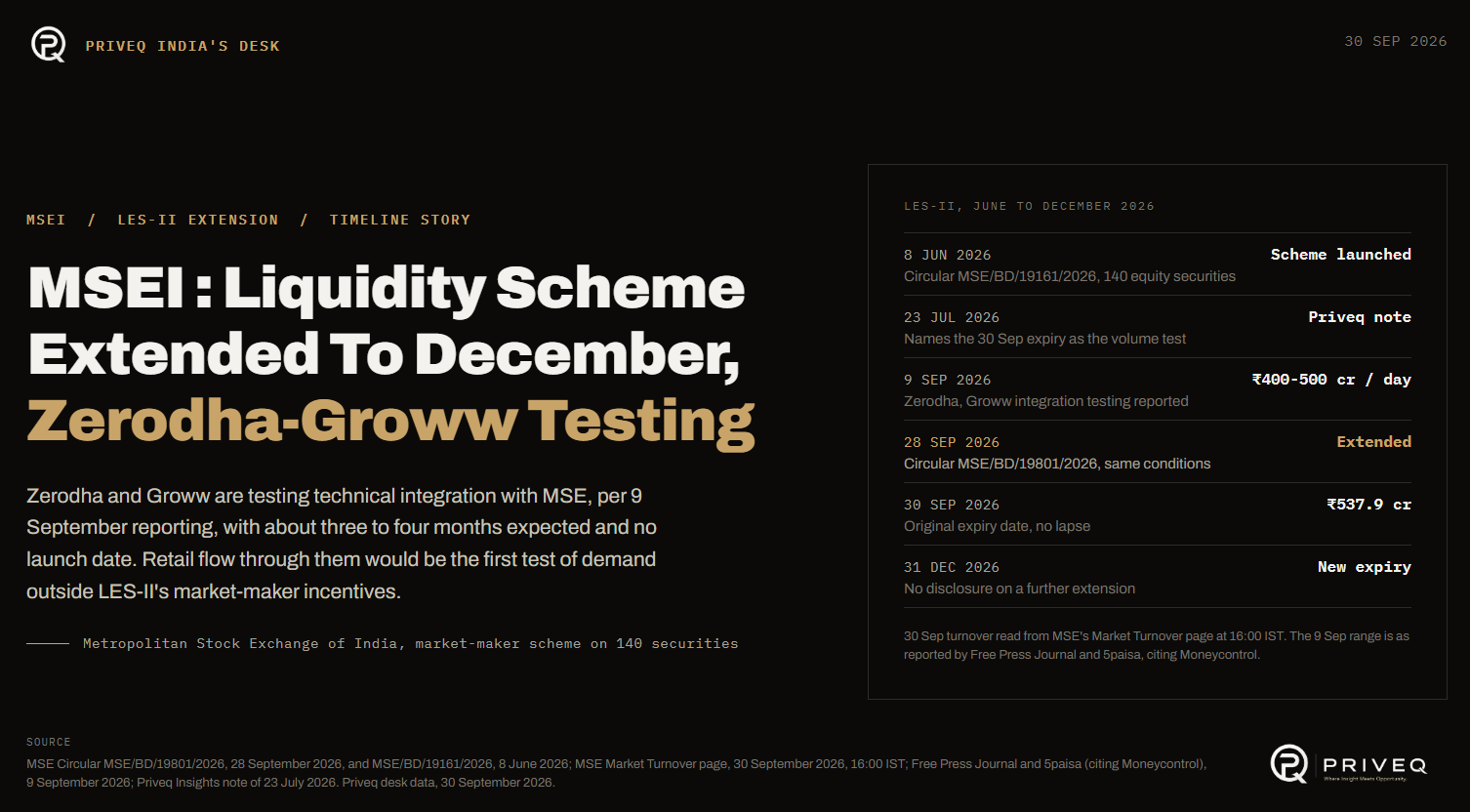
The table below lays out the sequence, from the original scheme through today's checkpoint.
Date | Event |
|---|---|
June 8, 2026 | Original LES-II circular issued (MSE/BD/19161/2026), covering 140 eligible equity securities |
July 23, 2026 | Priveq's prior note names September 30 as "the single most informative event available to anyone holding this stock" |
September 9, 2026 | Free Press Journal and 5paisa (citing Moneycontrol) report Zerodha and Groww testing technical integration with MSE; daily cash turnover cited at Rs. 400-500 crore |
September 28, 2026 | MSE issues Circular MSE/BD/19801/2026, extending LES-II to December 31, 2026, two days ahead of the original expiry |
September 30, 2026 | Original LES-II expiry date passes without a lapse; MSE equity segment turnover recorded at Rs. 537.9 crore |
Sourced to MSE's own circulars (MSE/BD/19161/2026 and MSE/BD/19801/2026) and Priveq's July 23, 2026 note, cross-checked against independent September 9, 2026 reporting from Free Press Journal and 5paisa.
The Cliff Priveq Flagged In July, And What Happened To It?
Priveq's July 23, 2026 note was explicit about what September 30 meant: "The 30 September cliff, LES-II expires on 30 September 2026, and the exchange reserves the right to amend or discontinue it on fifteen days' notice. What happens to volumes in October is the single most informative event available to anyone holding this stock." That note also disclosed MSE's FY26 revenue from operations at Rs. 3.38 crore against Rs. 55.69 crore of other income, the numbers behind why an exchange this small needs a market-maker subsidy to keep its order book functioning at all.
What actually happened is that the cliff did not arrive. Two days before LES-II was due to lapse, MSE extended it by another quarter. That is a materially different outcome from either "volumes held on their own" or "volumes collapsed once the scheme ended," the scenario the July piece was set up to test never occurred, because the exchange removed the test before October could happen.
Where Turnover Stands As Of September 30?
MSE's own Market Turnover page shows equity segment trade value of Rs. 53,789.58 lakh (Rs. 537.9 crore) on volume of 3,40,45,224 shares as of September 30, 2026, 16:00 IST, against 6,26,54,834 shares the previous trading day. That figure sits modestly above the Rs. 400-500 crore daily range that Free Press Journal and 5paisa (citing Moneycontrol) reported on September 9, 2026, as "including trades supported by its market maker" and driven primarily by proprietary trading firms such as Zanskar and Jainam rather than retail participation.
Metric | September 9, 2026 (reported) | September 30, 2026 (Priveq verified) |
|---|---|---|
Daily cash-market turnover | Rs. 400 - 500 crore | Rs. 537.9 crore (Rs. 53,789.58 lakh) |
Reported volume drivers | Proprietary trading firms / market maker (Zanskar, Jainam cited) | Not separately disclosed for this date |
Equity volume (shares) | Not disclosed in this range | 3.40 crore shares (previous trading day: 6.27 crore shares) |
The September 30 figures are a single-day snapshot read directly from MSE's own Market Turnover page (as on 16:00 IST). MSE's historical daily turnover archive could not be independently pulled to verify a multi-day trend against the September 9 reported range, the request failed on a certificate error, so this comparison is directional, not a verified full series. Two honest caveats on this comparison. First, the September 30 figure is a single-day snapshot pulled directly from MSE's own site, not a verified multi-week average, Priveq attempted to pull MSE's historical daily turnover archive independently to check the trend across the full month and could not (the request failed on a certificate error), so this is a directional read, not a full series. Second, MSE's own turnover page does not break down who is trading on any given day, so whether Zanskar, Jainam, or a different set of desks are still the ones driving September 30's volume specifically is not something Priveq can confirm from this data alone.
The Other Half Of The Story : Zerodha And Groww Testing MSE Integration
Zerodha and Groww are currently testing technical integration with MSE, according to Free Press Journal and 5paisa (the latter citing Moneycontrol), both published September 9, 2026. Both brokers are described as needing to "modify their trading systems," with the integration expected to take "around three to four months" and no confirmed retail launch date. MSE is reported to be holding back its futures and options segment until the cash market shows "stable and sustainable volumes," with F&O also targeted for the same three-to-four-month window.
This is the detail worth separating clearly from the LES-II extension above: the two are related (both bear on whether MSE's volume becomes durable) but they are not the same event, and they run on different clocks. LES-II's renewal is confirmed and dated. Broker integration is still in testing, unconfirmed for a live date, and not something Priveq can verify independently until either broker or MSE makes a public disclosure.
What A Completed Integration Could Plausibly Mean
Neither Zerodha, Groww, nor MSE has disclosed commercial terms, a revenue-sharing structure, or an expected volume uplift from this integration, so Priveq is not in a position to compute a run-rate or margin impact the way a disclosed contract would allow. What can be said, as a labeled desk scenario rather than a projection: if the integration completes on the reported three-to-four-month timeline and retail order flow through Zerodha and Groww becomes a meaningful share of MSE's daily turnover, it would be the first genuine test of demand independent of LES-II's market-maker incentives, something the September 30 checkpoint was supposed to provide and did not. The single assumption that would most change this read is adoption: two large brokers adding a venue to their app does not by itself guarantee retail traders choose to route orders there, particularly for a market that has spent most of 2026 trading through a subsidized order book rather than organic demand.
The Desk View
What's more resolved than before : The LES-II extension itself is now a confirmed, dated primary-source fact, MSE's own circular, not a secondary tracker's claim. The subsidy is not lapsing on schedule, and it is not being quietly left to expire either, MSE chose to extend it publicly and immediately.
What's still open : Whether MSEI's trading volume can survive without LES-II remains untested, because the test that would have answered that question was removed before it happened. Whether Zerodha and Groww integration goes live on the stated timeline, and whether it changes who is actually trading MSE, are both unconfirmed.
Priveq's read : The July thesis holds, and arguably strengthens. An exchange confident that its volume was organic would have let LES-II run out and watched what happened; instead, MSE renewed the subsidy two days before it would have found out. That is not proof the volume is fake, but it is one more quarter in which the question stays unanswered by MSE's own choice. The next real catalyst is not December 31, it is whichever comes first: a live Zerodha/Groww launch, or MSE choosing not to extend LES-II a third time.
FAQs
Did MSE's Liquidity Enhancement Scheme II expire on September 30, 2026?
No. MSE extended LES-II through December 31, 2026 via Circular No. MSE/BD/19801/2026, issued September 28, 2026, two days before the scheme's original expiry date. The extension carries over the same conditions as the original June 8, 2026 circular without disclosed changes to the eligible-securities list or incentive structure.
Is MSE's Liquidity Enhancement Scheme still active as of today?
Yes, as of September 30, 2026, LES-II is active and now runs through December 31, 2026, covering the same 140 eligible equity securities named in the original scheme. MSE has not disclosed whether it will extend the scheme again once this period ends.
Does this mean MSEI's trading volume is now proven to be organic rather than subsidized?
No, and that is the actual takeaway here. The scheme's extension means the organic-versus-subsidized question Priveq's July note set out to test never got tested, because the subsidy never lapsed long enough to find out what volume would look like without it.
What is MSE's Liquidity Enhancement Scheme (LES-II)?
LES-II is a market-maker incentive scheme under which MSE pays participating brokers to maintain quotes and trading activity across 140 eligible equity securities, intended to build a functioning order book on an exchange with historically thin volume. It was introduced by Circular No. MSE/BD/19161/2026 on June 8, 2026, and has now been extended once.
Will Zerodha and Groww customers be able to trade MSEI-listed stocks soon?
Not yet. As of September 9, 2026 reporting, both brokers were still testing technical integration with MSE, a process described as taking three to four months with no confirmed launch date. Priveq has not found any subsequent disclosure updating that timeline.
What We Can And Cannot Stand Behind
Primary-sourced and verified :
The extension circular (MSE/BD/19801/2026, September 28, 2026) and its October 1 - December 31, 2026 date range, read directly from MSE's own circular.
MSE's equity segment turnover on September 30, 2026 (Rs. 537.9 crore, 3.40 crore shares), read directly from MSE's own Market Turnover page.
The Zerodha/Groww integration-testing story and the Rs. 400-500 crore daily range, independently reported by Free Press Journal and 5paisa (citing Moneycontrol), both September 9, 2026.
Partially or indirectly corroborated :
Whether September 30's Rs. 537.9 crore turnover reflects a genuine continuation of the September 9-reported range or a single-day figure, MSE's historical daily archive could not be independently pulled to verify a multi-day trend (the request failed on a certificate error).
Whether Zanskar, Jainam, or other proprietary desks remain the dominant source of turnover specifically on September 30, since September 9 reporting is the most recent independent confirmation of who is trading.
Could not be confirmed :
Whether Zerodha and Groww's integration testing results in a live retail launch on the reported three-to-four-month timeline, or at all.
Any revenue or volume impact a completed integration would have on MSE, since no commercial terms have been disclosed by either broker or the exchange.
Whether MSE will extend LES-II again after December 31, 2026, or allow it to lapse.
Track MSEI On Priveq
For live pricing and tracking, see MSEI on Priveq Marketplace.
Disclaimer
This note is for informational purposes only and does not constitute investment advice, a recommendation, or an offer to buy or sell any security. Unlisted and pre-IPO shares carry risks including illiquidity, valuation uncertainty, and regulatory change. Figures are sourced as cited and are current only as of the dates stated; prices and scheme terms can change without notice. Readers should conduct their own due diligence and consult a qualified advisor before making investment decisions.