


Metropolitan Stock Exchange (MSEI) Unlisted Shares
vs. prev. close ₹7
52W High
₹7.75
52W Low
₹2.75
Market cap
₹7,697 Cr
IPO stage
No DRHP filed
Risk level
High
CIN
U65999MH2008PLC185856
Price History
52W High
₹7.75
52W Low
₹2.75
About Metropolitan Stock Exchange (MSEI) Unlisted Shares
Metropolitan Stock Exchange of India Limited, recognized by SEBI under Section 4 of the Securities Contracts (Regulation) Act 1956, is India's third national-level stock exchange.
Two exchanges control over 99% of India's trading volumes. Every equity derivative, every cash market trade, every futures contract that moves through the system passes through infrastructure owned by the same two institutions. Regulators globally have learned that this level of concentration in financial market infrastructure creates systemic fragility, cost opacity, and zero pressure on innovation. India's SEBI has not missed this lesson.
MSEI : Licensed to operate in equity, equity derivatives, currency derivatives, debt, and SME segments, it has operated since 2008 with a clean, glitch-free technology record across 17-plus years. Revenue from operations has been declining for years: ₹3.38 crore in FY26 against a near-negligible base. The exchange has been loss-making since inception. The net loss was ₹25.84 crore in FY26, narrowing from ₹48.7 crore in FY24.
None of that is why institutional investors are now backing it. In December 2024 and August 2025, MSEI raised ₹1,238 crore across two rounds: Groww (Billionbrains), Zerodha (Rainmatter), Share India Securities, Peak XV Venture Partners, Trust Investment Advisors, and others invested at ₹2/share. The exchange now carries ₹1,369 crore in equity on its balance sheet, a new data center powered by NTT is in commissioning, a Liquidity Enhancement Scheme covering 143-plus securities launched in January 2026, and market maker operations have commenced. In April 2026, MSEI recorded a single-day equity traded value exceeding ₹132 crore.
This is not a conventional investment. It is a structured bet on whether India's third exchange can finally break the liquidity trap that has defined its first 17 years.
MSEI Unlisted Shares: India's Third Exchange, ₹1,238 Crore in Fresh Capital, and the Hardest Problem in Financial Markets
Every financial market has a network effect at its core. Buyers go where sellers are. Sellers go where buyers are. The exchange with the most volume attracts more volume. The exchange with the thinnest order book repels it. This is not a problem that money alone solves. It is a problem that requires either regulatory mandated rebalancing, a product category the dominant exchange has not yet addressed, or a sufficiently large and coordinated set of market participants willing to trade on a new venue simultaneously.
MSEI has tried, and failed to break this problem, since it launched equity and derivatives trading in 2013. Revenue has declined every year. Its trading volumes remain a fraction of the dominant exchanges. The case for investing in MSEI unlisted shares is not that these structural realities have disappeared. It is that three things changed simultaneously in 2024-25 that create a credible, if far-from-certain, scenario for revival: a SEBI regulatory shift that explicitly supports exchange competition, ₹1,238 crore in committed capital from some of India's most sophisticated market participants, and an early operational signal in the form of rising single-day traded values and active market maker operations.
Origin: From MCX-SX to MSEI, a History of Structural Challenge
The exchange was originally set up in 2008 as MCX Stock Exchange (MCX-SX) by entities linked to Jignesh Shah, the promoter of Multi Commodity Exchange. It commenced operations in the currency derivatives segment on October 7, 2008 — a full-service national exchange licensed under SEBI regulation. Currency derivatives trading gave the company a viable if modest revenue base.
In 2013, the exchange launched its Capital Market segment (equities, F&O), the flagship SX40 index, and began trading in equity futures and options. The commercial name changed over time to Metropolitan Stock Exchange of India Limited (MSEI). The CIN is U65999MH2008PLC185856. The ISIN is INE312K01010. Face value is ₹1 per share.
The 2013 crisis around the National Spot Exchange Limited (NSEL), which involved Jignesh Shah-linked entities, severely damaged MSEI's institutional reputation even though the exchange itself had no direct involvement in NSEL. Investor confidence evaporated, membership declined, and trading volumes that were already thin collapsed further. Multiple attempted rights issues in 2014-15 failed to raise meaningful capital. By FY21, revenue from operations had fallen to ₹10.6 crore. By FY25, it was ₹4.31 crore.
The Jignesh Shah-era promoter shareholding was replaced over time by a diversified set of institutional investors: State Bank of India, Bank of Baroda, Punjab National Bank, Axis Bank, HDFC Bank, Union Bank of India, and other public and private sector lenders became shareholders. As at FY24, banks and FIIs collectively held approximately 23.64% of the company. Corporate bodies held approximately 15.49% and public shareholders approximately 58.96%.
Latika S. Kundu became Managing Director and CEO. She was reappointed for a fresh three-year term in August 2025, providing leadership continuity through the current revival phase.
The Two Capital Rounds That Changed Everything: December 2024 and August 2025
The December 2024 round is the inflection point in MSEI's recent history. The exchange's board approved a private placement of 119 crore equity shares at ₹2 per share (₹1 face value plus ₹1 premium), raising ₹238 crore from four investors: Billionbrains Garage Ventures (the parent entity of Groww, India's largest retail stockbroker by active clients), Rainmatter Investments (the investment arm of the Kamath brothers, founders of Zerodha), Share India Securities Limited, and Securocorp Securities India.
Share India Securities disclosed the transaction to its regulators as a strategic investment: ₹59.5 crore for a 4.958% stake, implying a post-money valuation of approximately ₹1,200 crore for MSEI. The fact that Groww and Zerodha — two of the three largest retail brokers in India by active client count — chose to invest was read by the market as a strong signal: if the order flow from these brokers is even partially routed to MSEI, trading volumes could rise meaningfully. The unlisted share price surged from approximately ₹2 to ₹12 in the immediate aftermath of this announcement.
The August 2025 round was larger and more diverse. MSEI raised ₹1,000 crore through a second private placement, with participation from Peak XV Venture Partners Investments VII, Trust Investment Advisors, Pharma Ventures International LLP, and several other brokers and investment firms. The total capital raised across both rounds: ₹1,238 crore. The exchange now holds ₹1,369.29 crore in consolidated equity, against accumulated losses that had previously wiped out earlier capital. For the first time since its founding, MSEI's balance sheet shows positive other equity (₹269.77 crore in FY26) after years of negative reserves.
The significance of Peak XV's involvement deserves specific mention. Peak XV Venture Partners (formerly Sequoia India) is India's most consistently successful institutional venture investor, with a portfolio spanning Byju's, Zomato, OYO, Freshworks, and dozens of others. Their willingness to deploy capital in a stock exchange — a highly regulated, structurally challenged business — at this stage of MSEI's turnaround tells a specific story about how Peak XV is pricing the optionality.
FY26 Financial Performance: Loss Narrowing, But the Revenue Problem Persists
All financial data is sourced from publicly available consolidated MCA filings. Investors should verify with the company's audited annual report.
Revenue from operations was ₹3.38 crore in FY26, down from ₹4.31 crore in FY25. The primary revenue line has declined every year without exception since at least FY21. The exchange earns from transaction charges (per-lot fees on every trade) and member-related fees. With near-zero equity trading volumes and minimal currency derivatives activity, these revenues are structurally tiny.
Other income was ₹55.69 crore in FY26, up sharply from ₹13.07 crore in FY25. This is entirely a function of the capital raised: ₹1,238 crore of investor money, deployed into bonds, corporate FDs, and mutual funds, is generating approximately ₹40 crore in interest income and ₹6-8 crore in fair value gains on investments. The exchange is currently earning more from its investment portfolio than from its core exchange operations.
Total expenses were ₹84.91 crore in FY26, up from ₹52.23 crore in FY25. The increase reflects deliberate investment: technology expenses ₹17.86 crore, employee costs ₹25.32 crore (up from ₹15.38 crore as headcount expanded for the operational rebuild), D&A ₹12.56 crore (data center and intangibles amortizing), and administration ₹12.15 crore.
Net loss : ₹25.84 crore in FY26 versus ₹34.22 crore in FY25 and ₹48.7 crore in FY24. The trajectory of narrowing losses is genuine: three consecutive years of improvement. The company is not yet anywhere near operating breakeven, and the path to it runs entirely through achieving meaningful trading volumes, which remains unproven.
The balance sheet tells a different story than the P&L. Total assets of ₹1,434.48 crore are dominated by financial investments (₹745.97 crore), infrastructure assets including the new data center and technology platform (PPE ₹112.66 crore, intangibles ₹63.77 crore, up from near-zero in FY25), and other financial assets. Total equity of ₹1,369.29 crore leaves the balance sheet virtually debt-free with only ₹6.97 crore in lease liabilities. For an exchange making ₹3.38 crore in revenue, having ₹1,369 crore in equity is a stark contrast. That mismatch is the entire investment thesis: the capital is the runway, not a reward.
Early Operational Signals: Market Makers, LES, and ₹132 Crore in a Day
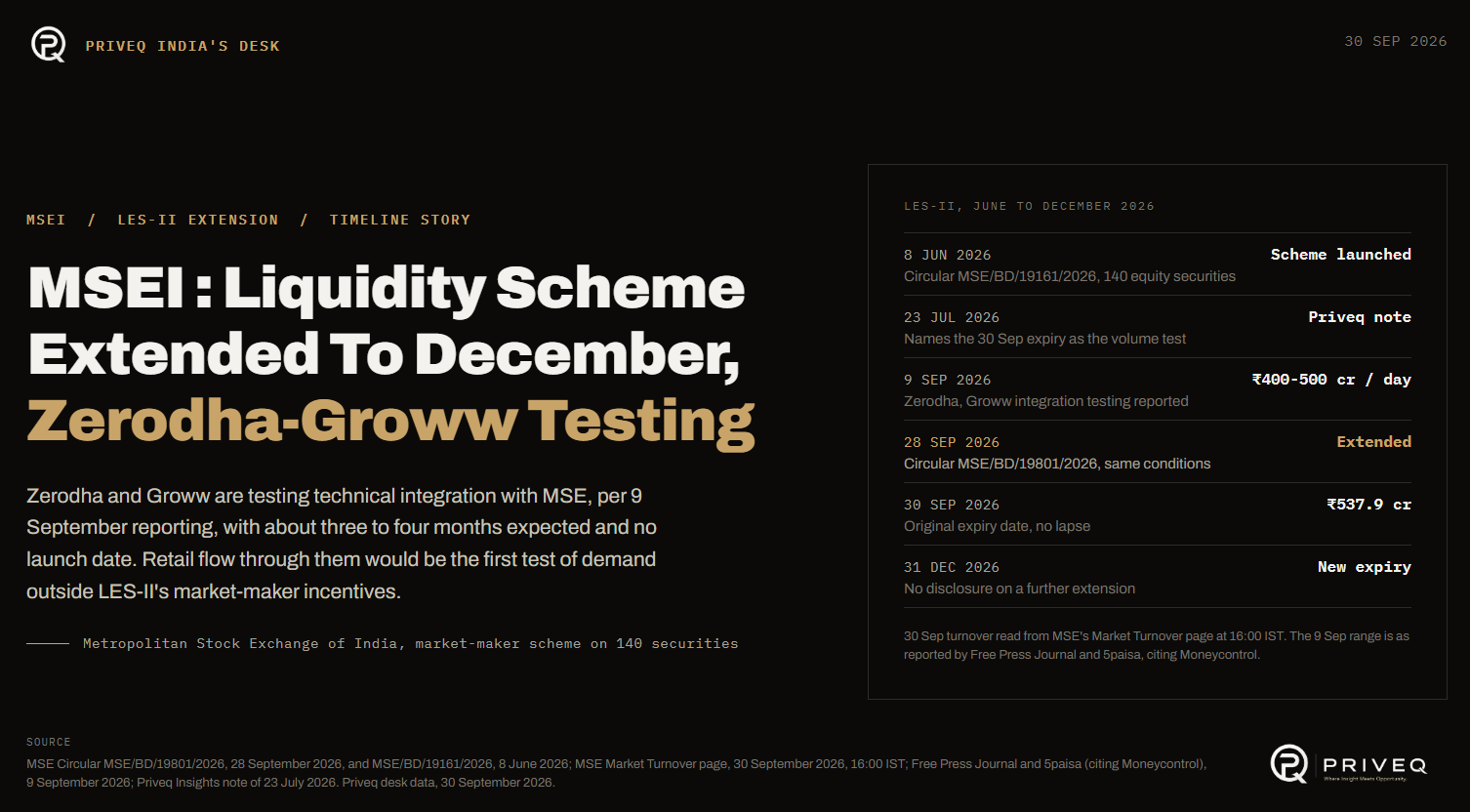
Three developments between January and April 2026 represent the first concrete operational progress in years. In January 2026, MSEI implemented a new mandatory trading software version (25.0.0) for its Equity Capital Market, signaling infrastructure readiness for higher volumes. Also in January 2026, MSEI introduced a Liquidity Enhancement Scheme covering 143-plus securities, aligned with SEBI guidelines, designed to pay designated market makers to quote two-sided prices continuously in listed stocks, narrowing spreads and making the market more hospitable for genuine investors.
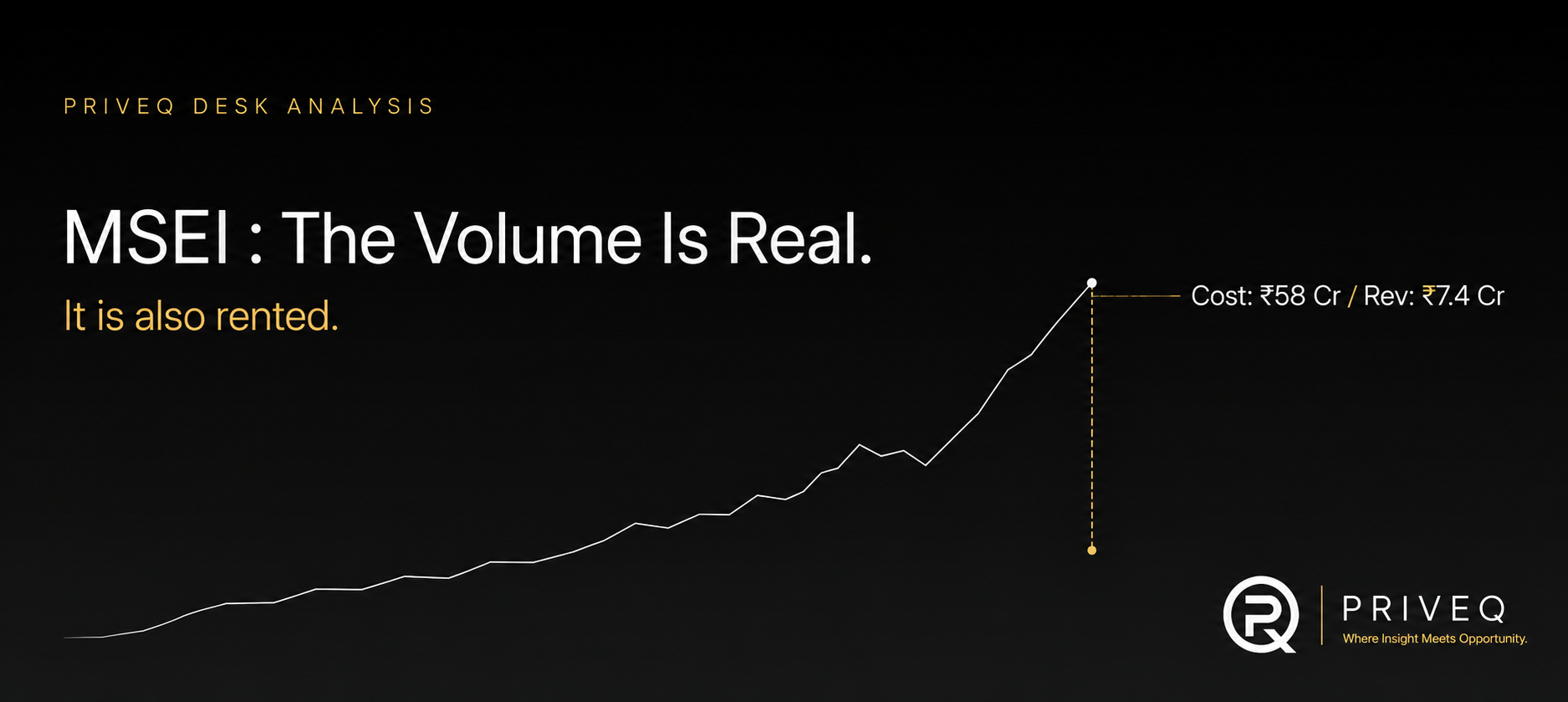
Market maker operations then commenced. And on April 8, 2026, MSEI recorded a single-day equity traded value exceeding ₹132 crore. For an exchange that had been essentially dormant in equity trading, ₹132 crore in a single session, even if driven by market makers rather than organic order flow, is a material proof of concept. It demonstrates that the platform can process volume, that the technology infrastructure holds, and that the liquidity incentive programs can generate quoted activity.
These are early, fragile signals. They do not yet translate into the sustainable, self-reinforcing order flow that defines a viable exchange. But they are the first substantive positive operational development in MSEI's equity cash segment since 2013.
The Investment Thesis : Option Value on Exchange Competition
At ₹6 per share and approximately 1,099.52 crore shares outstanding, MSEI trades at a market cap of approximately ₹6,600 crore. This values the exchange at approximately 1,954 times its FY26 revenue from operations of ₹3.38 crore. By conventional metrics, this is not a valuation anyone should defend with a straight face.
The correct framework for MSEI is not revenue multiples. It is option pricing. What is the probability that MSEI achieves, say, 1-2% market share in Indian equity cash trading within 5 years? And what is that worth? India's equity market capitalization is ₹462 trillion. Daily cash market turnover runs at ₹100,000-₹150,000 crore. A 1% MSEI share of cash market at 0.003% transaction fee = approximately ₹4-5 crore in daily revenue = ₹1,000-₹1,200 crore annualized revenue. At 40-50% operating margins (exchange business economics at scale), that is ₹400-₹600 crore in annual PAT. At 25-30x P/E, that is ₹10,000-₹18,000 crore in market cap. Against a current market cap of ₹6,600 crore, the upside in that scenario is real.
But the key word is probability. MSEI has had 11 years since its equity segment launch to demonstrate any market share gains, and has none. The structural barriers are formidable. Whether the combination of new capital, institutional broker shareholders who can route order flow, a SEBI environment that is explicitly supportive of exchange competition, and a post-SEBI derivatives circular landscape where MSEI's SX40 has a dedicated weekly expiry slot can actually generate sustainable volumes — that is a question with no certain answer.
KEY RISKS :
Revenue Has Declined Every Year for Five-Plus Years — No Volume Growth Yet : Revenue from operations fell from ₹10.6 crore in FY21 to ₹3.38 crore in FY26. Despite the capital infusions, the April 2026 single-day traded value of ₹132 crore is still a fraction of daily volumes on established exchanges. There is no evidence yet that MSEI is on a trajectory toward meaningful market share. Until sustained volume growth shows up in the revenue line, the investment case rests entirely on future optionality that has never materialized despite a decade of trying.
Liquidity Is a Network Effect — Money Alone Cannot Buy It : The dominant exchanges built their order books over decades. Every additional market participant adds liquidity that attracts more participants. This virtuous cycle, once established, is extremely difficult to displace from outside. Even with ₹1,238 crore in capital, MSEI can fund market makers and subsidize trading fees, but it cannot force genuine price discovery or organic institutional order flow. The history of exchange competition globally is littered with well-capitalized challengers who could not break the network effect of incumbents.
SEBI Derivatives Circular Dampened the Original Thesis : The December 2024 Zerodha/Groww investment was driven partly by SEBI's regulatory environment that appeared to allow MSEI's SX40 weekly expiry from January 1, 2025. But SEBI simultaneously introduced restrictions limiting weekly expiry contracts, constraining smaller exchanges' ability to build derivatives volume. The regulatory tailwind and headwind coexist, and SEBI's future decisions on exchange competition are uncertain and unpredictable.
Conflict of Interest: Major Shareholders Are Also Members : Zerodha, Groww, Share India Securities, and Securocorp are all MSEI shareholders and trading members. An exchange that is owned by the brokers who are supposed to be regulated by it faces an inherent governance tension. Retail traders filing complaints against a broker that owns the exchange creates a structural conflict that SEBI has flagged in public commentary. This could limit retail participation and invite regulatory scrutiny.
No IPO Timeline — No Confirmed Exit Mechanism : As of May 2026, no DRHP has been filed with SEBI. A public listing would require MSEI to demonstrate consistent profitability and meet SEBI's Market Infrastructure Institution listing prerequisites — conditions that have not been satisfied. SEBI's MII listing framework is stringent specifically for exchanges. Pre-IPO investors in MSEI face an indefinite hold period with no regulated exit mechanism other than OTC transactions at negotiated prices.
Capital Is Deployed in Investments, Not Yet in Revenue-Generating Operations : Of the ₹1,369 crore in equity, ₹745.97 crore sits in bonds and mutual funds. This capital is earning investment returns (the ₹55.69 crore in other income in FY26) but is not generating exchange revenue. If the operational build-out consumes capital without generating trading volumes, the balance sheet will erode, and the runway shortens. MSEI has historically burned ₹30-₹50 crore annually in losses; at current rates, the cash runway is long but not infinite.
History of Failed Revivals : A 2014-15 rights issue planned at ₹200 crore raised only ₹6.85 crore. Multiple management changes and strategy pivots over 11 years have not produced exchange volume. Each new capital infusion has been met with initial price optimism followed by price correction. The share price spike to ₹12 after the December 2024 round was followed by a correction to ₹2.50-₹6 range. Investors who entered at peak prices have experienced significant losses.
KEY OPPORTUNITIES :
SEBI's Explicit Pro-Competition Policy Is the Most Important Structural Change : SEBI has made it unambiguous through recent regulatory actions and public statements that it supports competition in India's exchange ecosystem. The approved SX40 weekly expiry for MSEI, the interoperability framework allowing trades on MSEI to be cleared through ICCL or NSCCL (making it easier for members to trade on MSEI without additional clearing arrangements), and the regulator's observation that exchange concentration creates risks — all point to a regulatory environment that is structurally supportive of MSEI in a way it has not been historically.
Zerodha and Groww as Shareholders = Potential Order Flow : Zerodha has approximately 6-7 million active clients. Groww has approximately 13 million active clients. If even a fraction of the retail equity order flow from these platforms is routed to MSEI, the exchange's cash segment volumes could change character overnight. Shareholders with aligned incentives — broker-owners whose exchange investment pays off only if the exchange succeeds — have a stronger reason to route flow than an unrelated broker would. This is an unusual structural advantage.
Peak XV's Involvement Is a Signal of Long-Duration Conviction : Peak XV Venture Partners does not make casual investments. Their commitment of capital to MSEI in August 2025 signals a considered, long-duration view that the exchange's combination of SEBI license, technology infrastructure, institutional backing, and market timing creates asymmetric upside. They are pricing a scenario where MSEI achieves meaningful market share within a 5-10 year investment horizon.
Data Center and Technology Platform as Moat-Building : The new data center powered by NTT, the ₹112.66 crore in PPE and ₹63.77 crore in intangible assets capitalized in FY26, and the mandatory trading software upgrade to version 25.0.0 represent a genuine infrastructure buildout. A state-of-the-art, low-latency trading infrastructure is a prerequisite for institutional algo traders and high-frequency market makers. Without it, no amount of fee subsidies will attract sophisticated liquidity providers. With it, MSEI can compete on the infrastructure dimension that sophisticated traders care most about.
Carbon Credit and Green Finance Market Is MSEI's Unopened Option : India's Carbon Credit Trading Scheme, announced by the government and in regulatory development, will require an exchange platform. If MSEI receives approval to operate India's carbon credit exchange, or secures a role in the green bond or sustainable finance segment, it would create an entirely new revenue stream unrelated to the equity/derivatives duopoly. This is speculative but structurally available to any SEBI-recognized exchange.
The Math of Marginal Volume Gains Is Exponential for an Exchange : Exchange businesses have extreme operating leverage. At ₹3-4 crore in operating revenue, MSEI loses ₹25-30 crore. At ₹100-150 crore in operating revenue (still a fraction of established exchange revenues), the operating cost base of ₹75-85 crore is covered and profitability commences. The jump from ₹5 crore to ₹100 crore in exchange revenues requires order flow growth of 20-30x, which is enormous. But once crossed, the P&L inflection is rapid and the business becomes massively cash-generative.
Disclaimer : The financial information presented on this page has been sourced from publicly available consolidated MCA filings and third-party financial data platforms. This page does not incorporate directly verified primary audited financial statements from Metropolitan Stock Exchange of India Limited. Financial figures may differ from those in the company's official audited annual report, which investors are strongly advised to obtain directly from the company. Metropolitan Stock Exchange of India Limited is a loss-making entity with declining revenue from operations: ₹3.38 crore in FY26, declining from ₹10.6 crore in FY21. The company has no confirmed IPO timeline or DRHP filing as of May 2026. There is no regulated exit mechanism for unlisted shareholders other than OTC transactions. The current unlisted price range of ₹5.65 to ₹6.80 per share referenced herein reflects over-the-counter market data and varies significantly across platforms (52-week range: ₹2.50 to ₹9.00). The last allotment price was ₹2 per share in August 2025; the current market price implies a premium of approximately 3x to the last institutional issuance price. The presence of major brokers (including Zerodha and Groww-parent Billionbrains) as both shareholders and exchange members creates governance conflicts of interest that investors should independently evaluate. All capital raises and corporate developments cited are based on publicly available information, including company disclosures and media reports. Investing in MSEI unlisted shares carries exceptionally high risk, including illiquidity, the absence of earnings, the possibility of total loss, dependence on highly uncertain volume growth, an indefinite holding period, and regulatory uncertainty. This content is intended solely for informational and educational purposes and does not constitute investment advice. Priveq.in accepts no liability for decisions made in reliance on this content.
Company Details
Industry
Stock Exchange
Founded
2008
Headquarters
Mumbai, India
Min Lot Size
4000
Face Value
₹1.00
Total Shares
10995239362
Regulatory Information
Corporate Identity Number (CIN)
U65999MH2008PLC185856
PAN Number
AAFCM6942F
ISIN
INE312K01010
Depository
NSDL & CDSL
Registrar & Transfer Agent (RTA)
KFin Technologies
Key Valuation Ratios
Valuation
Market Cap
₹7,696.67 Cr
P/E Ratio
—
Not meaningful — loss-making
P/S Ratio
1,785.77×
P/B Ratio
19.40×
EV / EBITDA
—
Returns & Per Share
ROE
-8.63%
EPS
₹-0.03
Book Value / Share
₹0.36
Solvency
Debt / Equity
—
Interest Coverage
-133.04×
Company Fundamentals
As of FY2025 Annual · updated 19 Sept 2026Gross Profit
₹4.31 Cr
EBITDA
₹-29.49 Cr
Revenue Growth
-41.44%
Profit Margin
-793.97%
Performance Trends
4 annual periods · derived from filed statements
Revenue
₹ Cr
Net Profit
₹ Cr · losses in red
Earnings Per Share
₹ per share
Return on Equity
ROE %
Return on Capital Employed
ROCE %
EBITDA Margin
-684.22%
Interest Coverage
-133.04×
Financial Statements
| Line item | FY2022 | FY2023 | FY2024 | FY2025 |
|---|---|---|---|---|
| Total Income | ||||
| Revenue from operationsDisclosed | 10.06₹ Crore | 9.22₹ Crore | 7.36₹ Crore | 4.31₹ Crore |
| Other incomeDisclosed | 15₹ Crore | 45.44₹ Crore | 13.69₹ Crore | 13.07₹ Crore |
| Total IncomeDerived | 25.06₹ Crore | 54.66₹ Crore | 21.05₹ Crore | 17.38₹ Crore |
| Expenses | ||||
| Cost of goods soldDisclosed | 0₹ Crore | 0₹ Crore | 0₹ Crore | 0₹ Crore |
| Changes in inventoriesDisclosed | 0₹ Crore | 0₹ Crore | 0₹ Crore | 0₹ Crore |
| Employee benefits expenseDisclosed | 19.85₹ Crore | 18.97₹ Crore | 16.57₹ Crore | 15.38₹ Crore |
| Finance costsDisclosed | 60₹ Lakh | 39₹ Lakh | 98₹ Lakh | 26₹ Lakh |
| Depreciation and amortization expenseDisclosed | 10.48₹ Crore | 10.65₹ Crore | 6.06₹ Crore | 5.1₹ Crore |
| Operating expensesDisclosed | 17.3₹ Crore | 23.24₹ Crore | 28.98₹ Crore | 21.4₹ Crore |
| Other expensesDisclosed | 8.09₹ Crore | 16.13₹ Crore | 16.05₹ Crore | 10.09₹ Crore |
| Total ExpensesDerived | 56.32₹ Crore | 69.38₹ Crore | 68.64₹ Crore | 52.23₹ Crore |
| Profit | ||||
| Exceptional itemsDisclosed | 0₹ Crore | 5.21₹ Crore | 0₹ Crore | 0₹ Crore |
| Profit before taxDerived | -31.26₹ Crore | -9.51₹ Crore | -47.59₹ Crore | -34.85₹ Crore |
| Current tax expenseDisclosed | 14₹ Lakh | 0₹ Crore | 63₹ Lakh | 0₹ Crore |
| Deferred tax expenseDisclosed | 27₹ Lakh | -1.27₹ Crore | 0₹ Crore | 0₹ Crore |
| Tax expenseDisclosed | 41₹ Lakh | -1.27₹ Crore | 1.15₹ Crore | -63₹ Lakh |
| Profit After TaxDerived | -31.67₹ Crore | -8.24₹ Crore | -48.74₹ Crore | -34.22₹ Crore |
| Other comprehensive incomeDisclosed | 32₹ Lakh | 27₹ Lakh | 12₹ Lakh | 11₹ Lakh |
| Total Comprehensive IncomeDerived | -31.35₹ Crore | -7.97₹ Crore | -48.62₹ Crore | -34.11₹ Crore |
Documents Library
Access all financial reports and filings
Annual Report
Quarterly Report
EGM Notice of MSEI others EGM to approve a 1 000
Outcome of Board Meeting Equity Shares Issuance c
MSEI Private Placement corporate action MSEI appro
EGM Notice of MSEI corporate action MSEI EGM Notic
9MFY26 Results of MSEI others The consolidated financial results for the quarter ending Dec 31, 2025 (Q3)
9MFY26 Results of MSEI others The consolidated financial results for the quarter ending Dec 31, 2025 (Q3)
9MFY26 Results of MSEI others The consolidated financial results for the quarter ending Dec 31, 2025 (Q3)
9MFY26 Results of MSEI others The consolidated financial results for the quarter ending Dec 31, 2025 (Q3)
9MFY26 Results of MSEI others The consolidated financial results for the quarter ending Dec 31, 2025 (Q3)
9MFY26 Results of MSEI others The consolidated financial results for the quarter ending Dec 31, 2025 (Q3)
9MFY26 Results of MSEI others The consolidated financial results for the quarter ending Dec 31, 2025 (Q3)
9MFY26 Results of MSEI others The consolidated financial results for the quarter ending Dec 31, 2025 (Q3)
9MFY26 Results of MSEI others The consolidated financial results for the quarter ending Dec 31, 2025 (Q3)
9MFY26 Results of MSEI others The consolidated financial results for the quarter ending Dec 31, 2025 (Q3)
Download AttachmentMSE Liquidity Enhancement Scheme for Equity others MSE has launched a Liquidity Enhancement Scheme to improve liquidity in equity stocks through designated market makers.
MSE Liquidity Enhancement Scheme for Equity others MSE has launched a Liquidity Enhancement Scheme to improve liquidity in equity stocks through designated market makers.
MSE Liquidity Enhancement Scheme for Equity others MSE has launched a Liquidity Enhancement Scheme to improve liquidity in equity stocks through designated market makers.
MSE Liquidity Enhancement Scheme for Equity others MSE has launched a Liquidity Enhancement Scheme to improve liquidity in equity stocks through designated market makers.
MSE Liquidity Enhancement Scheme for Equity others MSE has launched a Liquidity Enhancement Scheme to improve liquidity in equity stocks through designated market makers.
MSE Liquidity Enhancement Scheme for Equity others MSE has launched a Liquidity Enhancement Scheme to improve liquidity in equity stocks through designated market makers.
MSE Liquidity Enhancement Scheme for Equity others MSE has launched a Liquidity Enhancement Scheme to improve liquidity in equity stocks through designated market makers.
MSE Liquidity Enhancement Scheme for Equity others MSE has launched a Liquidity Enhancement Scheme to improve liquidity in equity stocks through designated market makers.
MSE Liquidity Enhancement Scheme for Equity others MSE has launched a Liquidity Enhancement Scheme to improve liquidity in equity stocks through designated market makers.
MSE Liquidity Enhancement Scheme for Equity others MSE has launched a Liquidity Enhancement Scheme to improve liquidity in equity stocks through designated market makers.
Download Attachment6MFY2026 Results of MSEI others The consolidated financial results for the quarter ending Sep 30, 2025 (Q2)
6MFY2026 Results of MSEI others The consolidated financial results for the quarter ending Sep 30, 2025 (Q2)
6MFY2026 Results of MSEI others The consolidated financial results for the quarter ending Sep 30, 2025 (Q2)
6MFY2026 Results of MSEI others The consolidated financial results for the quarter ending Sep 30, 2025 (Q2)
6MFY2026 Results of MSEI others The consolidated financial results for the quarter ending Sep 30, 2025 (Q2)
6MFY2026 Results of MSEI others The consolidated financial results for the quarter ending Sep 30, 2025 (Q2)
6MFY2026 Results of MSEI others The consolidated financial results for the quarter ending Sep 30, 2025 (Q2)
6MFY2026 Results of MSEI others The consolidated financial results for the quarter ending Sep 30, 2025 (Q2)
6MFY2026 Results of MSEI others The consolidated financial results for the quarter ending Sep 30, 2025 (Q2)
6MFY2026 Results of MSEI others The consolidated financial results for the quarter ending Sep 30, 2025 (Q2)
Download AttachmentEGM Notice of MSEI others EGM to approve a ₹1,000 crore private placement by issuing 500 crore equity shares at ₹2 each
EGM Notice of MSEI others EGM to approve a ₹1,000 crore private placement by issuing 500 crore equity shares at ₹2 each
EGM Notice of MSEI others EGM to approve a ₹1,000 crore private placement by issuing 500 crore equity shares at ₹2 each
EGM Notice of MSEI others EGM to approve a ₹1,000 crore private placement by issuing 500 crore equity shares at ₹2 each
EGM Notice of MSEI others EGM to approve a ₹1,000 crore private placement by issuing 500 crore equity shares at ₹2 each
EGM Notice of MSEI others EGM to approve a ₹1,000 crore private placement by issuing 500 crore equity shares at ₹2 each
EGM Notice of MSEI others EGM to approve a ₹1,000 crore private placement by issuing 500 crore equity shares at ₹2 each
EGM Notice of MSEI others EGM to approve a ₹1,000 crore private placement by issuing 500 crore equity shares at ₹2 each
EGM Notice of MSEI others EGM to approve a ₹1,000 crore private placement by issuing 500 crore equity shares at ₹2 each
EGM Notice of MSEI others EGM to approve a ₹1,000 crore private placement by issuing 500 crore equity shares at ₹2 each
Download AttachmentMSEI Private Placement corporate_action MSEI approves ₹500 Cr fundraise via private placement at ₹1 premium, pending EGM nod
MSEI Private Placement corporate_action MSEI approves ₹500 Cr fundraise via private placement at ₹1 premium, pending EGM nod
MSEI Private Placement corporate_action MSEI approves ₹500 Cr fundraise via private placement at ₹1 premium, pending EGM nod
MSEI Private Placement corporate_action MSEI approves ₹500 Cr fundraise via private placement at ₹1 premium, pending EGM nod
MSEI Private Placement corporate_action MSEI approves ₹500 Cr fundraise via private placement at ₹1 premium, pending EGM nod
MSEI Private Placement corporate_action MSEI approves ₹500 Cr fundraise via private placement at ₹1 premium, pending EGM nod
MSEI Private Placement corporate_action MSEI approves ₹500 Cr fundraise via private placement at ₹1 premium, pending EGM nod
MSEI Private Placement corporate_action MSEI approves ₹500 Cr fundraise via private placement at ₹1 premium, pending EGM nod
MSEI Private Placement corporate_action MSEI approves ₹500 Cr fundraise via private placement at ₹1 premium, pending EGM nod
MSEI Private Placement corporate_action MSEI approves ₹500 Cr fundraise via private placement at ₹1 premium, pending EGM nod
Download AttachmentQ4FY2025 Results of MSEI others The consolidated financial results for the quarter and year ending Mar 31, 2025 (Q4)
Q4FY2025 Results of MSEI others The consolidated financial results for the quarter and year ending Mar 31, 2025 (Q4)
Q4FY2025 Results of MSEI others The consolidated financial results for the quarter and year ending Mar 31, 2025 (Q4)
Q4FY2025 Results of MSEI others The consolidated financial results for the quarter and year ending Mar 31, 2025 (Q4)
Q4FY2025 Results of MSEI others The consolidated financial results for the quarter and year ending Mar 31, 2025 (Q4)
Q4FY2025 Results of MSEI others The consolidated financial results for the quarter and year ending Mar 31, 2025 (Q4)
Q4FY2025 Results of MSEI others The consolidated financial results for the quarter and year ending Mar 31, 2025 (Q4)
Q4FY2025 Results of MSEI others The consolidated financial results for the quarter and year ending Mar 31, 2025 (Q4)
Outcome of Board Meeting: Equity Shares Issuance corporate_action Board approved issuance of 119 crore equity shares via private placement, pending member approval at an EGM
Outcome of Board Meeting: Equity Shares Issuance corporate_action Board approved issuance of 119 crore equity shares via private placement, pending member approval at an EGM
Outcome of Board Meeting: Equity Shares Issuance corporate_action Board approved issuance of 119 crore equity shares via private placement, pending member approval at an EGM
Outcome of Board Meeting: Equity Shares Issuance corporate_action Board approved issuance of 119 crore equity shares via private placement, pending member approval at an EGM
Outcome of Board Meeting: Equity Shares Issuance corporate_action Board approved issuance of 119 crore equity shares via private placement, pending member approval at an EGM
Outcome of Board Meeting: Equity Shares Issuance corporate_action Board approved issuance of 119 crore equity shares via private placement, pending member approval at an EGM
Outcome of Board Meeting: Equity Shares Issuance corporate_action Board approved issuance of 119 crore equity shares via private placement, pending member approval at an EGM
Outcome of Board Meeting: Equity Shares Issuance corporate_action Board approved issuance of 119 crore equity shares via private placement, pending member approval at an EGM
EGM Notice of MSEI corporate_action MSEI EGM Notice
EGM Notice of MSEI corporate_action MSEI EGM Notice
EGM Notice of MSEI corporate_action MSEI EGM Notice
EGM Notice of MSEI corporate_action MSEI EGM Notice
EGM Notice of MSEI corporate_action MSEI EGM Notice
EGM Notice of MSEI corporate_action MSEI EGM Notice
EGM Notice of MSEI corporate_action MSEI EGM Notice
EGM Notice of MSEI corporate_action MSEI EGM Notice
Our research on this company
Express buy interest
No commitment — the desk will reach out
Current Price
₹7Secure & Verified Transaction
Unlisted shares are illiquid and carry higher market risks. Please read the Risk Disclosure before investing.
Talk to a Specialist
Get expert guidance on this investment
About Metropolitan Stock Exchange (MSEI) Unlisted Shares unlisted shares
Indicative · updated dailyMetropolitan Stock Exchange (MSEI) unlisted share price today
Metropolitan Stock Exchange (MSEI) unlisted share price today is ₹7.00 as of 16 October 2026.
Metropolitan Stock Exchange (MSEI) Unlisted Shares — frequently asked questions
- What is the grey market price for Metropolitan Stock Exchange (MSEI)?
No IPO is currently announced for Metropolitan Stock Exchange (MSEI), so no grey market exists; the price above reflects Priveq's own desk valuation.
- Has Metropolitan Stock Exchange (MSEI) filed for an IPO, and when might it list?
Metropolitan Stock Exchange (MSEI) has not filed a draft red herring prospectus, so no IPO is currently announced and no listing date has been set.
- How does Metropolitan Stock Exchange (MSEI) compare to its listed peers?
There is no closely comparable listed company for Metropolitan Stock Exchange (MSEI) in India today.
- Is Metropolitan Stock Exchange (MSEI) on the SME or Mainboard IPO track?
Metropolitan Stock Exchange (MSEI) has not filed a draft red herring prospectus, so no IPO track is set yet.
- What is Metropolitan Stock Exchange (MSEI)'s CIN and registered office?
Metropolitan Stock Exchange (MSEI)'s Corporate Identity Number is U65999MH2008PLC185856, registered at Mumbai, India.
- What is Metropolitan Stock Exchange (MSEI)'s market capitalisation?
Metropolitan Stock Exchange (MSEI)'s market capitalisation is approximately ₹7,697 crore, based on its current unlisted share price.
More in Stock Exchange
All Stock Exchange →Buying, selling and holding unlisted shares
Applies to every company on Priveq- How do I buy Metropolitan Stock Exchange (MSEI) unlisted shares?
Priveq Investech Private Limited is the named counterparty on every transaction. To buy Metropolitan Stock Exchange (MSEI) unlisted shares: complete KYC once (PAN, Aadhaar, bank details, and demat account information — SEBI-compliant, typically approved within 24 hours), then submit your order through your Priveq dashboard specifying quantity. Our team confirms price and payment details with you directly. Once payment is confirmed, Metropolitan Stock Exchange (MSEI) shares are transferred off-market straight to your demat account, with no pooling and no middlemen.
- How do I sell Metropolitan Stock Exchange (MSEI) unlisted shares?
Submit an Express Sell Interest for Metropolitan Stock Exchange (MSEI) through your Priveq dashboard, specifying quantity, the same way a buy order is placed. Priveq quotes you a bid price, which may differ from the live Buy price shown to buyers, since unlisted-share pricing works on a bid-ask basis rather than a single quote. Once you accept, you'll need to provide your Client Master List (CML), a cancelled cheque or bank details, and PAN. If you hold shares with CDSL, transfer can also be completed digitally via CDSL Easiest. You transfer Metropolitan Stock Exchange (MSEI) shares to Priveq first, and payment follows once the transfer is confirmed received, typically the same day, T+1, or occasionally T+2, communicated to you directly. For sizeable transactions worth crores of rupees, an escrow arrangement can be used instead, at the sole consent of both parties.
- What is the minimum investment for Metropolitan Stock Exchange (MSEI) unlisted shares?
Minimum investment varies by company and is shown as the Min Investment figure on this page. Metropolitan Stock Exchange (MSEI)'s minimum is ₹28,000.
- Is there a maximum investment limit?
There's no fixed maximum investment limit for Metropolitan Stock Exchange (MSEI) unlisted shares. For sizeable transactions worth crores of rupees, an escrow arrangement can be used at the sole consent of both parties, the same mechanism available on the sell side.
- Is buying Metropolitan Stock Exchange (MSEI) unlisted shares legal in India?
Yes. Buying and selling unlisted shares in India is legal and is subject to relevant SEBI regulations, including the mandatory lock-in period after listing, stamp duty, and depository participant charges on each transaction. Priveq's own KYC process is built to be SEBI-compliant.
- What is the lock-in period for Metropolitan Stock Exchange (MSEI) unlisted shares?
Metropolitan Stock Exchange (MSEI) has not filed a DRHP yet, so no listing date or lock-in period applies at this stage. Once an IPO is filed, this answer updates to reflect the applicable SME or Mainboard lock-in.
- What happens if Metropolitan Stock Exchange (MSEI)'s IPO is delayed or withdrawn?
If an IPO is delayed, shares remain unlisted and continue to trade on the desk at Priveq's indicative price, with no lock-in in effect until an actual listing happens. If a company formally withdraws its DRHP, the same applies: shares stay unlisted, with no lock-in period until and unless a fresh IPO process begins.
- How are capital gains on Metropolitan Stock Exchange (MSEI) unlisted shares taxed?
If you sell unlisted shares, including Metropolitan Stock Exchange (MSEI), within 24 months of purchase, the gain is taxed as short-term capital gain at your applicable income tax slab rate. Beyond 24 months, it is taxed as long-term capital gain at 12.5 percent, without indexation benefit, under the rules effective from 23 July 2024. If Metropolitan Stock Exchange (MSEI) lists and you sell after listing, the applicable tax treatment shifts to listed-security rates, with the holding period still measured from your original unlisted purchase date. This is general information, not tax advice; investors should confirm their specific position with a tax advisor.
- Can NRIs invest in Metropolitan Stock Exchange (MSEI) unlisted shares?
Yes, on a non-repatriable basis. NRIs can invest using funds from an NRO account; sale proceeds stay within India unless repatriated separately under RBI's own limits. Priveq does not currently support repatriable investment (NRE/FCNR-funded), which would require the investee company to file additional RBI paperwork as foreign direct investment.
- Does Priveq charge a platform fee on top of the share price?
No. The price quoted to you is all-in; there is no separate platform fee or brokerage added on top.
- How does Priveq determine the desk price for Metropolitan Stock Exchange (MSEI)?
Priveq's desk price reflects several inputs together, not a single formula: the seller's ask price at the time, current demand and supply on the platform for Metropolitan Stock Exchange (MSEI) specifically, broader sentiment in the unlisted and pre-IPO market, how Metropolitan Stock Exchange (MSEI)'s sector and listed peers are trading, the company's own recent financial performance and IPO-stage developments, and recent transaction history where deals have actually closed.
Because unlisted shares trade over the counter rather than on an exchange, this price is indicative, not a continuously live quoted market price, and the actual deal price is confirmed with you directly before a transaction closes.
- Is Priveq SEBI-registered? Does it give investment advice?
Priveq is not a SEBI-registered stock exchange and not a SEBI-registered investment adviser. Priveq Investech Private Limited operates Priveq.in as a research and information platform for unlisted and pre-IPO shares, and is the named counterparty on transactions executed through the platform. Nothing on this page is investment advice; it's information to help you evaluate a company and decide for yourself.
- Am I eligible to invest through Priveq if I'm not an HNI?
Yes. Priveq isn't a stock exchange with membership restrictions, and investing isn't limited to HNIs. Depending on the company, entry points can start as low as ₹20,000, though the minimum for any specific company is shown as the Min Investment figure on its page.
- What documents do I receive after buying unlisted shares?
You receive an email acknowledging and confirming your order, along with a deal note or invoice recording the transaction details.
- What happens to my shares or money if a deal falls through?
Because Priveq is the direct counterparty on every transaction rather than just connecting a buyer and seller, this risk sits with Priveq, not with you. If a deal falls through after you've committed funds or shares, they remain safe, and Priveq guarantees a refund.